Tuesday, December 6, 2022

ISS Daily Summary Report – 12/05/2022

iss-about-banner


USOS 3A ISS Roll Out Solar Array (IROSA) Install Extravehicular Activity (EVA): This past weekend on Saturday EV1 (Josh Cassada) and EV2 (Frank Rubio) conducted USOS EVA #82. The main goal of this EVA was to install and deploy the 3A IROSA and perform a 1B cable demate. Hatch opening occurred at 6:16 AM CT. … ...

December 05, 2022 at 11:00AM
From NASA: https://blogs.nasa.gov/stationreport/2022/12/05/iss-daily-summary-report-12-05-2022/

Monday, December 5, 2022

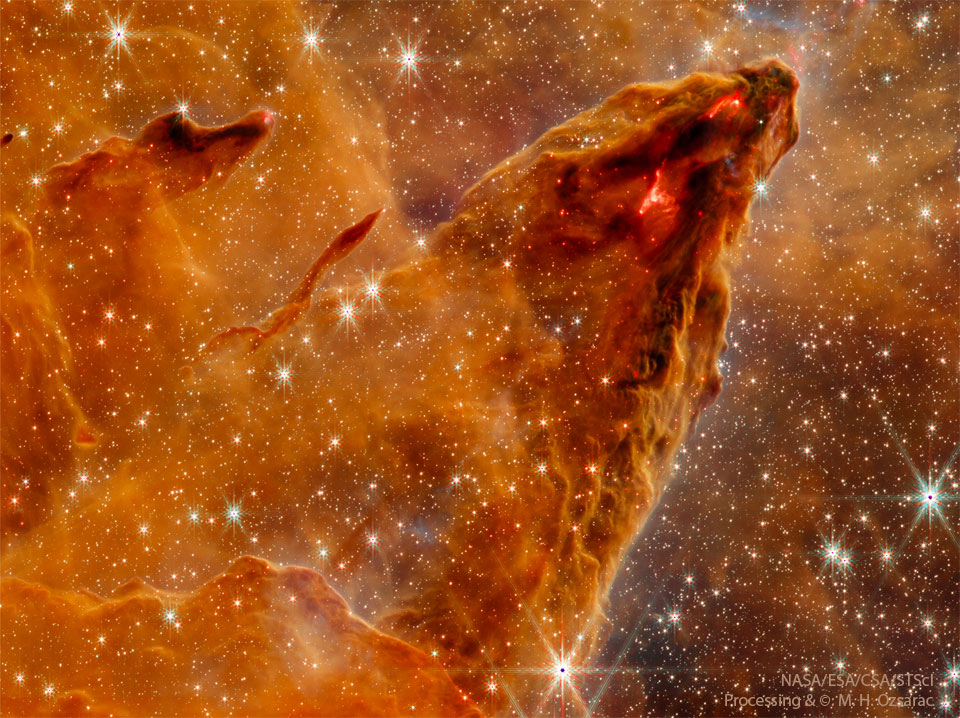
M16: A Star Forming Pillar from Webb


What̢۪s happening inside this interstellar mountain? Stars are forming. The mountain is actually a column of gas and dust in the picturesque Eagle Nebula (M16). A pillar like this is so low in density that you could easily fly though it -- it only appears solid because of its high dust content and great depth. The glowing areas are lit internally by newly formed stars. These areas shine in red and infrared light because blue light is scattered away by intervening interstellar dust. The featured image was captured recently in near-infrared light in unprecedented detail by the James Webb Space Telescope (JWST), launched late last year. Energetic light, abrasive winds, and final supernovas from these young stars will slowly destroy this stellar birth column over the next 100,000 years.

https://apod.nasa.gov/apod/ap221206.html ( December 06, 2022)

Orion Approaches Moon Before Return Flyby


On the 19th day of the Artemis I mission, Dec. 4, 2022, a camera mounted on the Orion spacecraft captured the Moon just in frame as Orion prepared for its return powered flyby on Dec. 5, when it passed approximately 79 miles above the lunar surface.

from NASA http://www.nasa.gov/image-feature/orion-approaches-moon-before-return-flyby
via IFTTT

Sunday, December 4, 2022

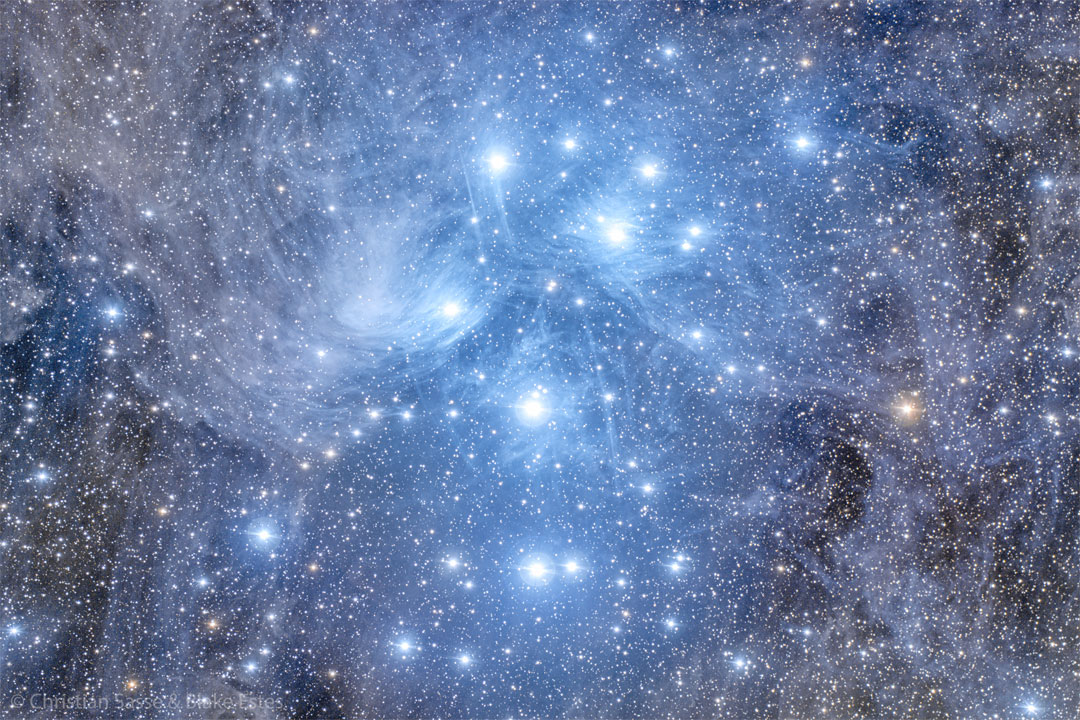
Pleiades: The Seven Sisters Star Cluster


Have you ever seen the Pleiades star cluster? Even if you have, you probably have never seen it as large and clear as this. Perhaps the most famous star cluster on the sky, the bright stars of the Pleiades can be seen with the unaided eye even from the depths of a light-polluted city. With a long exposure from a dark location, though, the dust cloud surrounding the Pleiades star cluster becomes very evident. The featured 11-hour exposure, taken from the Siding Spring Observatory in Australia, covers a sky area several times the size of the full moon. Also known as the Seven Sisters and M45, the Pleiades lies about 400 light years away toward the constellation of the Bull (Taurus). A common legend with a modern twist is that one of the brighter stars faded since the cluster was named, leaving only six of the sister stars visible to the unaided eye. The actual number of Pleiades stars visible, however, may be more or less than seven, depending on the darkness of the surrounding sky and the clarity of the observer's eyesight.

https://apod.nasa.gov/apod/ap221205.html ( December 05, 2022)

Saturday, December 3, 2022

Video: Powers of Ten


How different does the universe look on very small scales? On very large scales? The most famous short science film of its generation gives breathtaking comparisons. That film, Powers of Ten, originally created in the 1960s, has been officially posted to YouTube and embedded here. From a picnic blanket near Chicago out past the Virgo Cluster of Galaxies, every ten seconds the film zooms out to show a square a factor of ten times larger on each side. The 9-minute video then reverses, zooming back in a factor of ten every two seconds and ends up inside a single proton. The Powers of Ten sequence is actually based on the book Cosmic View by Kees Boeke in 1957, as is a similar but mostly animated film Cosmic Zoom that was also created in the late 1960s. The changing perspectives are so enthralling and educational that sections have been recreated using more modern computerized techniques, including the first few minutes of the movie Contact. Ray and husband Charles Eames, the film's creators, were known as quite visionary spirits and even invented their own popular chair.

https://apod.nasa.gov/apod/ap221204.html ( December 04, 2022)

Friday, December 2, 2022

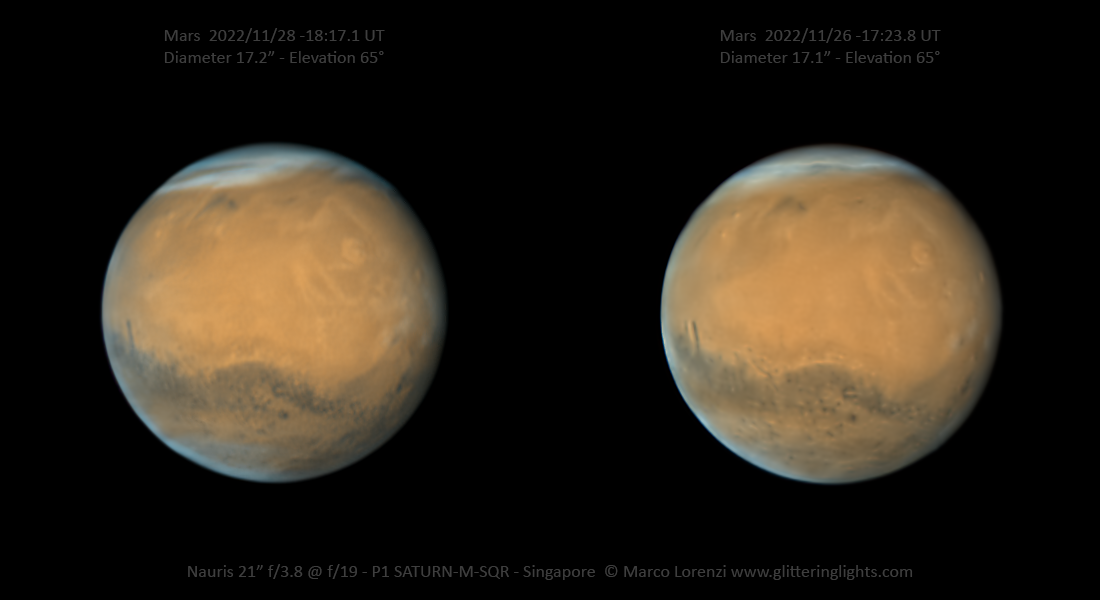
Stereo Mars


Mars looks sharp in these two rooftop telescope views captured in late November from Singapore, planet Earth. At the time, Mars was about 82 million kilometers from Singapore and approaching its opposition, opposite the Sun in planet Earth's sky on December 8. Olympus Mons, largest of the volcanoes in the Tharsis Montes region (and largest known volcano in the Solar System), is near Mars' western limb. In both the images it's the whitish donut-shape at the upper right. The dark area visible near center is the Terra Sirenum region while the long dark peninsula closest to the planet's eastern limb is Sinus Gomer. Near its tip is Gale crater, the Curiosity rover's landing site in 2012. Above Sinus Gomer, white spots are other volcanoes in the Elysium region. At top of the planet is the north polar cap covered with ice and clouds. Taken about two days apart, these images of the same martian hemisphere form a stereo pair. Look at the center of the frame and cross your eyes until the separate images come together to see the Red Planet in 3D.

https://apod.nasa.gov/apod/ap221203.html ( December 03, 2022)

ISS Daily Summary Report – 12/01/2022

iss-about-banner


Payloads: Human Research Facility Veggie Facility (HRF Veg): Profile of Mood States (POMS) short form questionnaires was completed.  The Pick-and-Eat Salad-Crop Productivity, Nutritional Value, and Acceptability to Supplement the ISS Food System investigation is a phased research project that includes Veg-04A, Veg-04B, Veg-05, and HRF Veg. This work addresses the need for a system to … ...

December 01, 2022 at 11:00AM
From NASA: https://blogs.nasa.gov/stationreport/2022/12/01/iss-daily-summary-report-12-01-2022/

Hubble Spies Emission Nebula-Star Cluster Duo


This whole collection is NGC 1858, an open star cluster in the northwest region of the Large Magellanic Cloud, a satellite galaxy of our Milky Way that boasts an abundance of star-forming regions. NGC 1858 is estimated to be around 10 million years old.

from NASA http://www.nasa.gov/image-feature/goddard/2022/hubble-spies-emission-nebula-star-cluster-duo
via IFTTT

Thursday, December 1, 2022

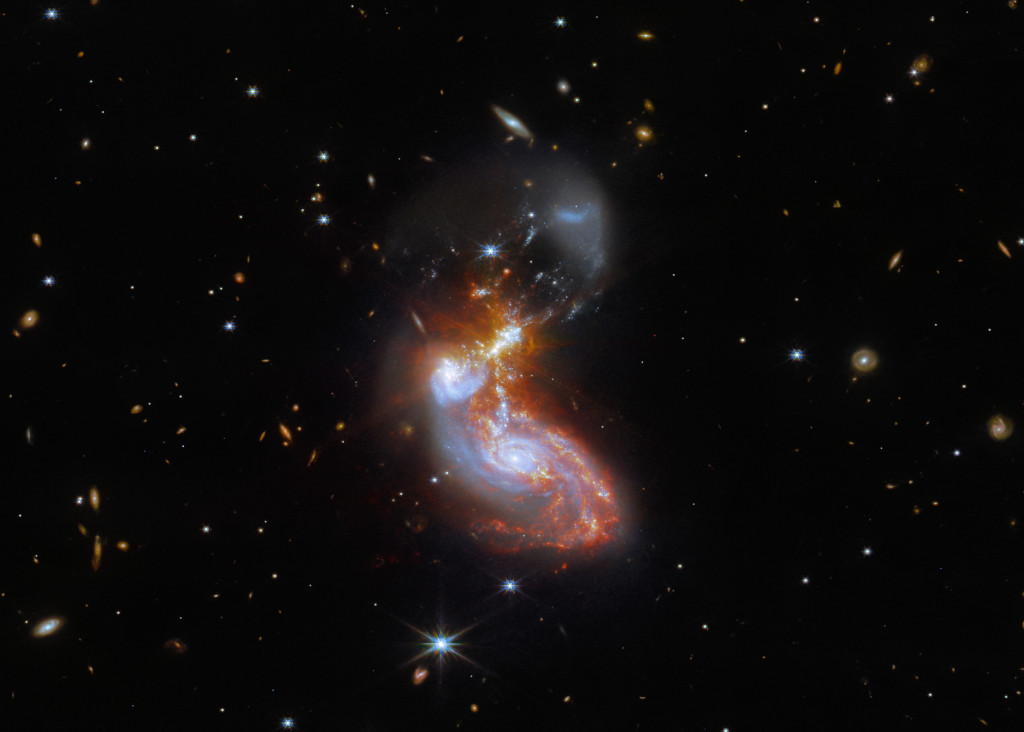
Merging Galaxy Pair IIZw096


Bright at infrared wavelengths, this merging galaxy pair is some 500 million light-years away toward the constellation Delphinus. The cosmic mashup is seen against a background of even more distant galaxies, and occasional spiky foreground stars. But the galaxy merger itself spans about 100,000 light-years in this deep James Webb Space Telescope image. The image data is from Webb's Near-InfraRed Camera (NIRCam) and Mid-InfraRed Instrument (MIRI). Their combined, sharp infrared view follows galactic scale restructuring in the dusty merger's wild jumble of intense star forming regions and distorted spiral arms

https://apod.nasa.gov/apod/ap221202.html ( December 02, 2022)

Orion’s Moon Crater Close-up


On the sixth day of the Artemis I mission, Nov. 21, 2022, the Orion spacecraft’s optical navigation camera captured black-and-white images of craters on the Moon below.

from NASA http://www.nasa.gov/image-feature/orion-s-moon-crater-close-up
via IFTTT