Sunday, January 8, 2023


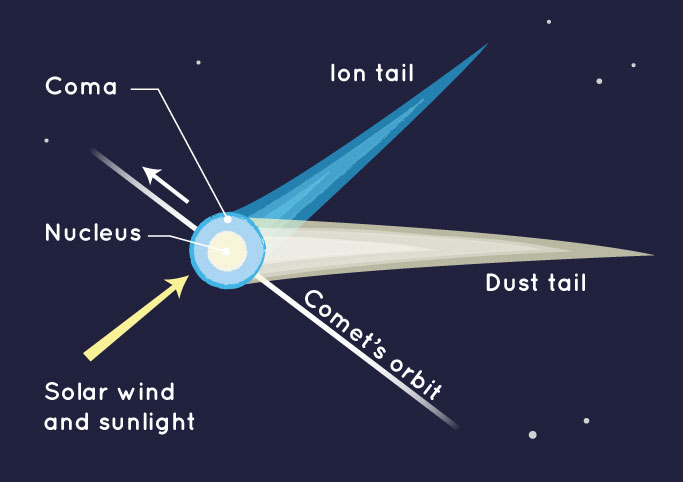
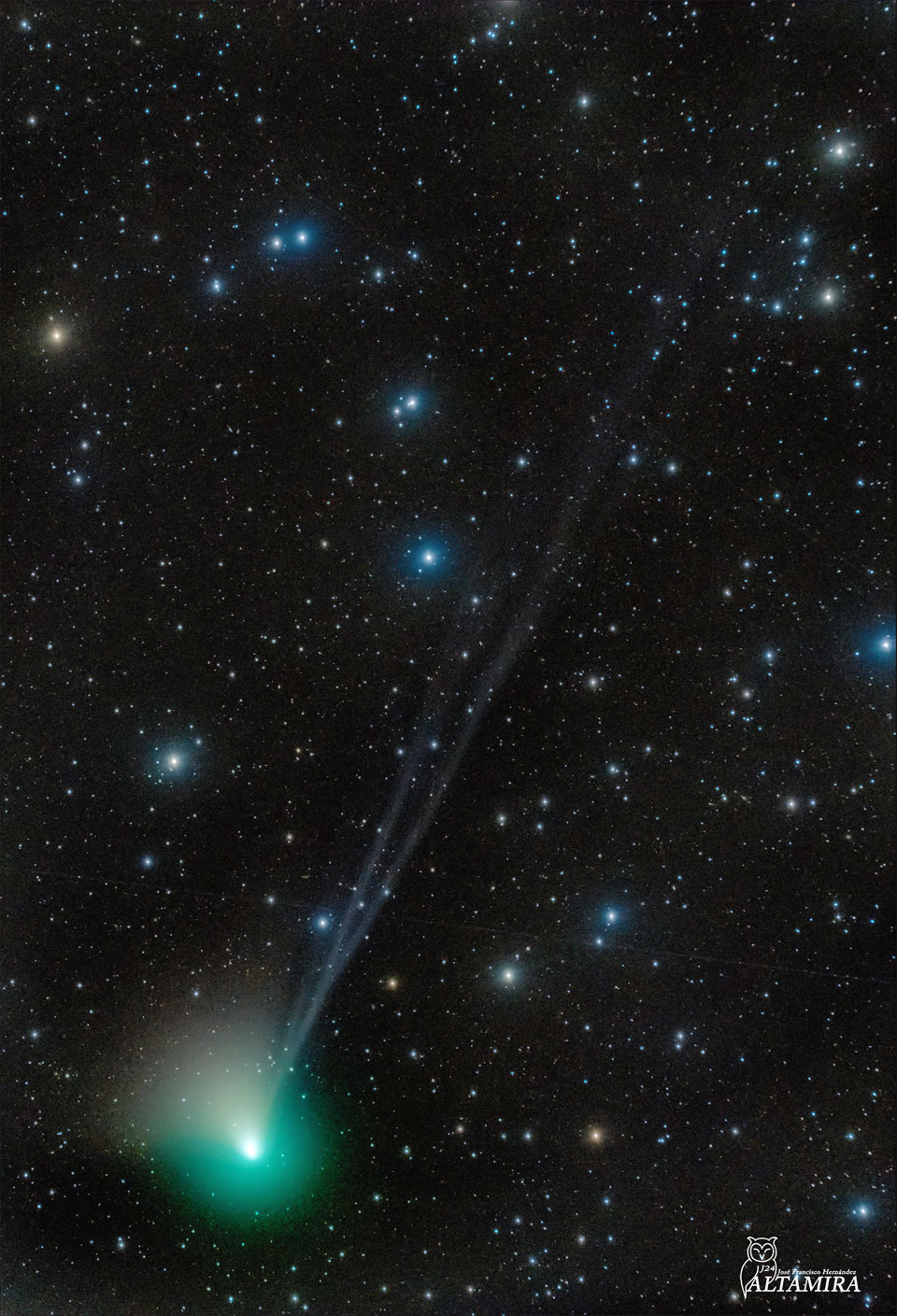
Comet ZTF may become visible to the unaided eye. Discovered early last year, this massive snowball has been brightening as it approaches the Sun and the Earth. C/2022 E3 (ZTF) will be closest to the Sun later this week, at which time it may become visible even without binoculars to northern observers with a clear and dark sky. As they near the Sun, comet brightnesses are notoriously hard to predict, though. In the featured image taken last week in front of a picturesque star field, three blue ion tails extend to the upper right, likely the result of a variable solar wind on ions ejected by the icy comet nucleus. The comet's white dust tail is visible to the upper left and much shorter. The green glow is the comet's coma, caused by glowing carbon gas. Comet ZTF is expected to pass nearest the Earth in early February, after which it should dim dramatically.

https://apod.nasa.gov/apod/ap230109.html ( January 09, 2023)

Saturday, January 7, 2023


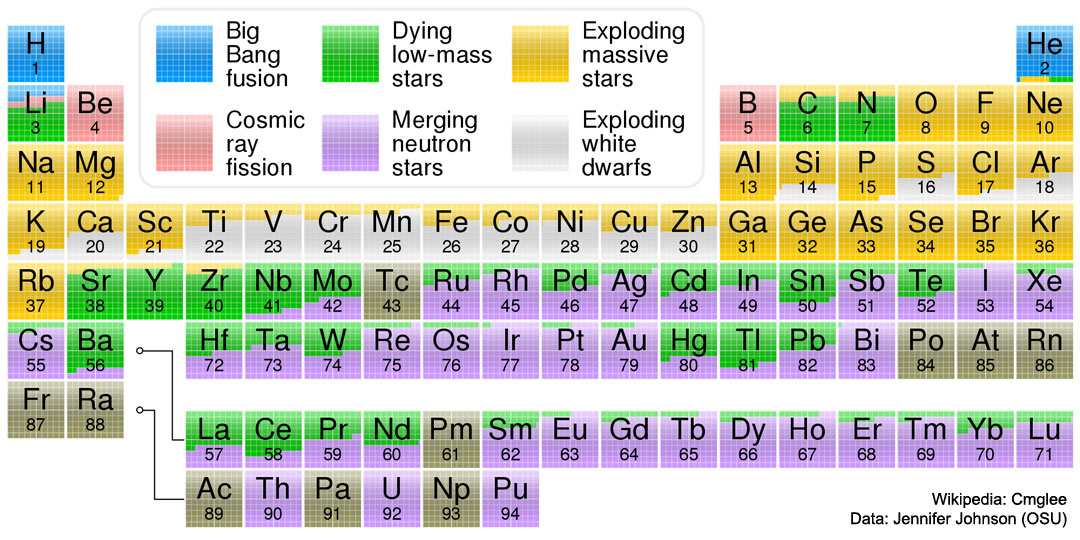
The hydrogen in your body, present in every molecule of water, came from the Big Bang. There are no other appreciable sources of hydrogen in the universe. The carbon in your body was made by nuclear fusion in the interior of stars, as was the oxygen. Much of the iron in your body was made during supernovas of stars that occurred long ago and far away. The gold in your jewelry was likely made from neutron stars during collisions that may have been visible as short-duration gamma-ray bursts or gravitational wave events. Elements like phosphorus and copper are present in our bodies in only small amounts but are essential to the functioning of all known life. The featured periodic table is color coded to indicate humanity's best guess as to the nuclear origin of all known elements. The sites of nuclear creation of some elements, such as copper, are not really well known and are continuing topics of observational and computational research.

https://apod.nasa.gov/apod/ap230108.html ( January 08, 2023)

Friday, January 6, 2023

Space Stations in Low Earth Orbit


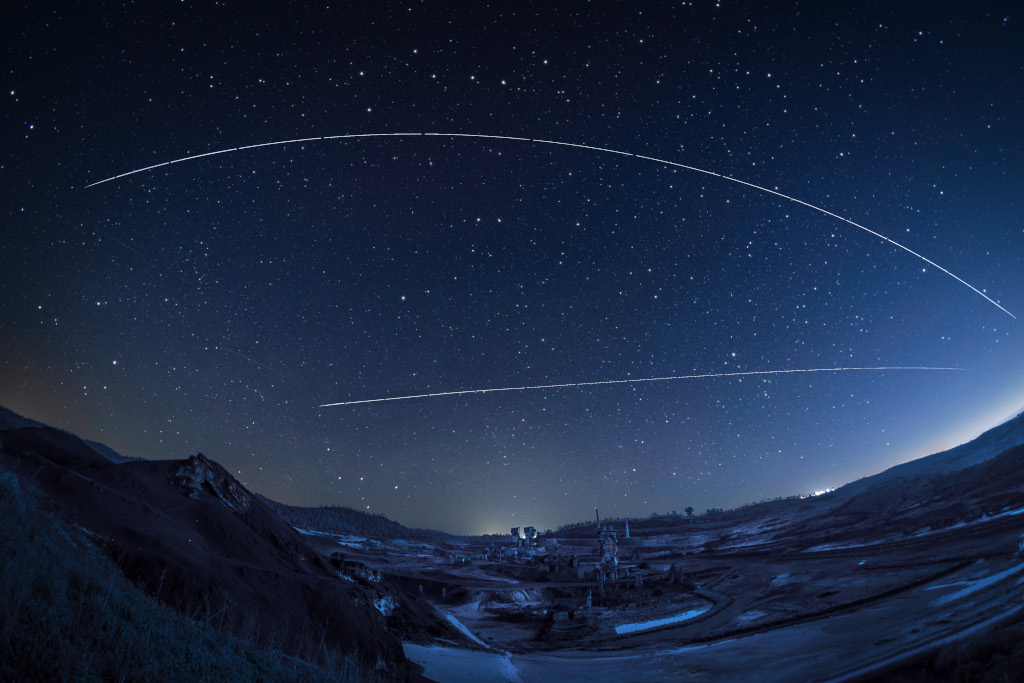
On January 3, two space stations already illuminated by sunlight in low Earth orbit crossed this dark predawn sky. Moving west to east (left to right) across the composited timelapse image China's Tiangong Space Station traced the upper trail captured more than an hour before the local sunrise. Seen against a starry background Tiangong passes just below the inverted Big Dipper asterism of Ursa Major near the peak of its bright arc, and above north pole star Polaris. But less than five minutes before, the International Space Station had traced its own sunlit streak across the dark sky. Its trail begins just above the W-shape outlined by the bright stars of Cassiopeia near the northern horizon. The dramatic foreground spans an abandoned mine at Achada do Gamo in southeastern Portugal.

https://apod.nasa.gov/apod/ap230107.html ( January 07, 2023)

Prepping to Study the World’s Water


The Surface Water and Ocean Topography (SWOT) spacecraft is in this early morning photo from Dec. 14, 2022, as preparations for launch continued.

from NASA http://www.nasa.gov/image-feature/prepping-to-study-the-world-s-water
via IFTTT

ISS Daily Summary Report – 1/05/2023

iss-about-banner


Payloads: BioNutrients-2: BioNutrients-2 Production Bags were hydrated and inspected. BioNutrients demonstrates a technology that enables on-demand production of human nutrients during long-duration space missions. The process uses engineered microbes, like yeast, to generate carotenoids from an edible media to supplement potential vitamin losses from food that is stored for very long periods. Specially designed storage/growth … ...

January 05, 2023 at 11:00AM
From NASA: https://blogs.nasa.gov/stationreport/2023/01/05/iss-daily-summary-report-1-05-2023/

Thursday, January 5, 2023

Moon O Clock 2022


The first Full Moon of 2023 is in the sky tonight opposite the Sun at 23:08 UTC. Big and beautiful, the Moon at its brightest phase should be easy to spot. Still, for quick reference images captured near the times of all the full moons of 2022 are aranged in this dedicated astro-imaging project from Sri Lanka, planet Earth. The day, month, and a traditional popular name for 2022's twelve full moons are given in the chart. The apparent size of each full moon depends on how close the full lunar phase is to perigee or apogee, the closest or farthest point in the Moon's elliptical orbit. Like the 2022 Wolf Moon at the 1 o'clock position, tonight's Full Moon occurs within a about two days of apogee. But unlike in 2022, the year 2023 will have 13 full moons that won't all fit nicely on the twelve hour clock.

https://apod.nasa.gov/apod/ap230106.html ( January 06, 2023)

Space Station Swings by Kennedy


On April 8, 2022, this 30-second exposure captured the International Space Station as it passed over the Space Launch System rocket and the Orion spacecraft at NASA’s Kennedy Space Center in Florida.

from NASA http://www.nasa.gov/image-feature/space-station-swings-by-kennedy
via IFTTT

ISS Daily Summary Report – 1/04/2023

iss-about-banner


Payloads: BioNutrients-2: BioNutrients-2 Production Bags were hydrated and inspected. BioNutrients demonstrates a technology that enables on-demand production of human nutrients during long-duration space missions. The process uses engineered microbes, like yeast, to generate carotenoids from an edible media to supplement potential vitamin losses from food that is stored for very long periods. Specially-designed storage/growth packets … ...

January 04, 2023 at 11:00AM
From NASA: https://blogs.nasa.gov/stationreport/2023/01/04/iss-daily-summary-report-1-04-2023/

Wednesday, January 4, 2023

Messier 45: The Daughters of Atlas and Pleione


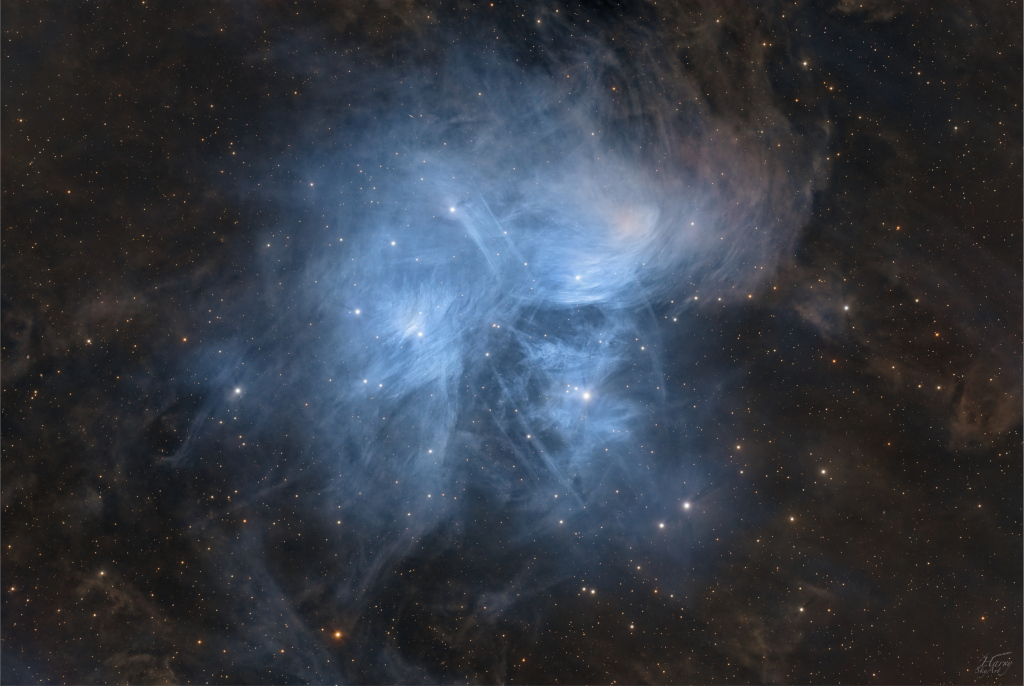
Hurtling through a cosmic dust cloud a mere 400 light-years away, the lovely Pleiades or Seven Sisters open star cluster is well-known for its striking blue reflection nebulae. It lies in the night sky toward the constellation Taurus and the Orion Arm of our Milky Way galaxy. The sister stars are not related to the dusty cloud though. They just happen to be passing through the same region of space. Known since antiquity as a compact grouping of stars, Galileo first sketched the star cluster viewed through his telescope with stars too faint to be seen by eye. Charles Messier recorded the position of the cluster as the 45th entry in his famous catalog of things which are not comets. In Greek myth, the Pleiades were seven daughters of the astronomical titan Atlas and sea-nymph Pleione. Their parents names are included in the cluster's nine brightest stars. This well-processed, color-calibrated telescopic image features pin-point stars and detailed filaments of interstellar dust captured in over 9 hours of exposure. It spans more than 20 light-years across the Pleiades star cluster.

https://apod.nasa.gov/apod/ap230105.html ( January 05, 2023)

Crew Recovers SpaceX Crew Dragon Endurance


Support teams work around the SpaceX Crew Dragon Endurance spacecraft shortly after it landed on Friday, May 6, 2022 with Crew-3 NASA astronauts Raja Chari, Kayla Barron, Tom Marshburn, and European Space Agency astronaut Matthias Maurer aboard.

from NASA http://www.nasa.gov/image-feature/crew-recovers-spacex-crew-dragon-endurance
via IFTTT