Thursday, January 6, 2022

Wednesday, January 5, 2022

The Last Days of Venus as the Evening Star


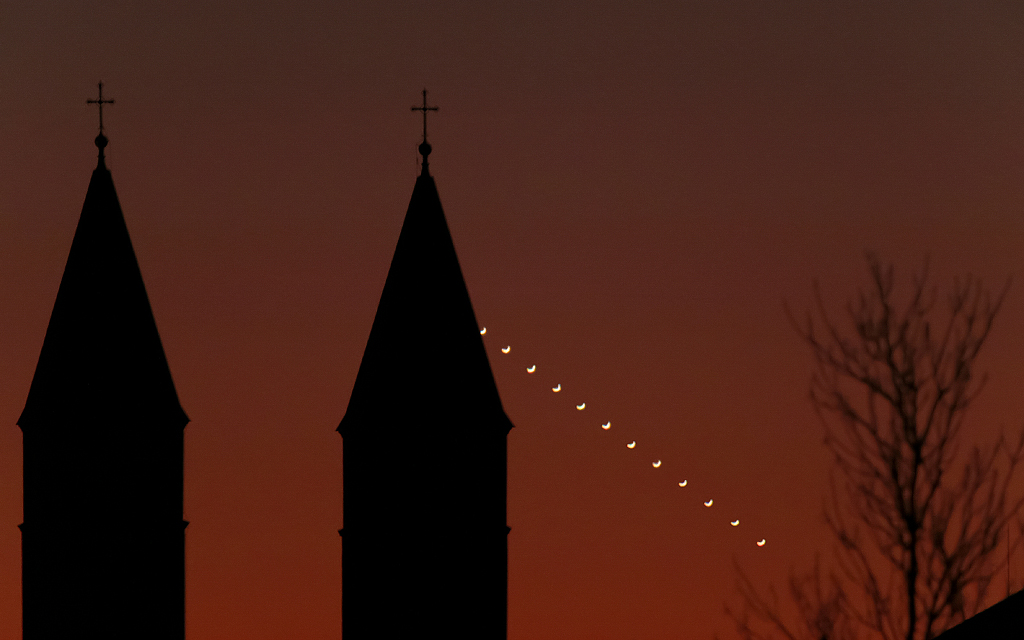
That's not a young crescent Moon posing behind cathedral towers after sunset. It's Venus in a crescent phase. About 40 million kilometers away and about 2 percent illuminated by sunlight, it was captured with camera and telephoto lens in this series of exposures as it set in western skies on January 1 from Veszprem, Hungary. The bright celestial beacon was languishing in the evening twilight, its days as the Evening Star coming to a close as 2022 began. But it was also growing larger in apparent size and becoming an ever thinner crescent in telescopic views. Heading toward a (non-judgemental) inferior conjunction, the inner planet will be positioned between Earth and Sun on January 9 and generally lost from view in the solar glare. A crescent Venus will soon reappear though. Rising in the east by mid-month just before the Sun as the brilliant Morning Star.

https://apod.nasa.gov/apod/ap220106.html ( January 06, 2022)

NASA’s X-59 Kicks Off 2022 in Texas for Ground Testing


2021 saw significant milestones achieved in the assembly of NASA’s X-59 Quiet SuperSonic Technology aircraft (QueSST), and all eyes now look forward to a pivotal 2022.

from NASA http://www.nasa.gov/centers/armstrong/image-feature/x59-ground-testing.html
via IFTTT

ISS Daily Summary Report – 1/04/2021

iss-about-banner


Payloads: Airborne Particulate Monitor (APM):  A crewmember removed the SD Card from APM, transferred its data to an SSC laptop, and re-insert the SD Card back into APM.  Air quality in crewed spacecraft is important for keeping astronauts healthy and comfortable. Although requirements exist for maximum allowable concentrations of particulate matter, currently no measurement capability … ...
January 04, 2022 at 11:00AM
From NASA: https://blogs.nasa.gov/stationreport/2022/01/04/iss-daily-summary-report-1-04-2021/

Tuesday, January 4, 2022

A Year of Sunrises


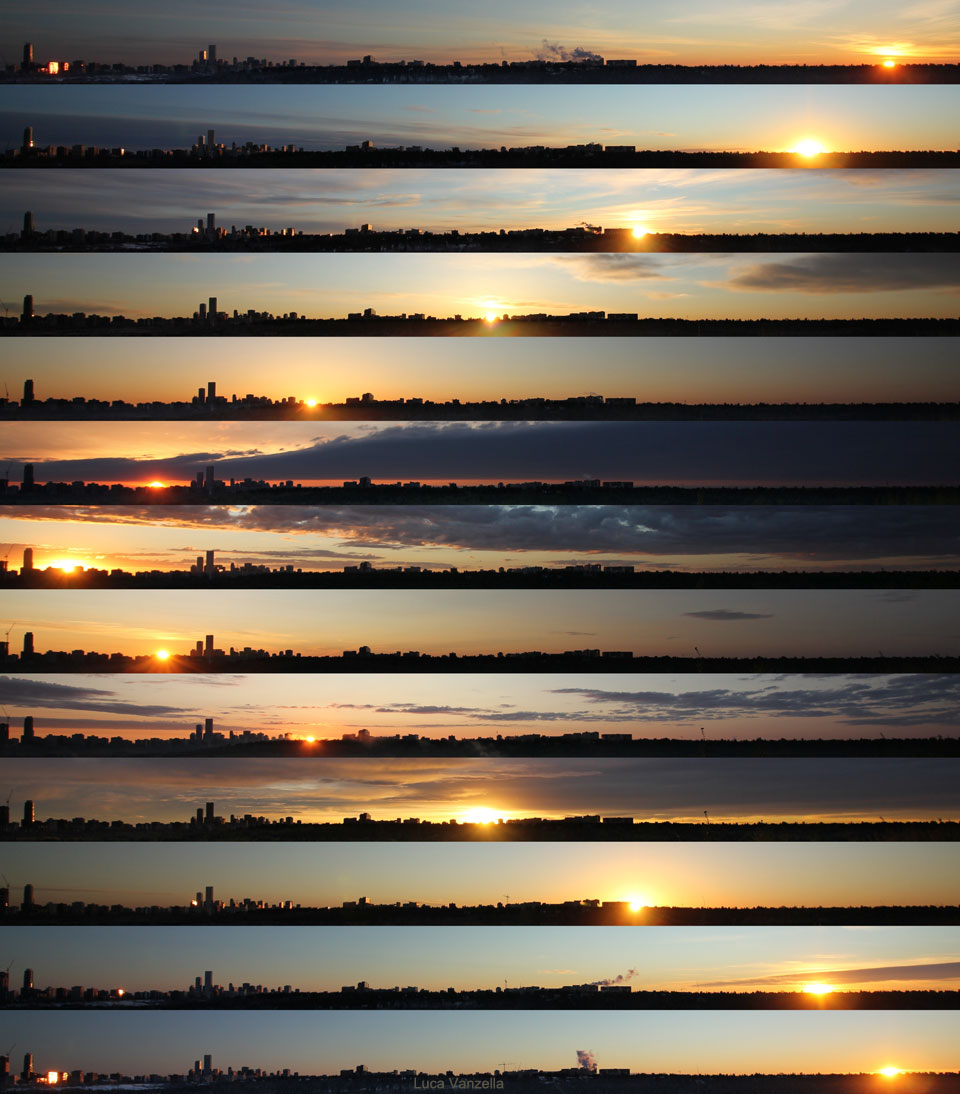
Does the Sun always rise in the same direction? No. As the months change, the direction toward the rising Sun changes, too. The featured image shows the direction of sunrise every month during 2021 as seen from the city of Edmonton, Alberta, Canada. The camera in the image is always facing due east, with north toward the left and south toward the right. As shown in an accompanying video, the top image was taken in 2020 December, while the bottom image was captured in 2021 December, making 13 images in total. Although the Sun always rises in the east in general, it rises furthest to the south of east on the December solstice, and furthest north of east on the June solstice. In many countries, the December Solstice is considered an official change in season: for example the first day of winter in the North. Solar heating and stored energy in the Earth's surface and atmosphere are near their lowest during winter, making the winter season the coldest of the year.

https://apod.nasa.gov/apod/ap220105.html ( January 05, 2022)

ISS Daily Summary Report – 1/03/2021

iss-about-banner


Payloads: BioMole: BioMole Surface Sampling and DNA Extraction was performed. The Environmental Health System (EHS) Biomole Facility non-culture based samples are capable of providing microbial identification on-orbit within days of sampling.  The goal of this Tech Demo is to conduct comparative analysis for possible replacement of current microbial monitoring systems. Cytoskeleton: The Med Reservoirs were … ...

January 03, 2022 at 11:00AM
From NASA: https://blogs.nasa.gov/stationreport/2022/01/03/iss-daily-summary-report-1-03-2021/

NASA Headquarters Photographers Pick Their Best


A United Launch Alliance Atlas V rocket with the Lucy spacecraft aboard is seen at Space Launch Complex 41, Thursday, Oct. 14, 2021.

from NASA http://www.nasa.gov/image-feature/nasa-headquarters-photographers-pick-their-best
via IFTTT

Monday, January 3, 2022

Moons Beyond Rings at Saturn


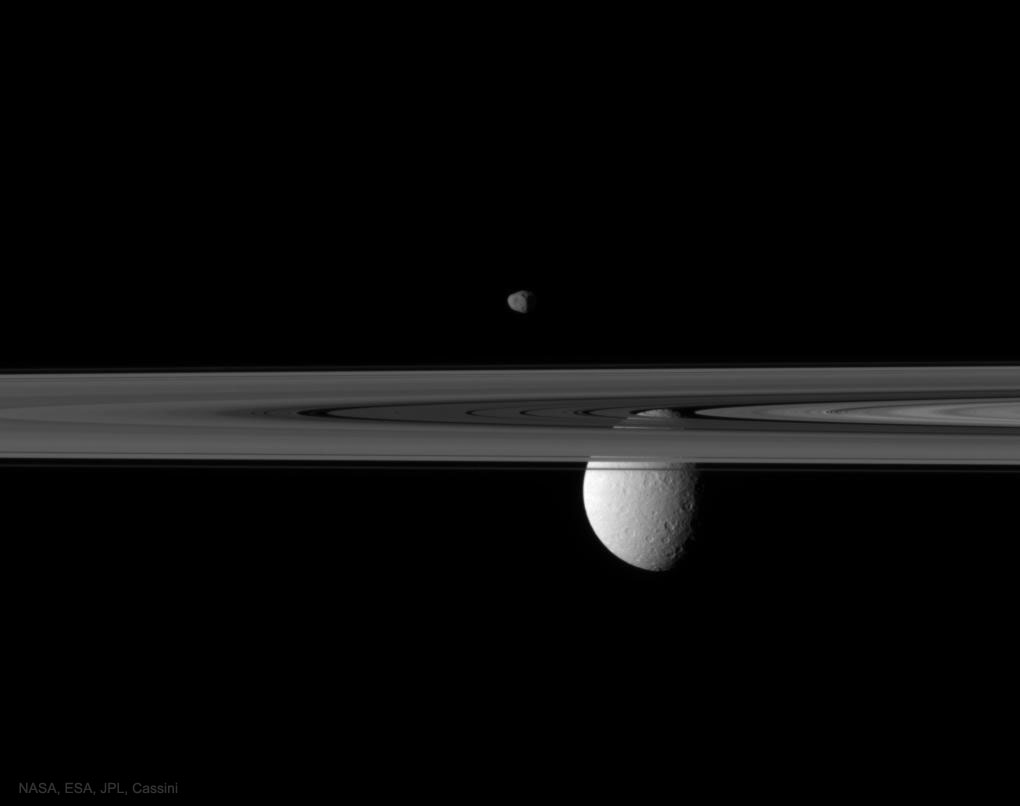
What's happened to that moon of Saturn? Nothing -- Saturn's moon Rhea is just partly hidden behind Saturn's rings. In 2010, the robotic Cassini spacecraft then orbiting Saturn took this narrow-angle view looking across the Solar System's most famous rings. Rings visible in the foreground include the thin F ring on the outside and the much wider A and B rings just interior to it. Although it seems to be hovering over the rings, Saturn's moon Janus is actually far behind them. Janus is one of Saturn's smaller moons and measures only about 180 kilometers across. Farther out from the camera is the heavily cratered Rhea, a much larger moon measuring 1,500 kilometers across. The top of Rhea is visible only through gaps in the rings. After more than a decade of exploration and discovery, the Cassini spacecraft ran low on fuel in 2017 and was directed to enter Saturn's atmosphere, where it surely melted.

https://apod.nasa.gov/apod/ap220104.html ( January 04, 2022)

The James Webb Telescope Lights Up the Sky During Launch


NASA’s James Webb Space Telescope, or JWST, launched aboard Arianespace's Ariane 5 rocket on Saturday, Dec. 25, 2021.

from NASA http://www.nasa.gov/image-feature/the-james-webb-telescope-lights-up-the-sky-during-launch
via IFTTT

Saturday, January 1, 2022

Quadruple Lunar Halo Over Winter Road


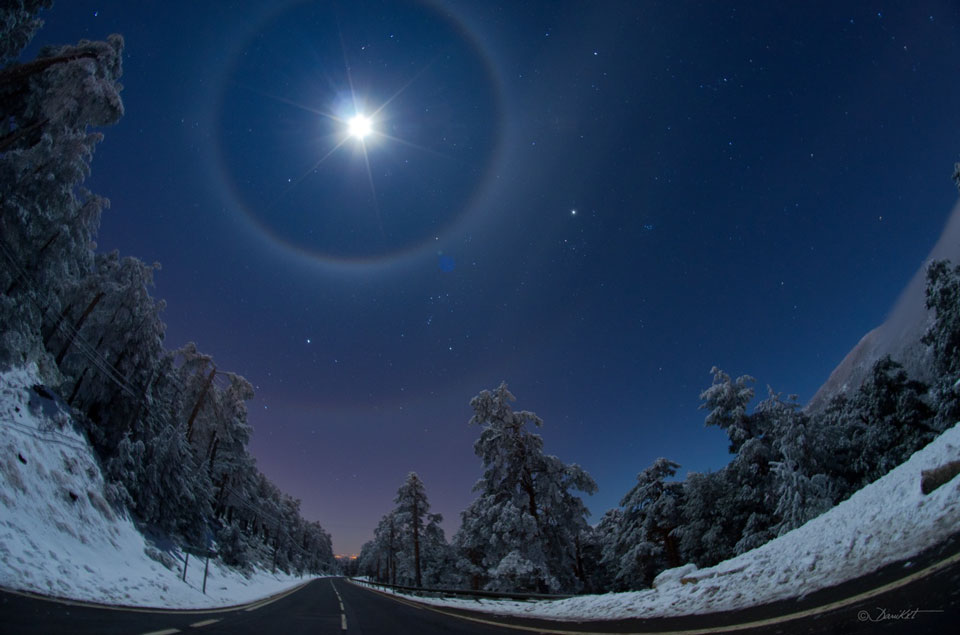
Sometimes falling ice crystals make the atmosphere into a giant lens causing arcs and halos to appear around the Sun or Moon. One Saturday night in 2012 was just such a time near Madrid, Spain, where a winter sky displayed not only a bright Moon but four rare lunar halos. The brightest object, near the top of the featured image, is the Moon. Light from the Moon refracts through tumbling hexagonal ice crystals into a somewhat rare 22-degree halo seen surrounding the Moon. Elongating the 22-degree arc horizontally is a more rare circumscribed halo caused by column ice crystals. Even more rare, some moonlight refracts through more distant tumbling ice crystals to form a (third) rainbow-like arc 46 degrees from the Moon and appearing here just above a picturesque winter landscape. Furthermore, part of a whole 46-degree circular halo is also visible, so that an extremely rare -- especially for the Moon -- quadruple halo was captured. Far in the background is a famous winter skyscape that includes Sirius, the belt of Orion, and Betelgeuse -- visible between the inner and outer arcs. Halos and arcs typically last for minutes to hours, so if you do see one there should be time to invite family, friends or neighbors to share your unusual lensed vista of the sky.

https://apod.nasa.gov/apod/ap220102.html ( January 02, 2022)