Tuesday, August 11, 2026

Perseids Over a Little Planet


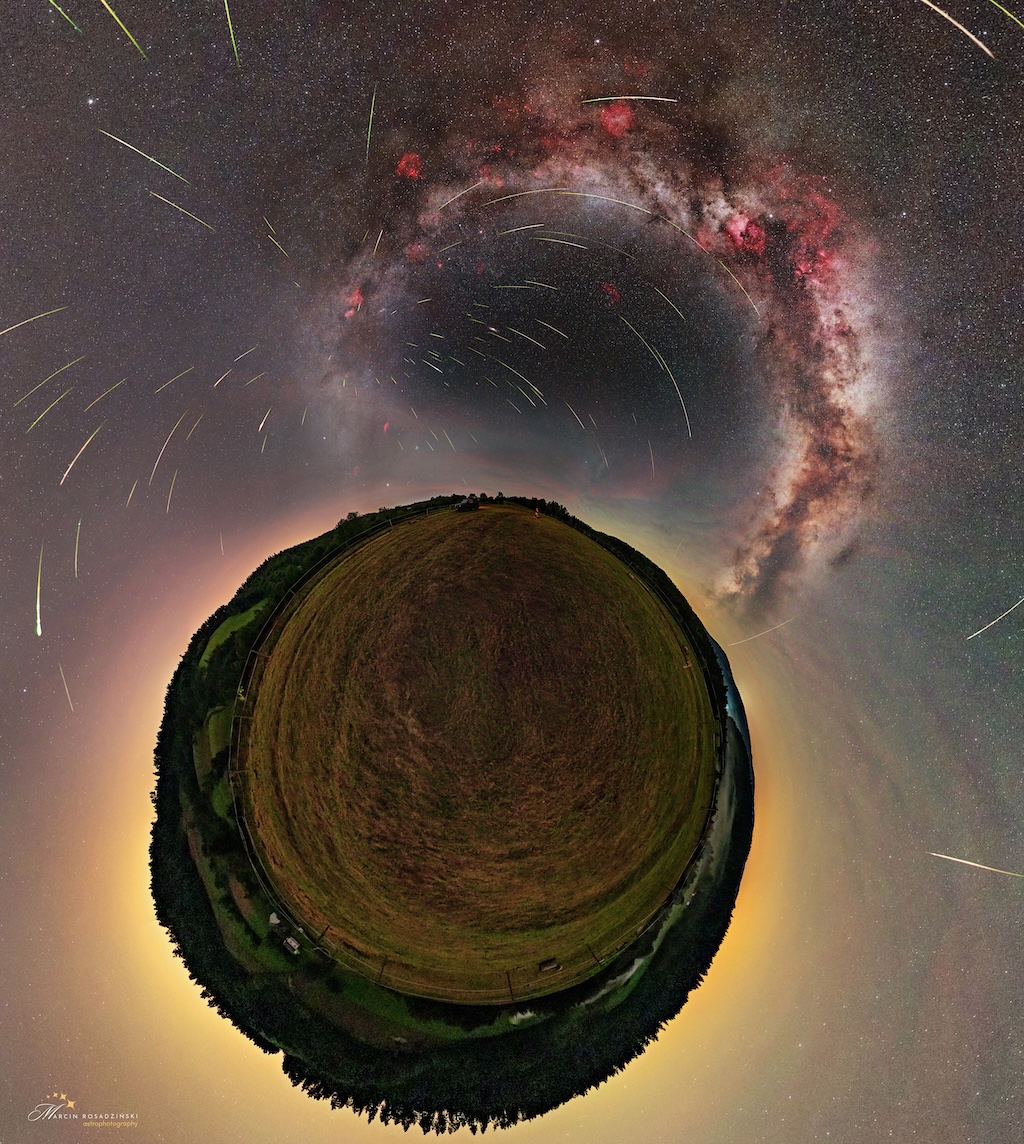
It looks like a view from the Little Prince's planet. The featured image is a throwback to the 2024 Perseid meteor shower, surrounded in this projection by the Bieszczady Mountains in Poland. Visible in the sky is the arch of the Milky Way, along with several nebulas in red and over a hundred meteors pointing to the radiant. The Perseids are easily visible and quite popular in the Northern Hemisphere summer. (Watching meteor showers in the winter is less convenient for a good reason). This year they are expected to offer an even more dazzling spectacle than usual, because the peak coincides with a new moon. The 2026 Perseid meteor shower will peak tonight with as many as 50-100 meteors per hour, when the Earth's path crosses through debris left behind by Comet Swift-Tuttle. Typically, the best times for seeing the meteors are between midnight and pre-dawn. You won't need binoculars to see the meteors, but a lawn chair and a dark sky location help.

https://apod.nasa.gov/apod/ap260812.html ( August 11, 2026 at 08:00PM)

Thursday, August 6, 2026

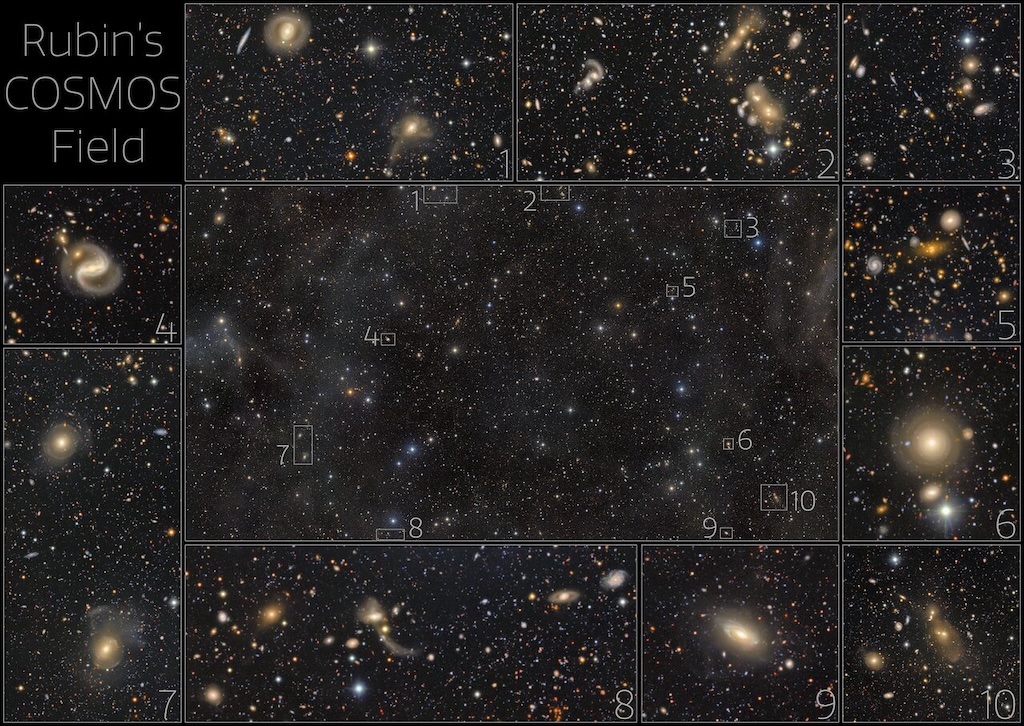
Rubin's COSMOS Field


There are more than half a million galaxies in the central panel of this image from the NSF-DOE Vera C. Rubin Observatory in Chile. This is the COSMOS field, a patch of sky several times larger than the full moon, first observed by Hubble. It has also been observed by Webb and other telescopes because it contains comparatively few bright stars from our own galaxy, offering a relatively unimpeded view of other galaxies outside the Milky Way. The outer panels, numbered 1-10, show zoomed-in views of the corresponding small regions highlighted in the central panel. The variety of galaxy shapes and sizes is astonishing. Some of them are so far away that their light has traveled for billions of years before reaching Earth. Rubin will come back every couple of days to the COSMOS field as part of its ten-year Legacy Survey of Space and Time. It will allow a dynamic view of the COSMOS field and how the sky changes over time.

https://apod.nasa.gov/apod/ap260807.html ( August 6, 2026 at 08:00PM)

Wednesday, July 29, 2026

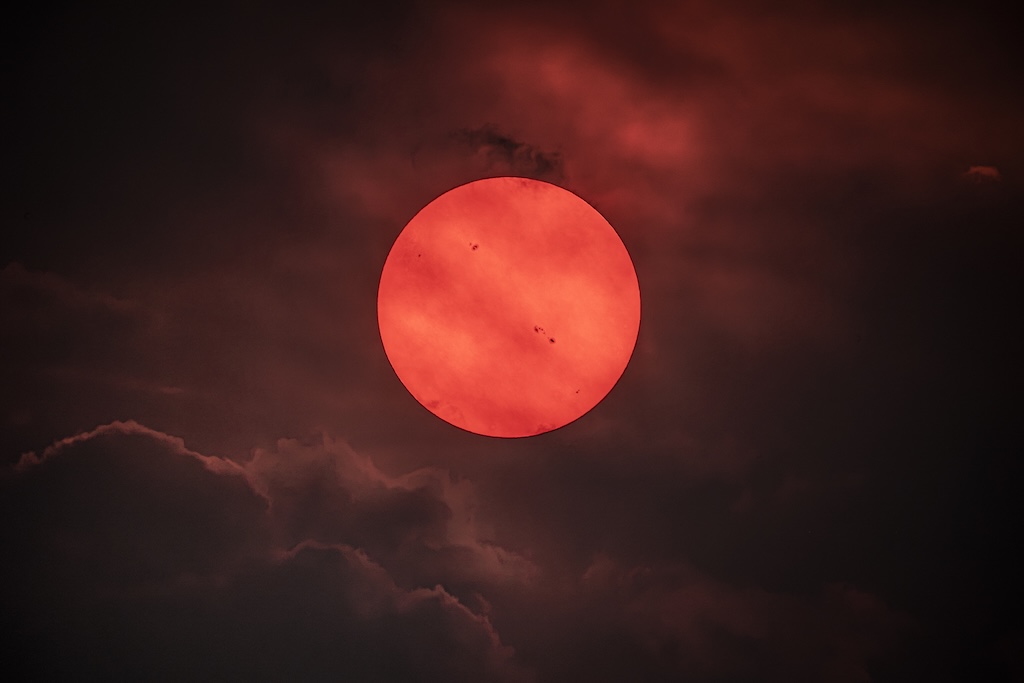
Red Sun through Wildfire Smoke


This could be the view from an exoplanet orbiting around a red dwarf star, but it is our own Sun. This image was taken on July 22, 2026, in the Okanagan region in the Canadian province of British Columbia. Wildfire smoke from the Pacific Northwest acted as a solar filter, allowing the photographer to take this photo of the Sun directly. Several sunspots are also visible in this eerie image; just below and right of the center is AR 4493, a fast evolving, giant active solar region and sunspot group. The smoke is made of tiny particles that help block and scatter light with bluer colors, so the light we see coming from the Sun is dimmer and redder than usual (but it is never safe to stare directly at the Sun). Sunsets and sunrises are also more colorful because of the smoke. Some 6 billion years from now, the Sun will actually start to turn redder as it approaches its red giant phase.

https://apod.nasa.gov/apod/ap260730.html ( July 29, 2026 at 08:00PM)

Wednesday, July 22, 2026

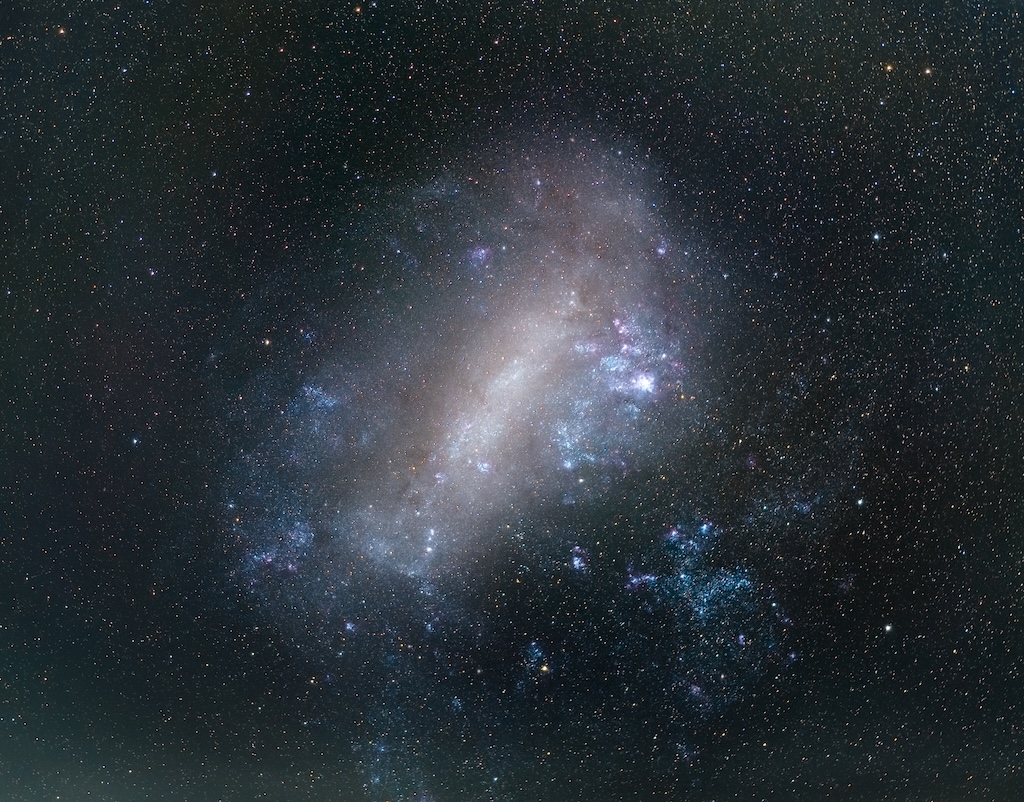
The Large Magellanic Cloud


Have you ever seen another galaxy with your own eyes? The featured image shows the Large Magellanic Cloud (LMC), one of the closest neighbors of our Milky Way. If you are anywhere south of latitude 20&deg N (but the further south, the better), you can see it with the unaided eye if you go to a dark sky location, away from big cities and light polution. It is a dwarfirregular galaxy about 163,000 light-years away, and a member of our Local Group of galaxies. Despite being small, with a total mass approximately equivalent to 10% - 20% of the mass of the Milky Way, the LMC is very actively forming stars. This is likely due in part to the gravitational push and pull of tides caused by the Milky Way on the LMC. Some astronomers have predicted that it will collide with the Milky Way in in about 2 billion years.

https://apod.nasa.gov/apod/ap260723.html ( July 22, 2026 at 08:00PM)

Wednesday, July 15, 2026

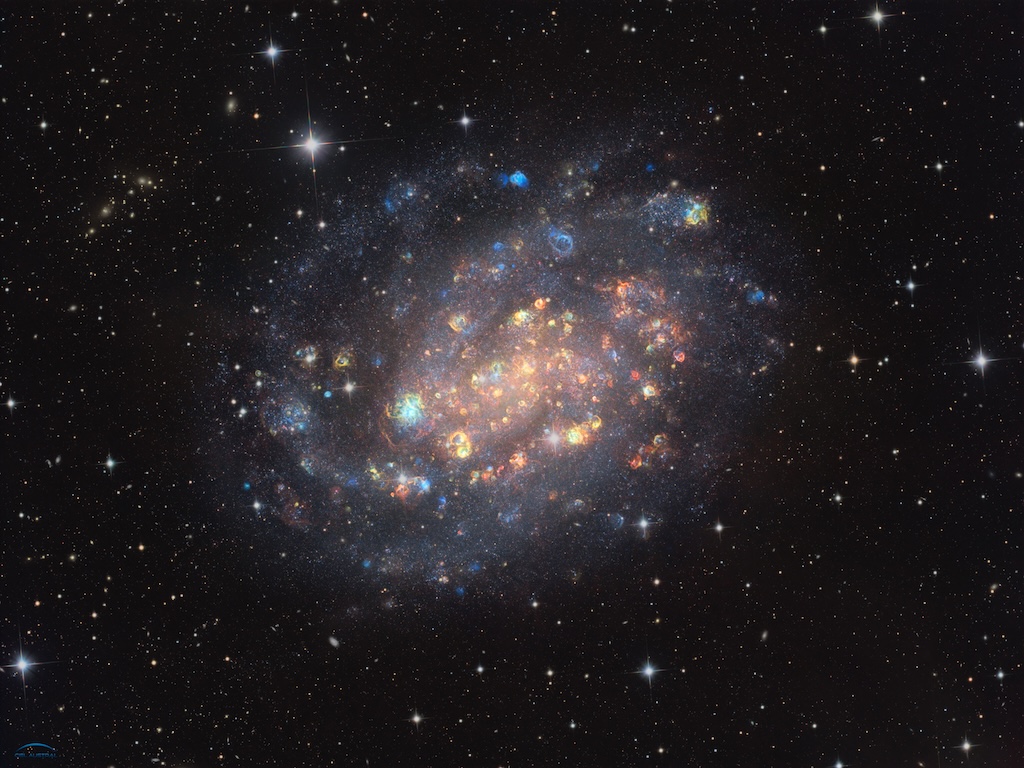
NGC 300: A Cosmic Gemstone with Stars and Gas Clouds


This sparkling, colorful gemstone is a spiral galaxy, NGC 300. It is one of the closest spiral galaxies to Earth, only about 6 million light-years away. But does it really look like this? Here is a more standard portrait of it. This unusual image combines the light from the stars and dust within the galaxy with the light from ionized clouds of interstellar gas shown in red (Sulphur), green (Hydrogen) and blue (Oxygen). Combining red and green light in different proportions makes yellow or orange light, most visible in the image. Light from other ionized gases is also at work in neon signs, fluorescent tubes and street lights. These massive clouds of ionized gas are typically created by young, massive stars that produce high-energy ultraviolet radiation capable of ionizing the gas. Massive stars are short-lived, compared with lighter stars like our sun, and explode as supernovas at the end of their lives. Some of the colorful clouds in the image could be hidingsupernova remnants.

https://apod.nasa.gov/apod/ap260716.html ( July 15, 2026 at 08:00PM)

Wednesday, July 1, 2026

Sibling Supernova Remnants


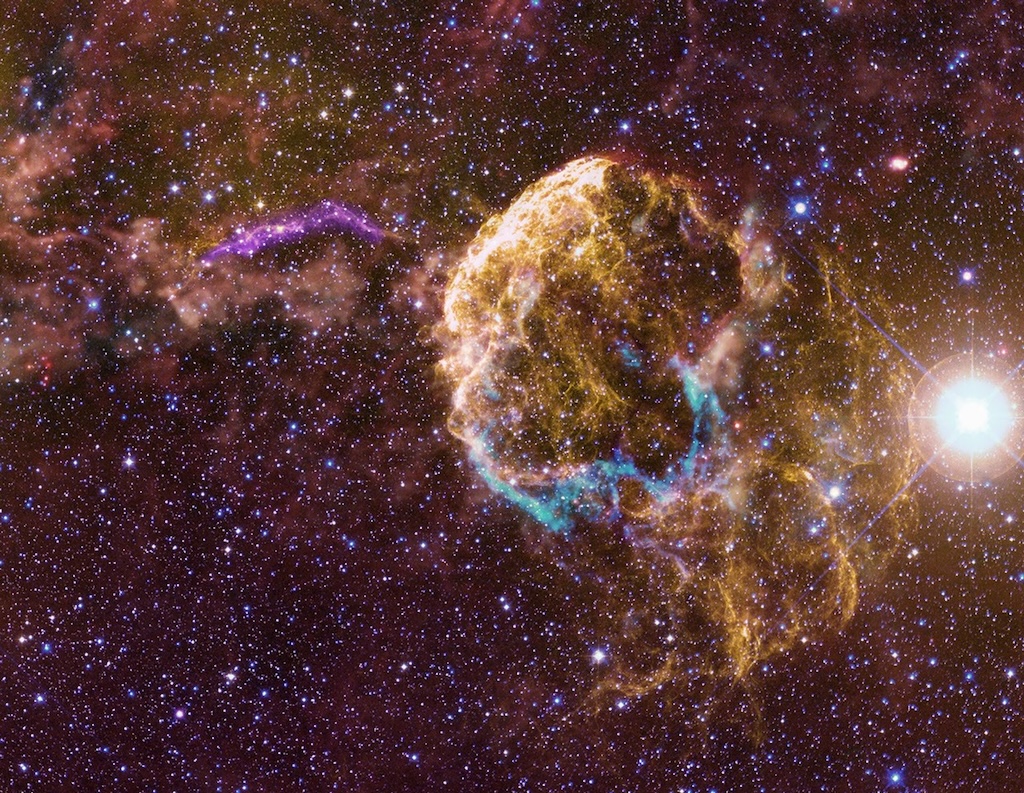
What happens when one of the stars in a binary goes supernova? This image combines visible (yellow), ultraviolet (purple) and infrared light (cyan, red and orange) to show two supernova remnants and their surrounding environment, about 6,000 light-years away. The younger one is the well-known Jellyfish Nebula in the center (mostly in yellow). If we could see it by eye, it would appear larger than the full moon in the sky. The filament shown in purple is part of an older, overlapping supernova remnant, G189.6+3.3. A new study used data from NASA's Fermi Gamma-ray Space Telescope to piece together their story. Astronomers believe that there were two stars in a binary system, then the first one exploded as a supernova, kicking away its companion, which also exploded as a supernova tens of thousands of years later, creating the superimposed supernova remnants we see today. The bright star on the right is actually a triple star system named Propus.

https://apod.nasa.gov/apod/ap260702.html ( July 1, 2026 at 08:00PM)

Wednesday, June 24, 2026

Anticrepuscular Rays over Sicily


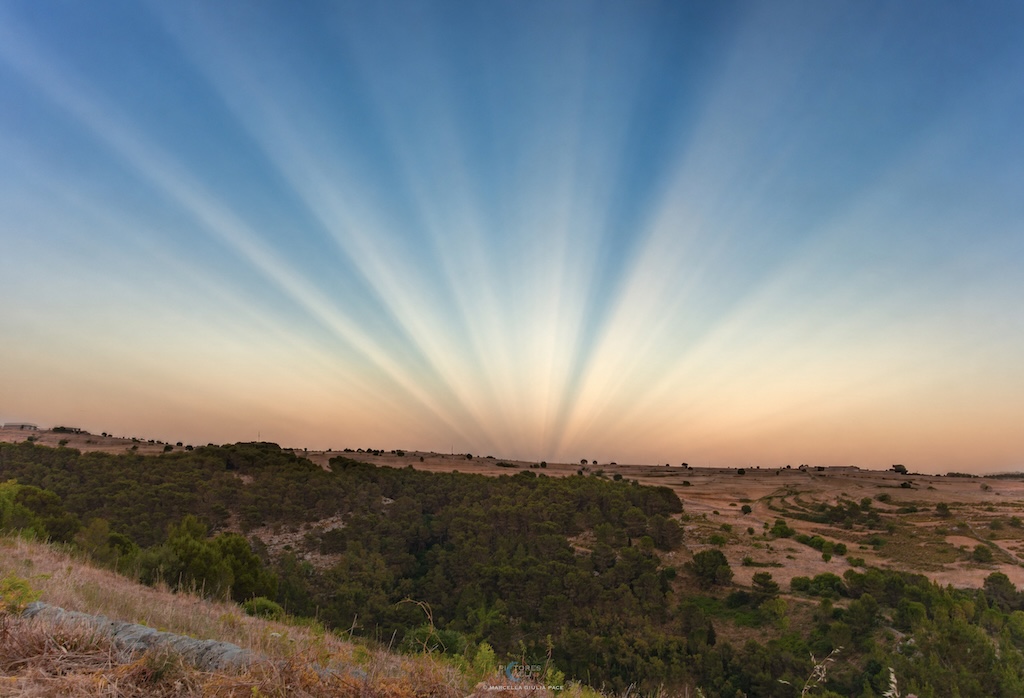
The Sun has just set... in the opposite side of the sky. Pictured here are anticrepuscular rays apparently converging in the east in this image of the limestone plateau in the heart of the Hyblaean Mountains of southeastern Sicily, in Italy. How were these anticrepuscular rays formed, if the Sun wasn't there? After the Sun set (in the west, as usual) its light still illuminated a cloud higher up in the sky. Partially blocked by the cloud, the sunlight produced patterns of light and shadow, crossing the sky in parallel lines. Perspective makes it look like they converge in the east, in the same way that train tracks appear to meet in the distance. This effect can also happen at sunrise, only the directions are exchanged. In rare cases, both crepuscular and anticrepuscular rays can be seen at the same time.

https://apod.nasa.gov/apod/ap260625.html ( June 24, 2026 at 08:00PM)

Tuesday, April 28, 2026


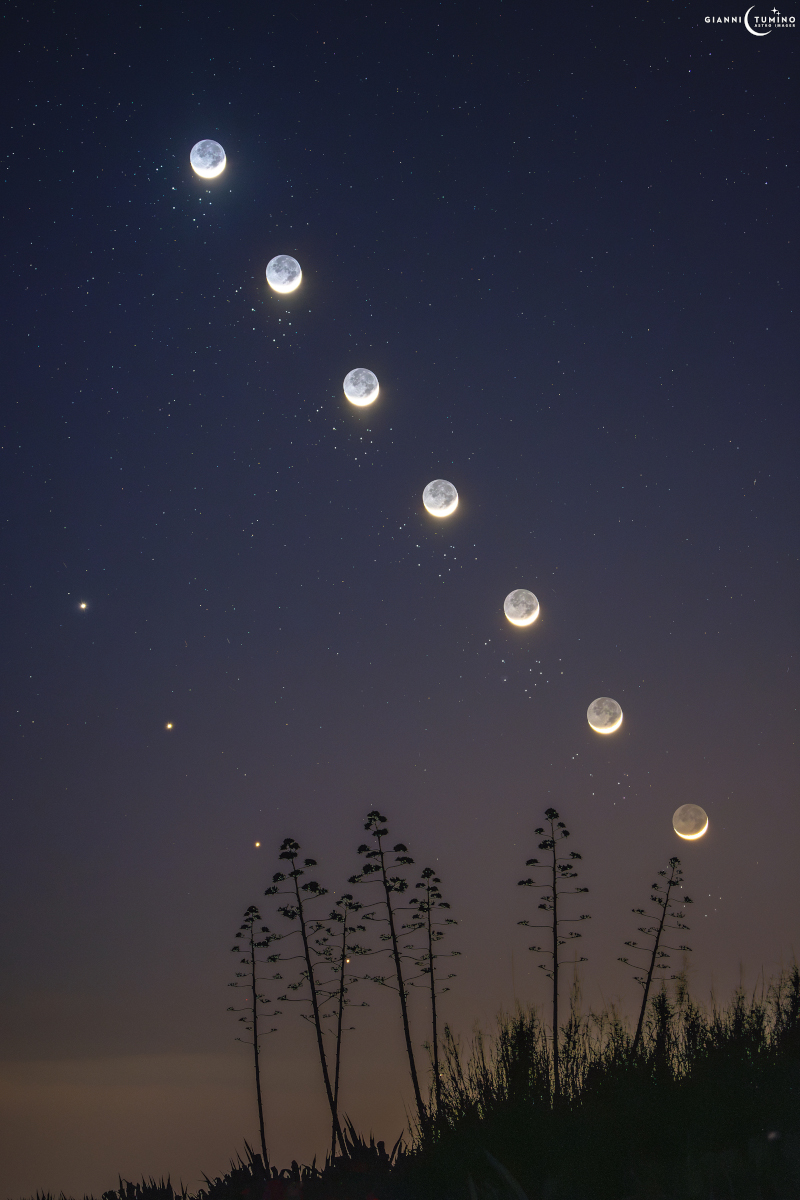
No, Earth did not recently acquire six more moons! Today’s APOD is a combination of images following the Moon, Venus, and the Pleiades across a southern Sicilian sky as twilight turned to evening on April 19. From 2023 to 2029, the Pleiades' and the Moon “visit" each other once per month due to the Pleiades' location in the ecliptic plane. April 2026 saw the celestial alignment of their visit with Venus. About six stars in the Pleiades cluster (Messier 45) are typically visible with the unaided eye. Due to the cluster’s visibility across the world, there are many myths and legends across cultures associated with the Pleiades. The Haudenosaunee people of North America, for example, say that seven boys danced so enthusiastically that they lifted off into the sky. Astronomers recently found thousands more Pleiades members, showing that after thousands of years of gazing upon this cluster, there is yet more to learn about the Pleiades.

https://apod.nasa.gov/apod/ap260429.html ( April 28, 2026 at 08:00PM)

Monday, April 27, 2026


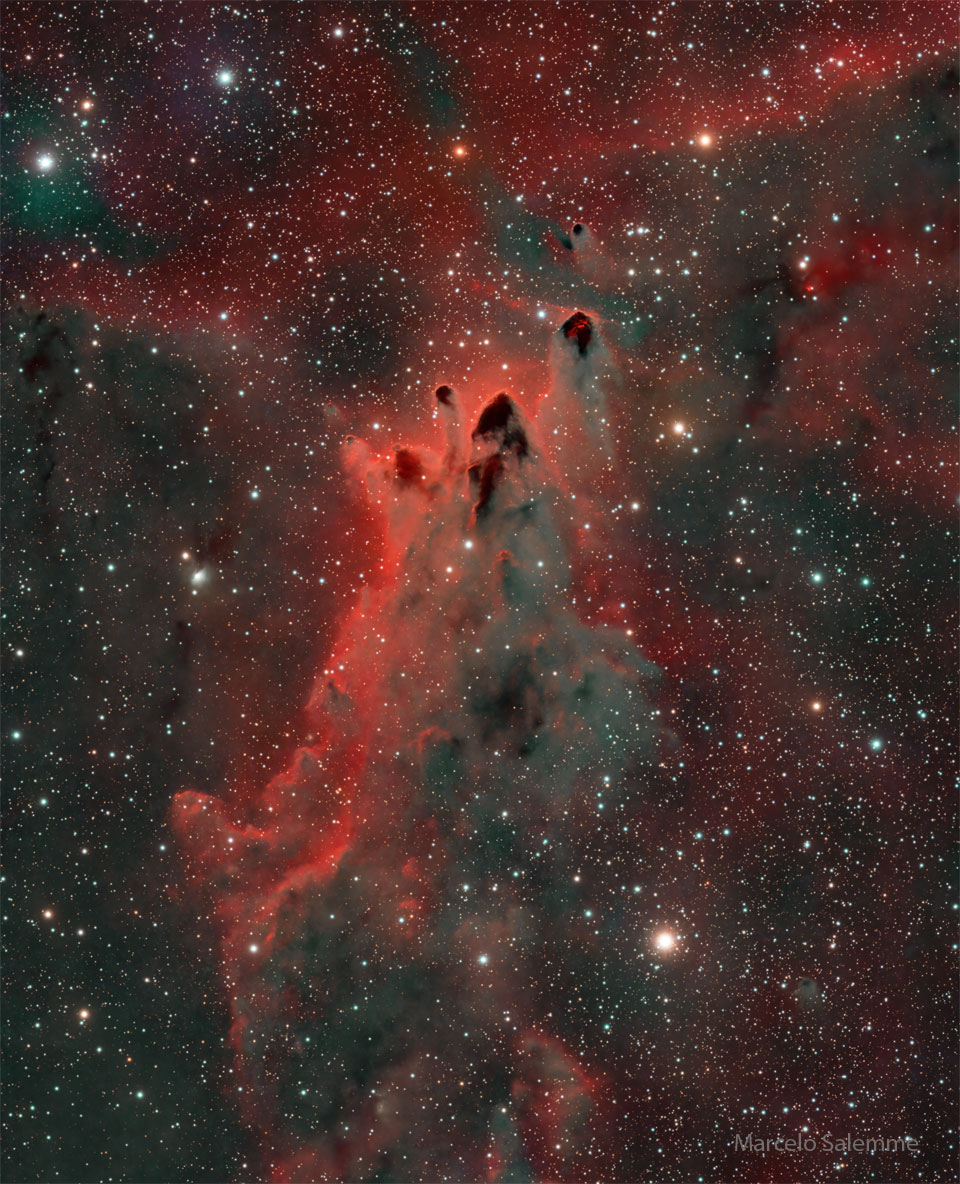
They're like mountain peaks, but they are forming stars. Bright-rimmed, flowing shapes gather near the center of this rich starfield toward the borders of the nautical southern constellations Puppis and Vela. Composed of interstellar gas and dust, the grouping of light-year sized cometary globules is about 1300 light-years distant. Energetic ultraviolet light from nearby hot stars has molded the globules and ionized their bright rims. The globules also stream away from the Vela supernova remnant which may have influenced their swept-back shapes. Within them, cores of cold gas and dust are likely collapsing to form low mass stars whose formation will ultimately cause the globules to disperse. In fact, cometary globule CG 30 (upper right in the group) sports a small reddish glow inside its head, a telltale sign of energetic jets from a star in the early stages of formation.

https://apod.nasa.gov/apod/ap260428.html ( April 27, 2026 at 08:00PM)

Sunday, April 26, 2026


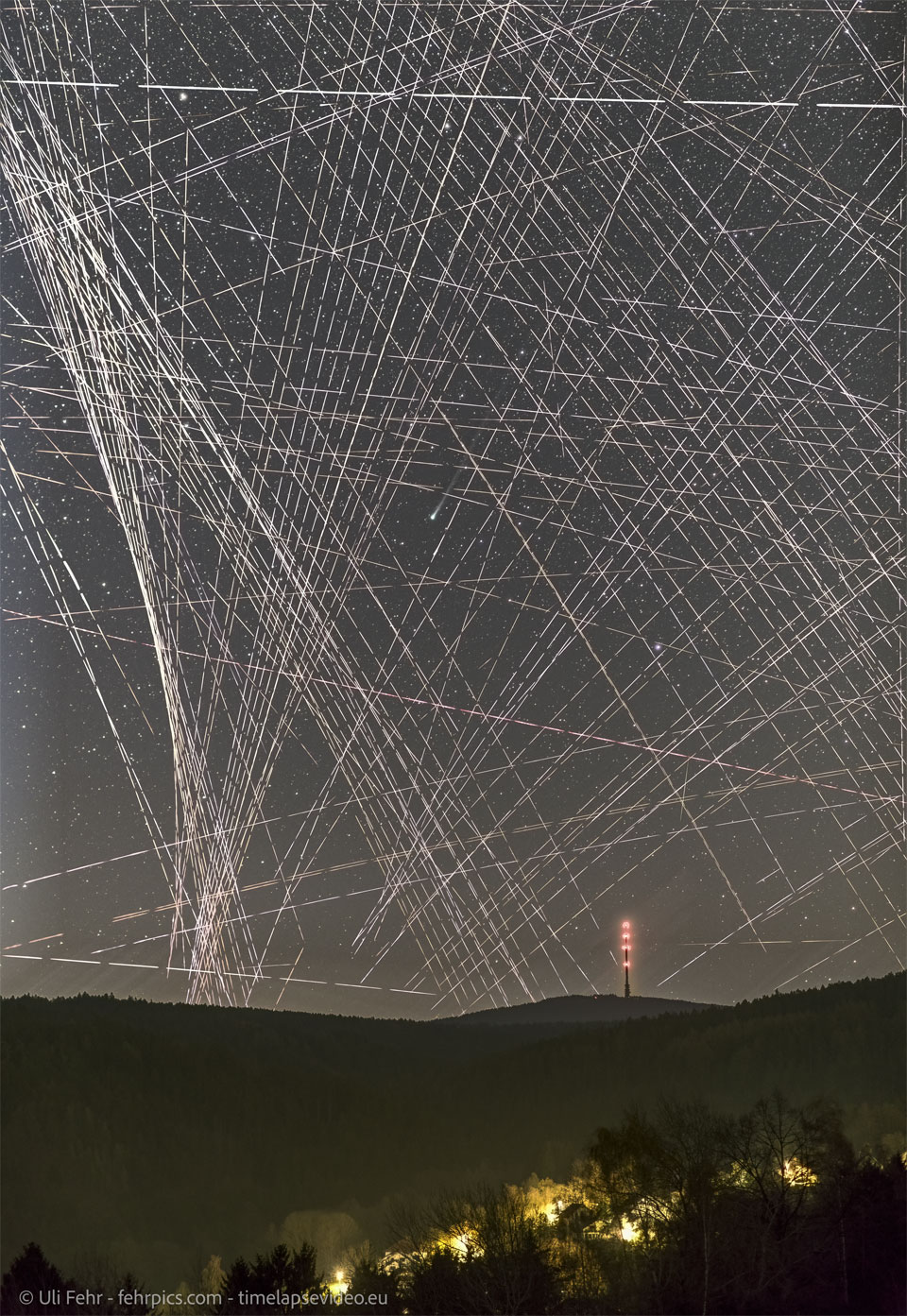
Can you find the comet? Somewhere through this web of satellite trails is Comet C/2025 R3 (PanSTARRS), a bright visitor passing through the inner Solar System. Now, the orbiting satellites themselves only appear as streaks because of the long camera exposure, over 10 minutes in this case. On the contrary, to the eye, satellites appear as points that drift slowly across the night sky and shine by reflecting sunlight -- primarily just after sunset and before sunrise. The featured image was taken just before sunrise two weeks ago from Bavaria, Germany. Presently, Comet R3 PanSTARRS is hard to see for even another reason -- because it is so (angularly) close to the Sun. As the comet rounds the Sun, it will be best seen in coming weeks from southern hemispheree skies, although then it will be heading out to interstellar space and fading. If you haven't yet found the comet, don't despair; please take a closer look just above the image center.

https://apod.nasa.gov/apod/ap260427.html ( April 26, 2026 at 08:00PM)