Sunday, March 31, 2024


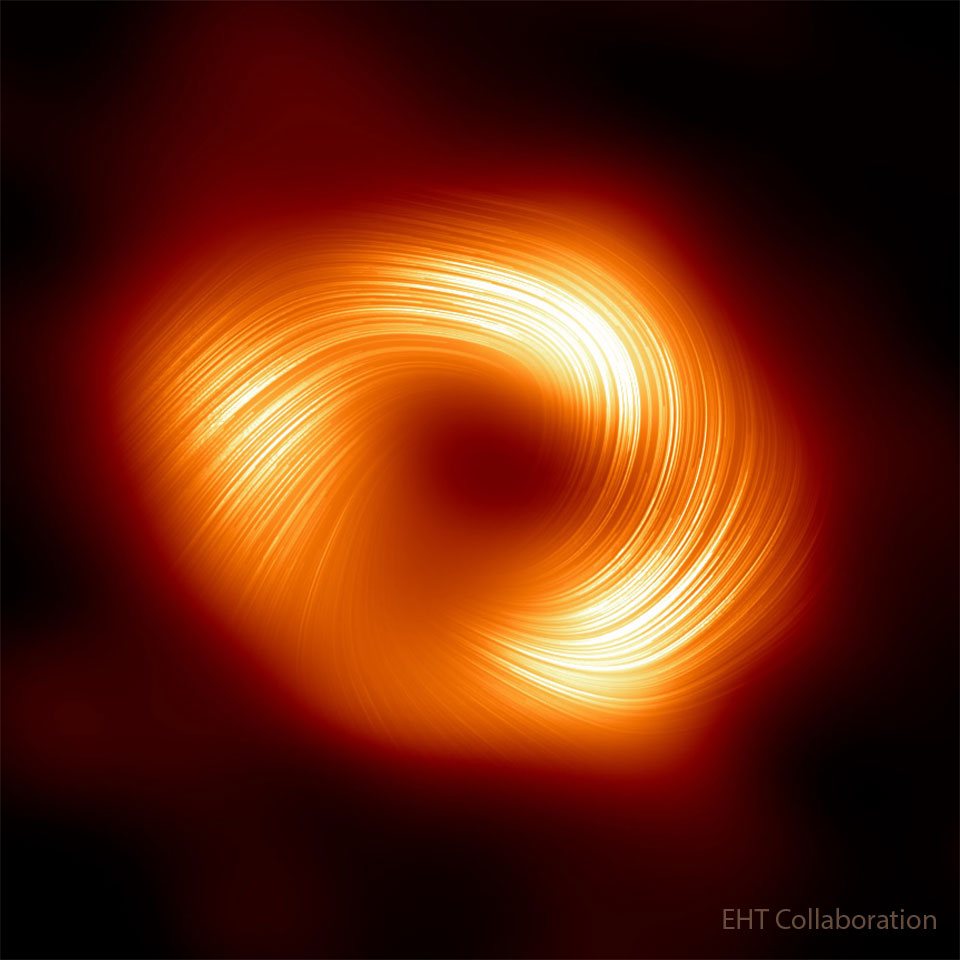
What's happening to the big black hole in the center of our galaxy? It is sucking in matter from a swirling disk -- a disk that is magnetized, it has now been confirmed. Specifically, the black hole's accretion disk has recently been seen to emit polarized light, radiation frequently associated with a magnetized source. Pictured here is a close-up of Sgr A*, our Galaxy's central black hole, taken by radio telescopes around the world participating in the Event Horizon Telescope (EHT) Collaboration. Superposed are illustrative curved lines indicating polarized light likely emitted from swirling magnetized gas that will soon fall into the 4+ million mass central black hole. The central part of this image is likely dark because little light-emitting gas is visible between us and the dark event horizon of the black hole. Continued EHT monitoring of this and M87's central black hole may yield new clues about the gravity of black holes and how infalling matter creates disks and jets.

https://apod.nasa.gov/apod/ap240401.html ( April 01, 2024)

Saturday, March 30, 2024


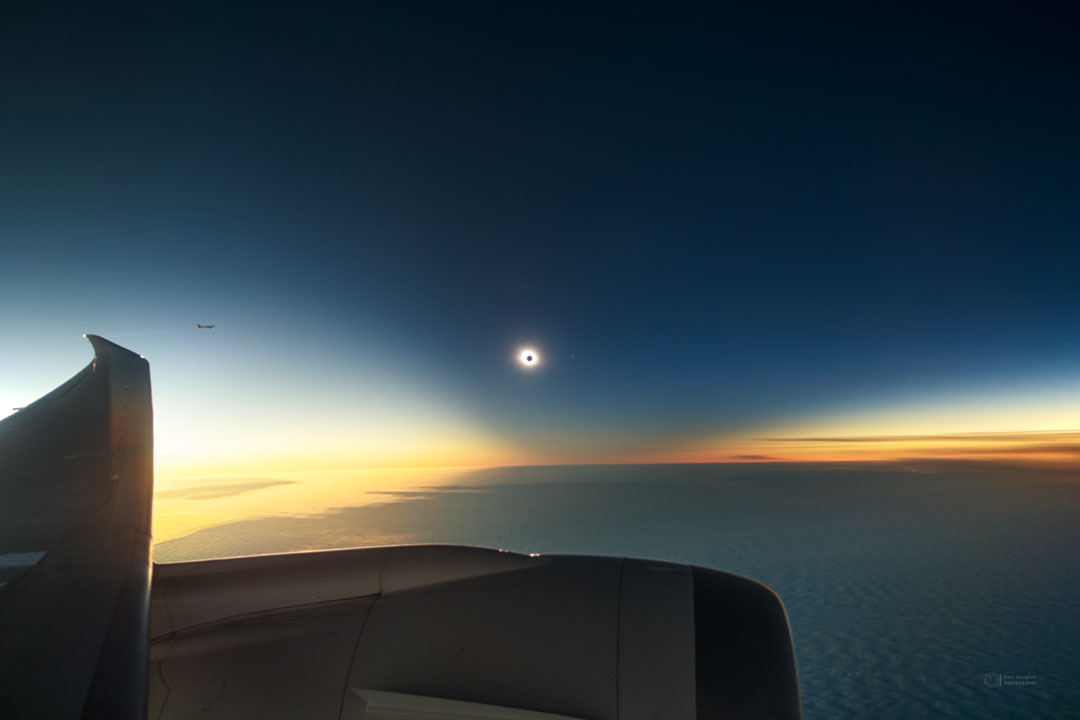
In late 2021 there was a total solar eclipse visible only at the end of the Earth. To capture the unusual phenomenon, airplanes took flight below the clouded seascape of Southern Ocean. The featured image shows one relatively spectacular capture where the bright spot is the outer corona of the Sun and the eclipsing Moon is seen as the dark spot in the center. A wing and engine of the airplane are visible across the left and bottom of the image, while another airplane observing the eclipse is visible on the far left. The dark area of the sky surrounding the eclipsed Sun is called a shadow cone. It is dark because you are looking down a long corridor of air shadowed by the Moon. A careful inspection of the eclipsed Sun will reveal the planet Mercury just to the right. You won't have to travel to the end of the Earth to see the next total solar eclipse. The total eclipse path will cross North America on 2024 April 8, just over one week from today.

https://apod.nasa.gov/apod/ap240331.html ( March 31, 2024)

Friday, March 29, 2024

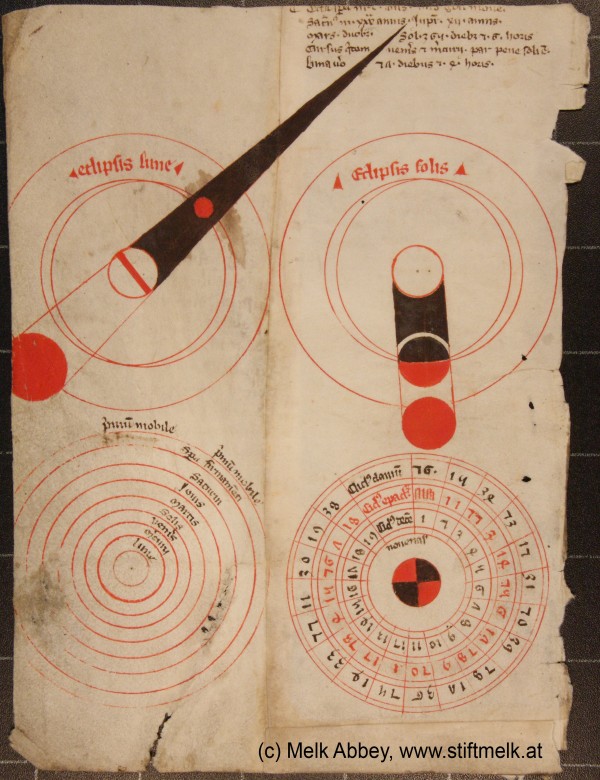
Medieval Astronomy from Melk Abbey


Discovered by accident, this manuscript page provides graphical insight to astronomy in medieval times, before the Renaissance and the influence of Nicolaus Copernicus, Tycho de Brahe, Johannes Kepler, and Galileo. The intriguing page is from lecture notes on astronomy compiled by the monk Magister Wolfgang de Styria before the year 1490. The top panels clearly illustrate the necessary geometry for a lunar (left) and solar eclipse in the Earth-centered Ptolemaic system. At lower left is a diagram of the Ptolemaic view of the Solar System with text at the upper right to explain the movement of the planets according to Ptolemy's geocentric model. At the lower right is a chart to calculate the date of Easter Sunday in the Julian calendar. The illustrated manuscript page was found at historic Melk Abbey in Austria.

https://apod.nasa.gov/apod/ap240330.html ( March 30, 2024)

ISS Daily Summary Report – 3/29/2024

iss-about-banner


Payloads: ADSEP-PIL-02: Fluid Loops were replaced on Modules A, B and C. In-Space Production Application – Pharmaceutical In-space Laboratory – 02 (InSPA-PIL-02) (ADSEP-PIL-02) aims to study the effect of microgravity on the production of various types of crystals. Understanding the effect of microgravity on these crystals may have important applications for research and development of … ...

March 29, 2024 at 12:00PM
From NASA: https://blogs.nasa.gov/stationreport/2024/03/29/iss-daily-summary-report-3-29-2024/

ISS Daily Summary Report – 3/28/2024

iss-about-banner


Payloads: Complement of Integrated Protocols for Human Exploration Research on Varying Mission Durations (CIPHER): The CIPHER investigation aims to improve our understanding of physiological and psychological changes in humans on missions that range from weeks to one year in duration. Conducting the same research over missions of different durations allows scientists to extrapolate the data … ...

March 28, 2024 at 12:00PM
From NASA: https://blogs.nasa.gov/stationreport/2024/03/28/iss-daily-summary-report-3-28-2024/

Thursday, March 28, 2024

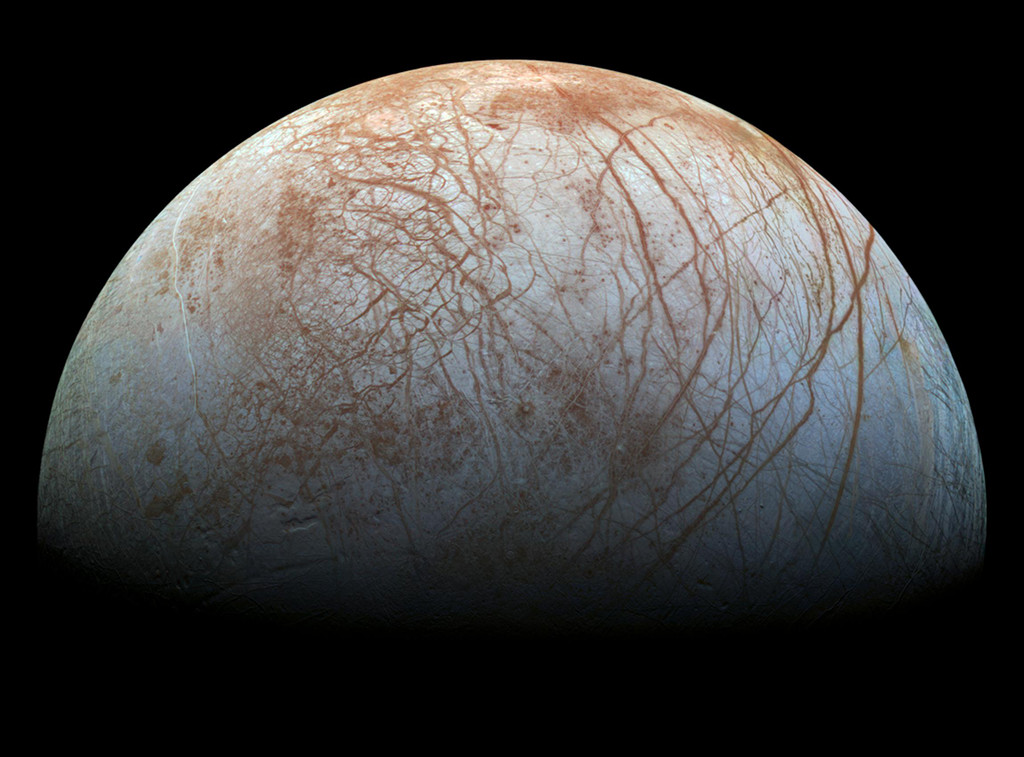
Galileo s Europa


Looping through the Jovian system in the late 1990s, the Galileo spacecraft recorded stunning views of Europa and uncovered evidence that the moon's icy surface likely hides a deep, global ocean. Galileo's Europa image data has been remastered here, with improved calibrations to produce a color image approximating what the human eye might see. Europa's long curving fractures hint at the subsurface liquid water. The tidal flexing the large moon experiences in its elliptical orbit around Jupiter supplies the energy to keep the ocean liquid. But more tantalizing is the possibility that even in the absence of sunlight that process could also supply the energy to support life, making Europa one of the best places to look for life beyond Earth. The Juno spacecraft currently in Jovian orbit has also made repeated flybys of the water world, returning images along with data exploring Europa's habitability. This October will see the launch of the NASA's Europa Clipper on a voyage of exploration. The spacecraft will make nearly 50 flybys, approaching to within 25 kilometers of Europa's icy surface.

https://apod.nasa.gov/apod/ap240329.html ( March 29, 2024)

ISS Daily Summary Report – 3/27/2024

iss-about-banner


Payloads: Complement of Integrated Protocols for Human Exploration Research on Varying Mission Durations (CIPHER): The crew performed the doff and closeout of the Blood Pressure 13-hour data collection sequence and stowed the hardware. The 48hour BioMonitor data collection was concluded and the hardware was doffed and stowed. Optical Tomography was also performed a subject. The … ...

March 27, 2024 at 12:00PM
From NASA: https://blogs.nasa.gov/stationreport/2024/03/27/iss-daily-summary-report-3-27-2024/

Wednesday, March 27, 2024

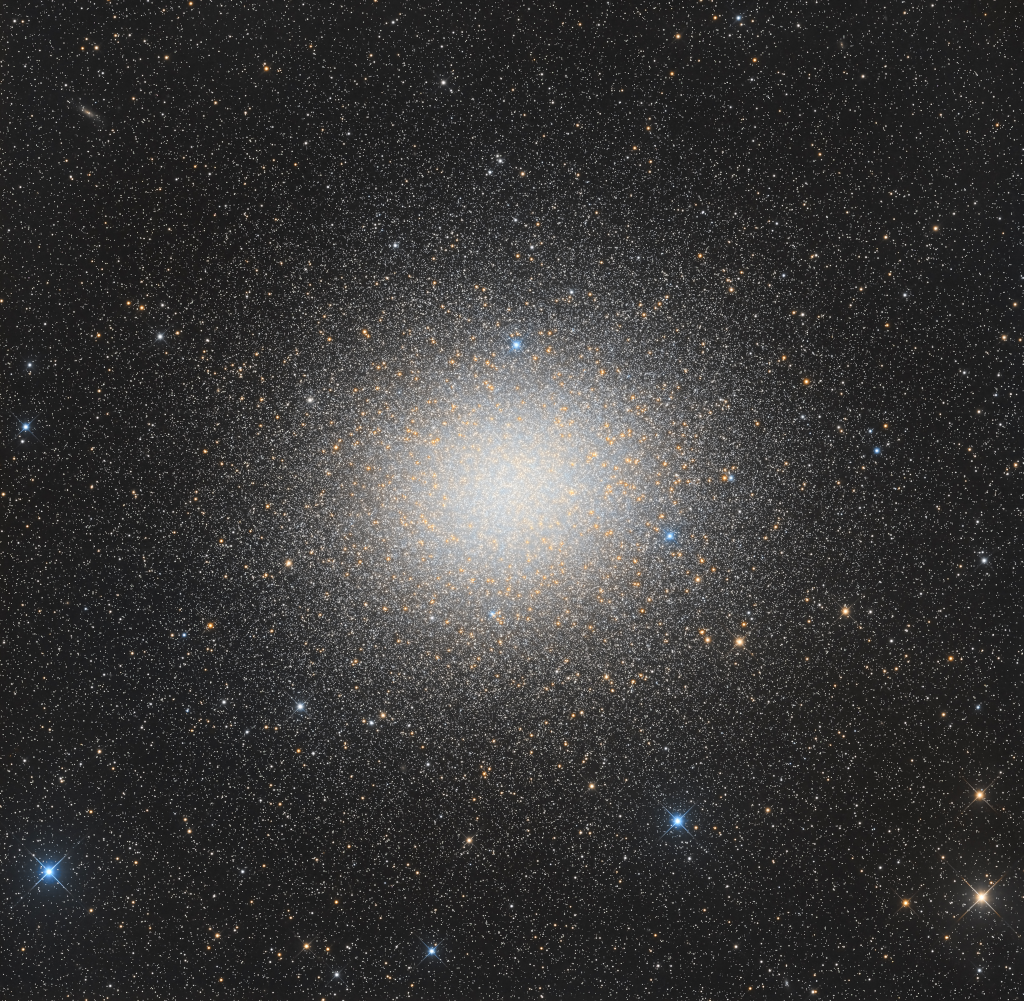
Millions of Stars in Omega Centauri


Globular star cluster Omega Centauri, also known as NGC 5139, is 15,000 light-years away. The cluster is packed with about 10 million stars much older than the Sun within a volume about 150 light-years in diameter. It's the largest and brightest of 200 or so known globular clusters that roam the halo of our Milky Way galaxy. Though most star clusters consist of stars with the same age and composition, the enigmatic Omega Cen exhibits the presence of different stellar populations with a spread of ages and chemical abundances. In fact, Omega Cen may be the remnant core of a small galaxy merging with the Milky Way. With a yellowish hue, Omega Centauri's red giant stars are easy to pick out in this sharp, color telescopic view.

https://apod.nasa.gov/apod/ap240328.html ( March 28, 2024)

ISS Daily Summary Report – 3/26/2024

iss-about-banner


Payloads: ADvanced Space Experiment Processor-2 (ADSEP-2): A fluid replacement was performed on Modules B and C. The ADSEP-2 is an automated multipurpose facility with three independent thermal zones that accommodate one cassette each and an internal computer that controls the functions of the cassettes. Cassettes house and process samples for a variety of biological and … ...

March 26, 2024 at 12:00PM
From NASA: https://blogs.nasa.gov/stationreport/2024/03/26/iss-daily-summary-report-3-26-2024/

Tuesday, March 26, 2024


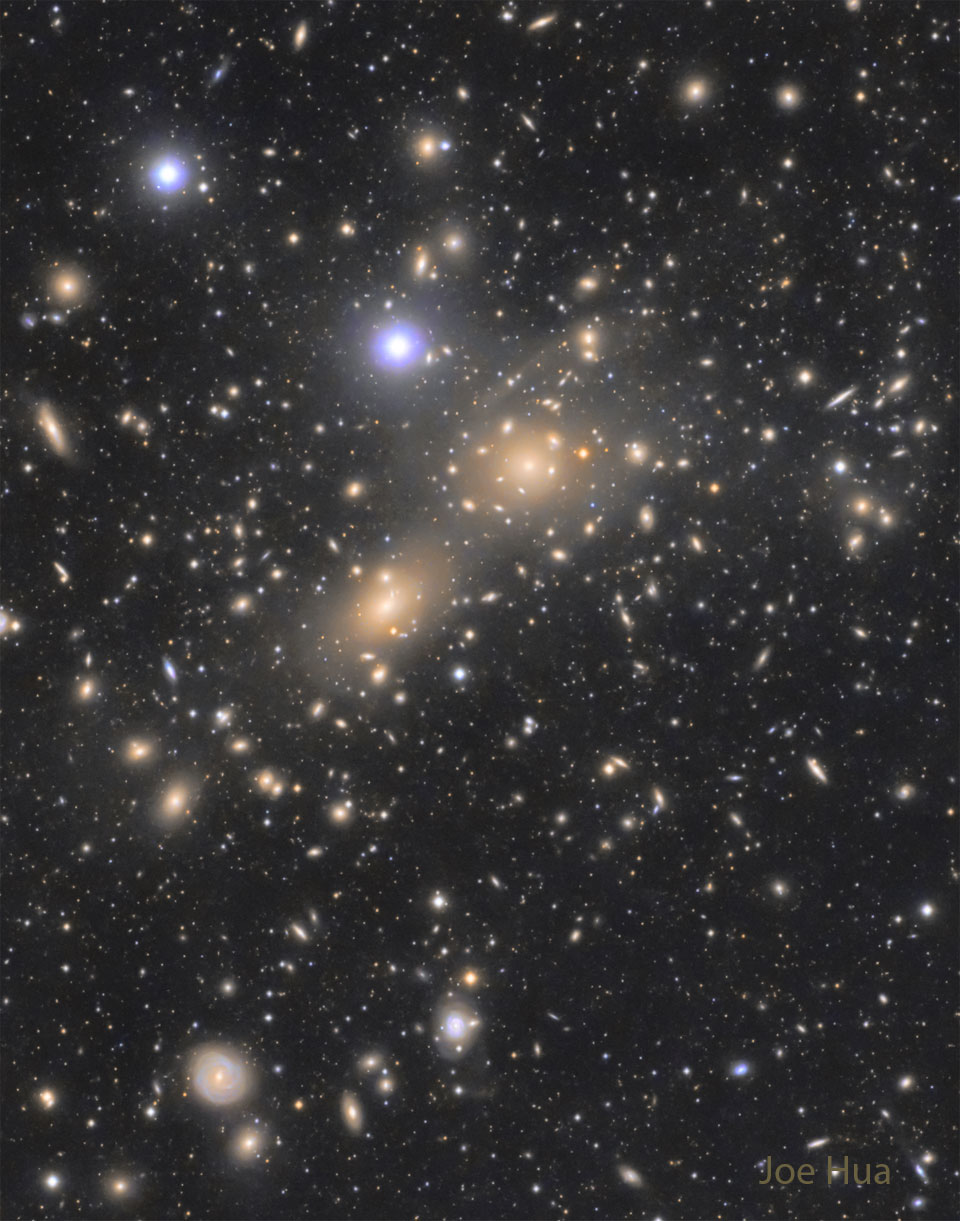
Almost every object in the featured photograph is a galaxy. The Coma Cluster of Galaxies pictured here is one of the densest clusters known - it contains thousands of galaxies. Each of these galaxies houses billions of stars - just as our own Milky Way Galaxy does. Although nearby when compared to most other clusters, light from the Coma Cluster still takes hundreds of millions of years to reach us. In fact, the Coma Cluster is so big it takes light millions of years just to go from one side to the other. Most galaxies in Coma and other clusters are ellipticals, while most galaxies outside of clusters are spirals. The nature of Coma's X-ray emission is still being investigated.

https://apod.nasa.gov/apod/ap240327.html ( March 27, 2024)