Wednesday, January 31, 2024

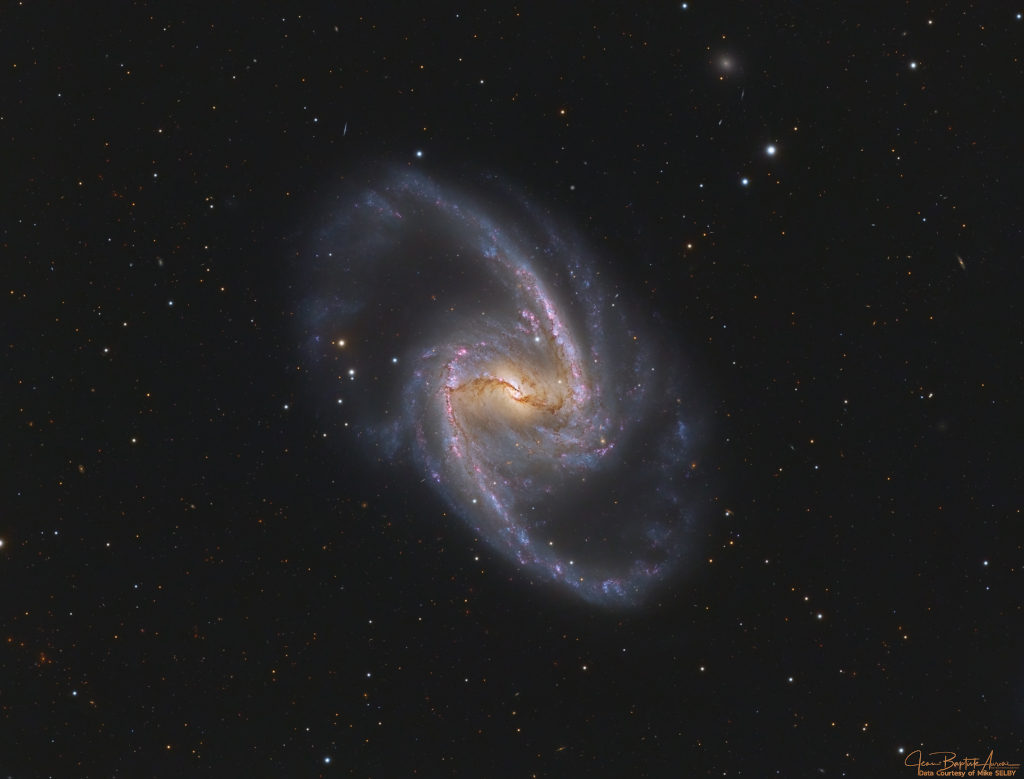
NGC 1365: Majestic Island Universe


Barred spiral galaxy NGC 1365 is truly a majestic island universe some 200,000 light-years across. Located a mere 60 million light-years away toward the faint but heated constellation Fornax, NGC 1365 is a dominant member of the well-studied Fornax Cluster of galaxies. This sharp color image shows the intense, reddish star forming regions near the ends of the galaxy's central bar and along its spiral arms. Seen in fine detail, obscuring dust lanes cut across the galaxy's bright core. At the core lies a supermassive black hole. Astronomers think NGC 1365's prominent bar plays a crucial role in the galaxy's evolution, drawing gas and dust into a star-forming maelstrom and ultimately feeding material into the central black hole.

https://apod.nasa.gov/apod/ap240201.html ( February 01, 2024)

ISS Daily Summary Report – 1/30/2024

iss-about-banner


Cygnus NG-20 Launch: The Cygnus NG-20 cargo vehicle launched today, January 30th, at 11:07 AM CST, and is planned to be captured and berthed to the ISS on Thursday, February 1st, at 3:20 AM CT and 7:40 AM CT respectively. Cygnus will be berthed to the Node 1 Nadir port and will deliver more than … ...

January 30, 2024 at 11:00AM
From NASA: https://blogs.nasa.gov/stationreport/2024/01/30/iss-daily-summary-report-1-30-2024/

Tuesday, January 30, 2024


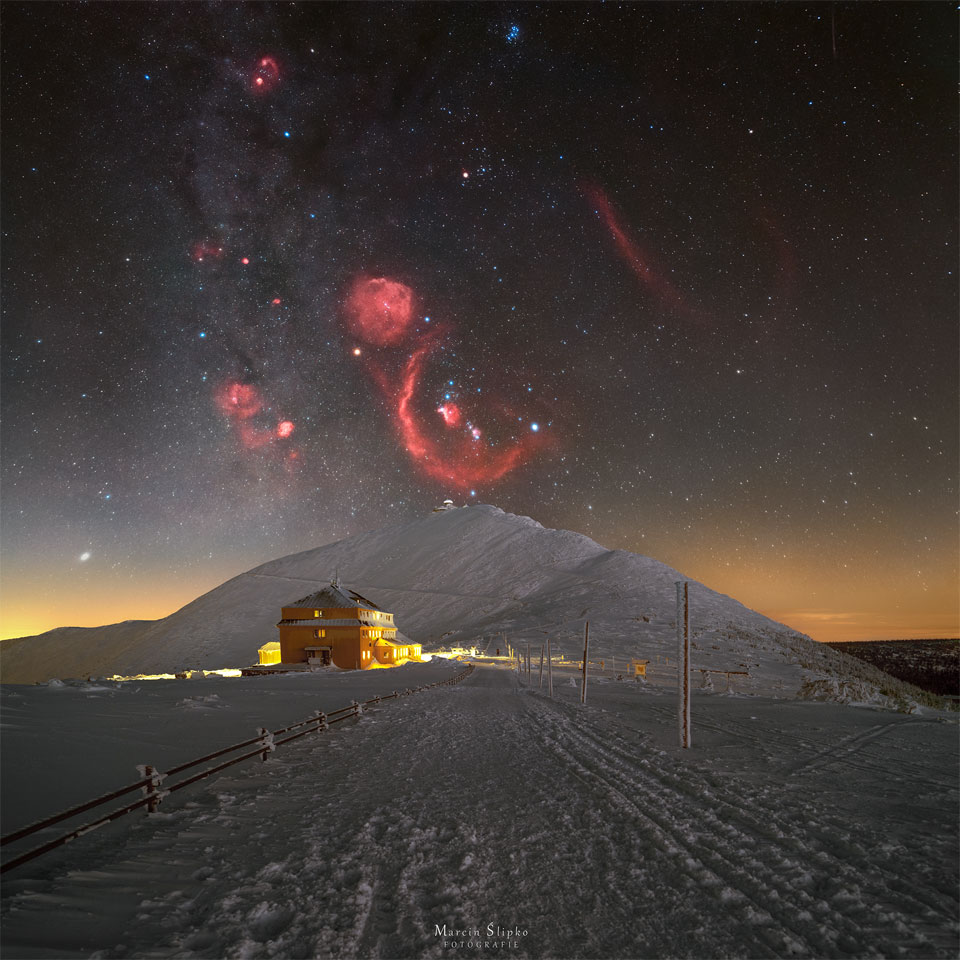
What does Orion rising look like to a camera? During this time of the year, the famous constellation is visible to the southeast just after sunset. From most Earthly locations, Orion's familiar star pattern, highlighted by the three-stars-in-a-row belt stars, rises sideways. An entire section of the night sky that includes Orion was photographed rising above Śnieżka, a mountain on the border between Poland and the Czech Republic. The long duration exposure sequence brings up many faint features including the Orion and Flame Nebulas, both encompassed by the curving Barnard's Loop. The featured wide-angle camera composite also captured night sky icons including the blue Pleiades star cluster at the image top and the red Rosette Nebula to the left of Orion. Famous stars in the frame include Sirius, Betelgeuse, Rigel and Aldebaran. Orion will appear successively higher in the sky at sunset during the coming months.

https://apod.nasa.gov/apod/ap240131.html ( January 31, 2024)

Monday, January 29, 2024


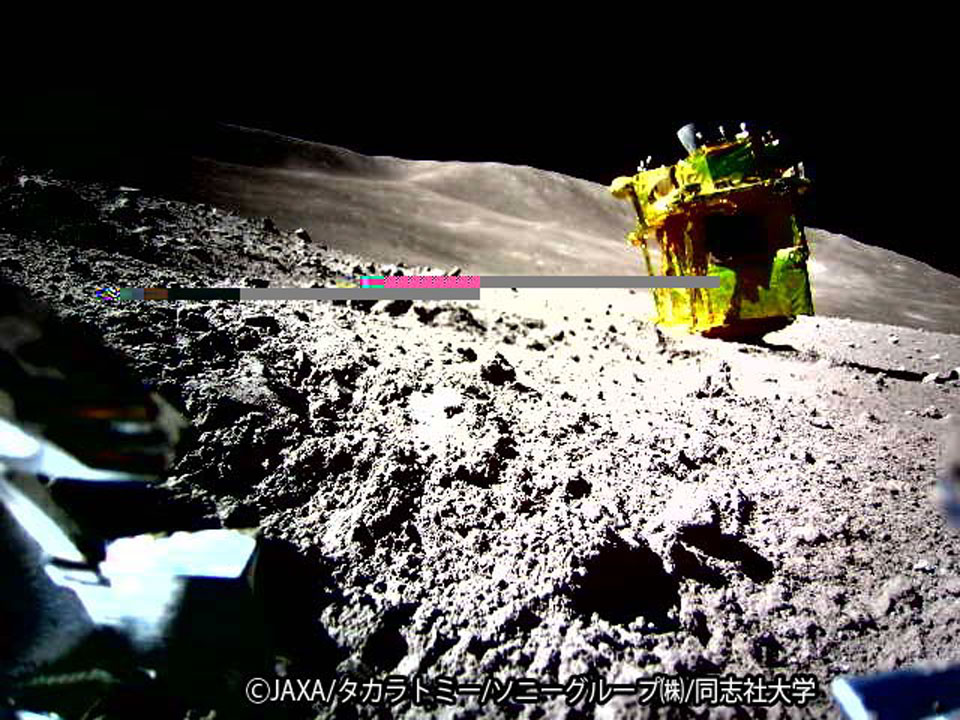
New landers are on the Moon. Nearly two weeks ago, Japan's Smart Lander for Investigating Moon (SLIM) released two rovers as it descended, before its main lander touched down itself. The larger of the two rovers can hop like a frog, while the smaller rover is about the size of a baseball and can move after pulling itself apart like a transformer. The main lander, nicknamed Moon Sniper, is seen in the featured image taken by the smaller rover. Inspection of the image shows that Moon Sniper's thrusters are facing up, meaning that the lander is upside down from its descent configuration and on its side from its intended landing configuration. One result is that Moon Sniper's solar panels are not in the expected orientation, so that powering the lander had to be curtailed and adapted. SLIM's lander has already succeeded as a technology demonstration, its main mission, but was not designed to withstand the lunar night -- which starts tomorrow.

https://apod.nasa.gov/apod/ap240130.html ( January 30, 2024)

Sunday, January 28, 2024


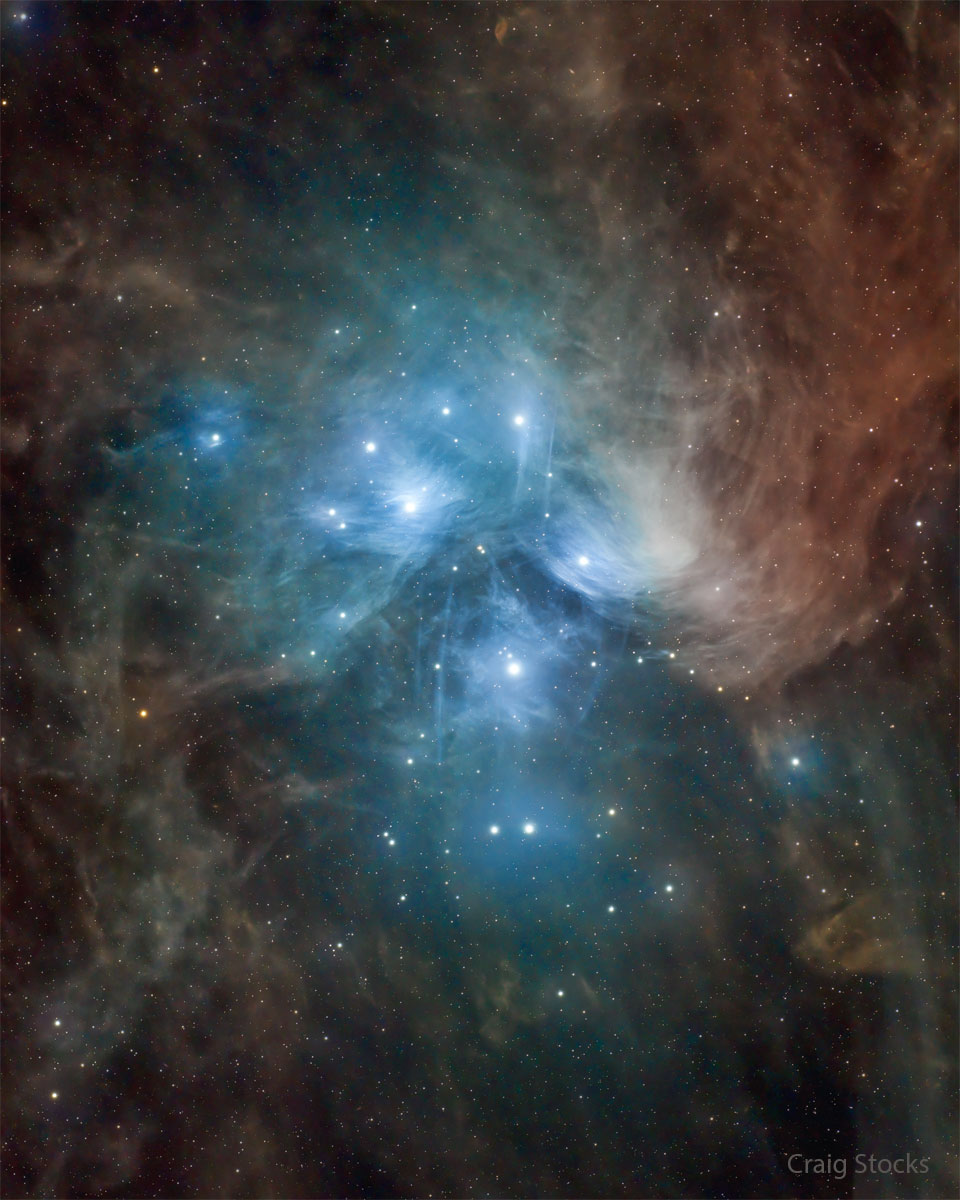
The well-known Pleiades star cluster is slowly destroying part of a passing cloud of gas and dust. The Pleiades is the brightest open cluster of stars on Earth's sky and can be seen from almost any northerly location with the unaided eye. Over the past 100,000 years, a field of gas and dust is moving by chance right through the Pleiades star cluster and is causing a strong reaction between the stars and dust. The passing cloud might be part of the Radcliffe wave, a newly discovered structure of gas and dust connecting several regions of star formation in the nearby part of our Milky Way galaxy. Pressure from the stars' light significantly repels the dust in the surrounding blue reflection nebula, with smaller dust particles being repelled more strongly. A short-term result is that parts of the dust cloud have become filamentary and stratified. The featured deep image incorporates nearly 9 hours of exposure and was captured from Utah Desert Remote Observatory in Utah, USA, last year.

https://apod.nasa.gov/apod/ap240129.html ( January 29, 2024)

Saturday, January 27, 2024


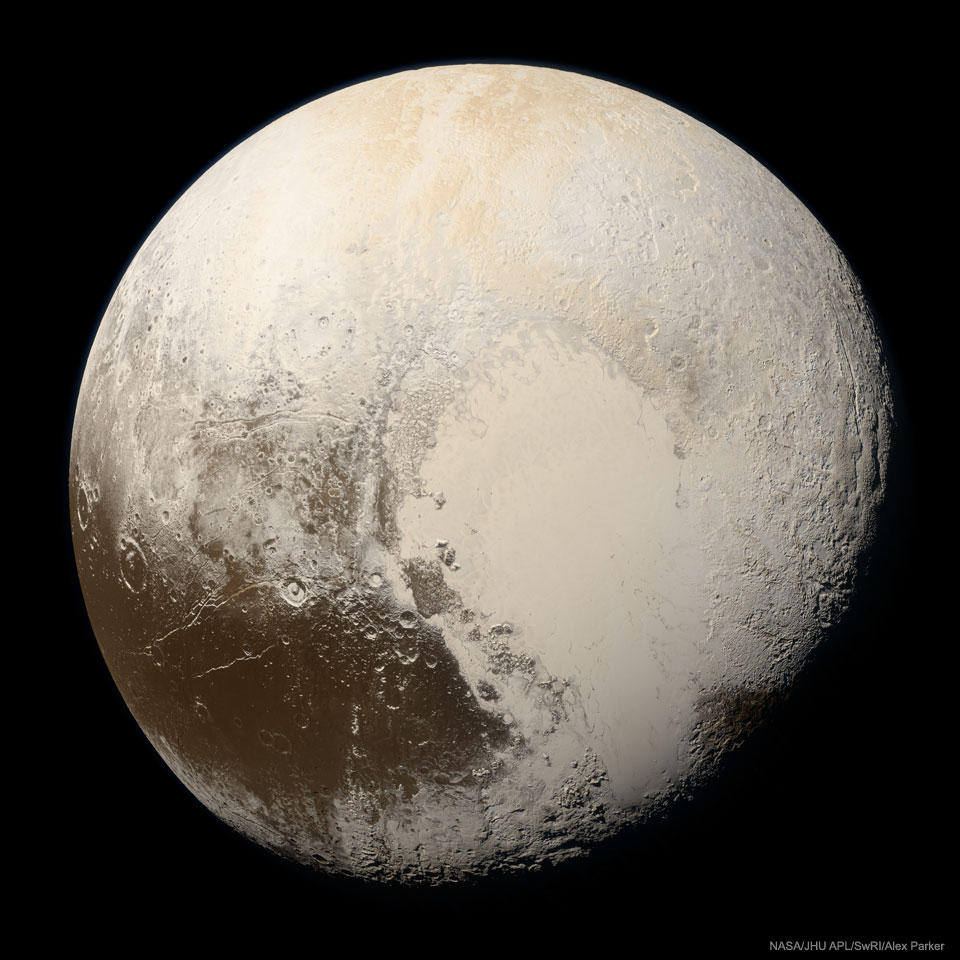
What color is Pluto, really? It took some effort to figure out. Even given all of the images sent back to Earth when the robotic New Horizons spacecraft sped past Pluto in 2015, processing these multi-spectral frames to approximate what the human eye would see was challenging. The result featured here, released three years after the raw data was acquired by New Horizons, is the highest resolution true color image of Pluto ever taken. Visible in the image is the light-colored, heart-shaped, Tombaugh Regio, with the unexpectedly smooth Sputnik Planitia, made of frozen nitrogen, filling its western lobe. New Horizons found the dwarf planet to have a surprisingly complex surface composed of many regions having perceptibly different hues. In total, though, Pluto is mostly brown, with much of its muted color originating from small amounts of surface methane energized by ultraviolet light from the Sun.

https://apod.nasa.gov/apod/ap240128.html ( January 28, 2024)

Friday, January 26, 2024

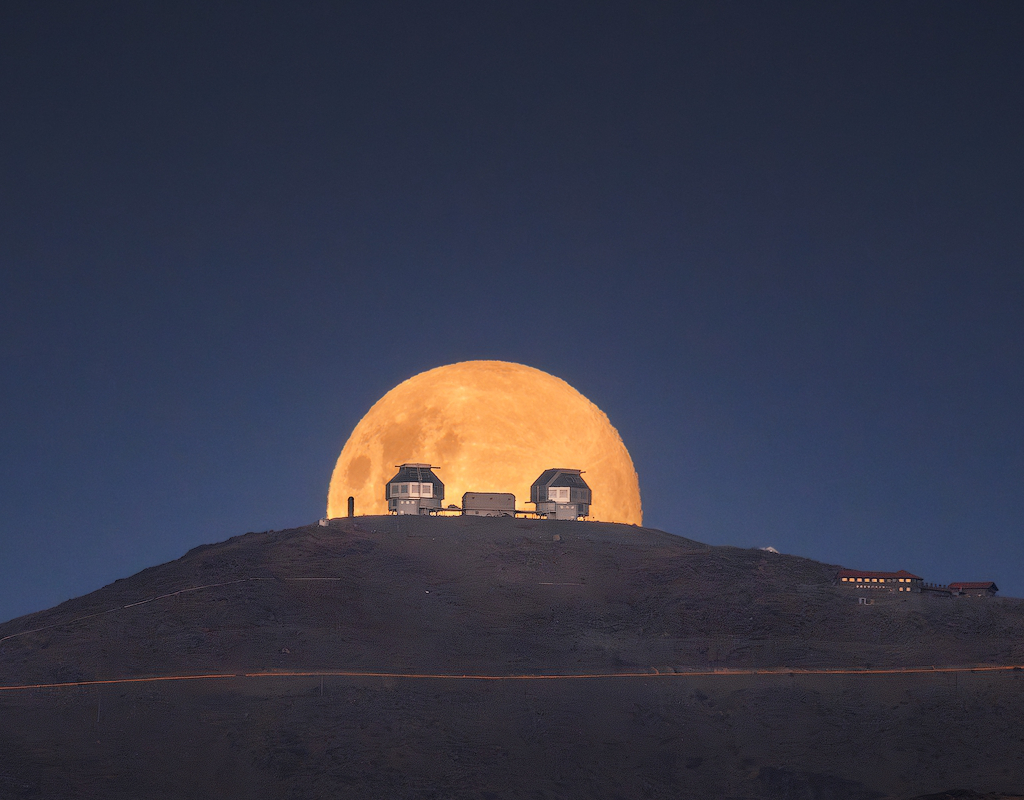
Full Observatory Moon


A popular name for January's full moon in the northern hemisphere is the Full Wolf Moon. As the new year's first full moon, it rises over Las Campanas Observatory in this dramatic Earth-and-moonscape. Peering from the foreground like astronomical eyes are the observatory's twin 6.5 meter diameter Magellan telescopes. The snapshot was captured with telephoto lens across rugged terrain in the Chilean Atacama Desert, taken at a distance of about 9 miles from the observatory and about 240,000 miles from the lunar surface. Of course the first full moon of the lunar new year, known to some as the Full Snow Moon, will rise on February 24.

https://apod.nasa.gov/apod/ap240127.html ( January 27, 2024)

Thursday, January 25, 2024

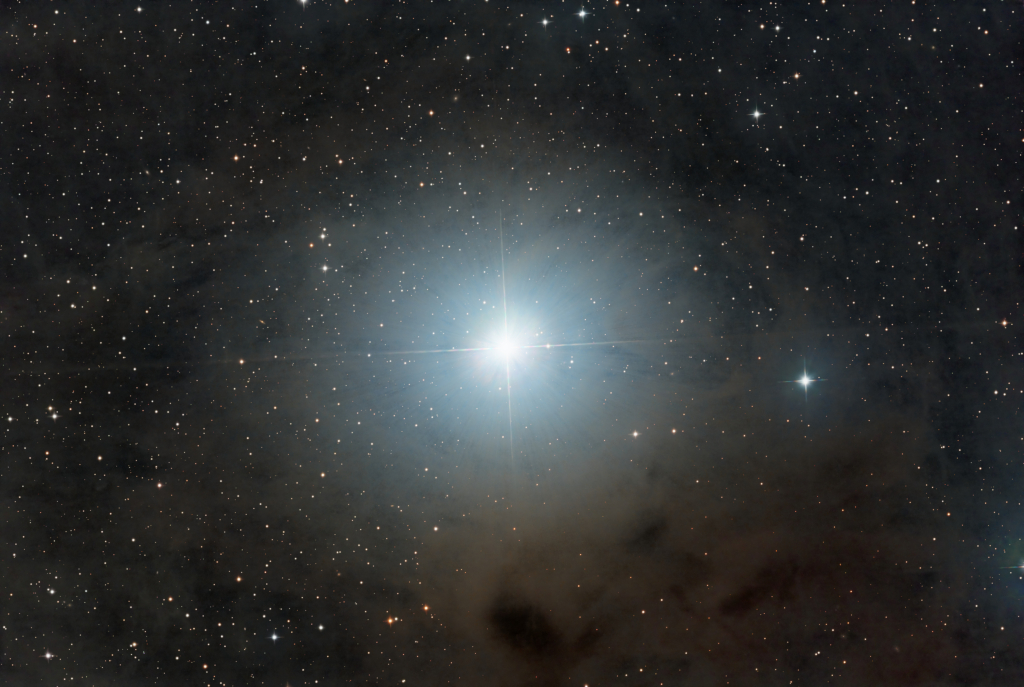
Epsilon Tauri: Star with Planet


Epsilon Tauri lies 146 light-years away. A K-type red giant star, epsilon Tau is cooler than the Sun, but with about 13 times the solar radius it has nearly 100 times the solar luminosity. A member of the Hyades open star cluster the giant star is known by the proper name Ain, and along with brighter giant star Aldebaran, forms the eyes of Taurus the Bull. Surrounded by dusty, dark clouds in Taurus, epsilon Tau is also known to have a planet. Discovered by radial velocity measurements in 2006, Epsilon Tauri b is a gas giant planet larger than Jupiter with an orbital period of 1.6 years. And though the exoplanet can't be seen directly, on a dark night its parent star epsilon Tauri is easily visible to the unaided eye.

https://apod.nasa.gov/apod/ap240126.html ( January 26, 2024)

Wednesday, January 24, 2024

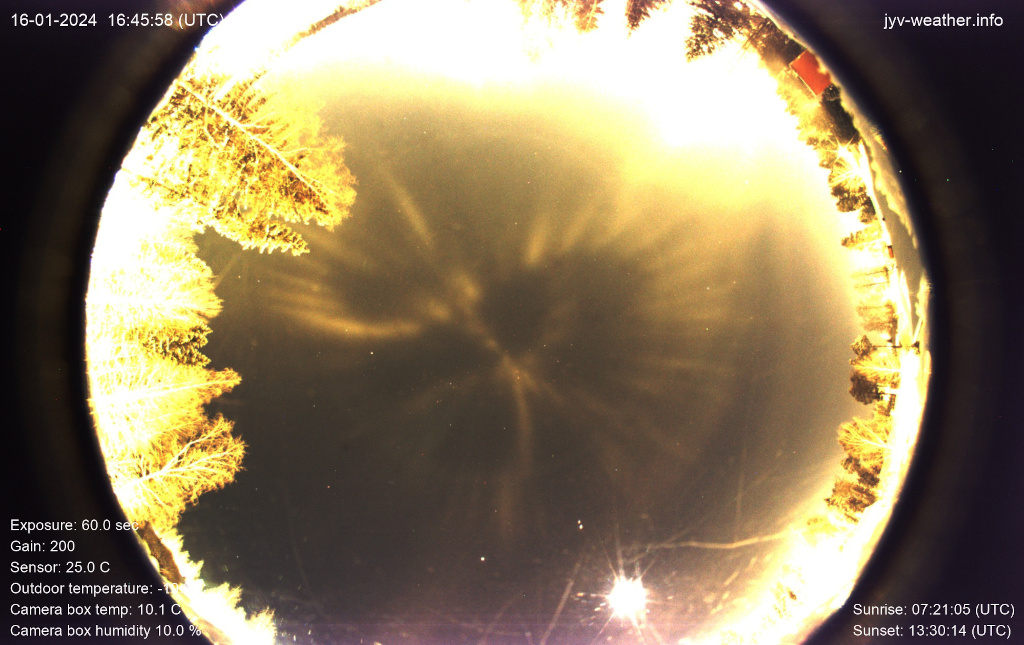
Jyväskylä in the Sky


You might not immediately recognize this street map of a neighborhood in Jyväskylä, Finland, planet Earth. But that's probably because the map was projected into the night sky and captured with an allsky camera on January 16. The temperature recorded on that northern winter night was around minus 20 degrees Celsius. As ice crystals formed in the atmosphere overhead, street lights spilling illumination into the sky above produced visible light pillars, their ethereal appearance due to specular reflections from the fluttering crystals' flat surfaces. Of course, the projected light pillars trace a map of the brightly lit local streets, though reversed right to left in the upward looking camera's view. This light pillar street map was seen to hover for hours in the Jyväskylä night.

https://apod.nasa.gov/apod/ap240125.html ( January 25, 2024)

ISS Daily Summary Report – 1/23/2024

iss-about-banner


Private Astronaut Mission (PAM) Axiom 3: Outreach and Payload Activities: Three ESA sponsored Ice Cube events were completed today, including a joint event for Marcus Wandt and ISS Commander Andy Mogensen with the European Space Conference.  Additional outreach events included a live event with a Swedish Newspaper, Aftonbladet, and an event between Michael López-Alegría and … ...

January 23, 2024 at 11:00AM
From NASA: https://blogs.nasa.gov/stationreport/2024/01/23/iss-daily-summary-report-1-23-2024/