Tuesday, September 6, 2022

Tarantula Stars R136 from Webb


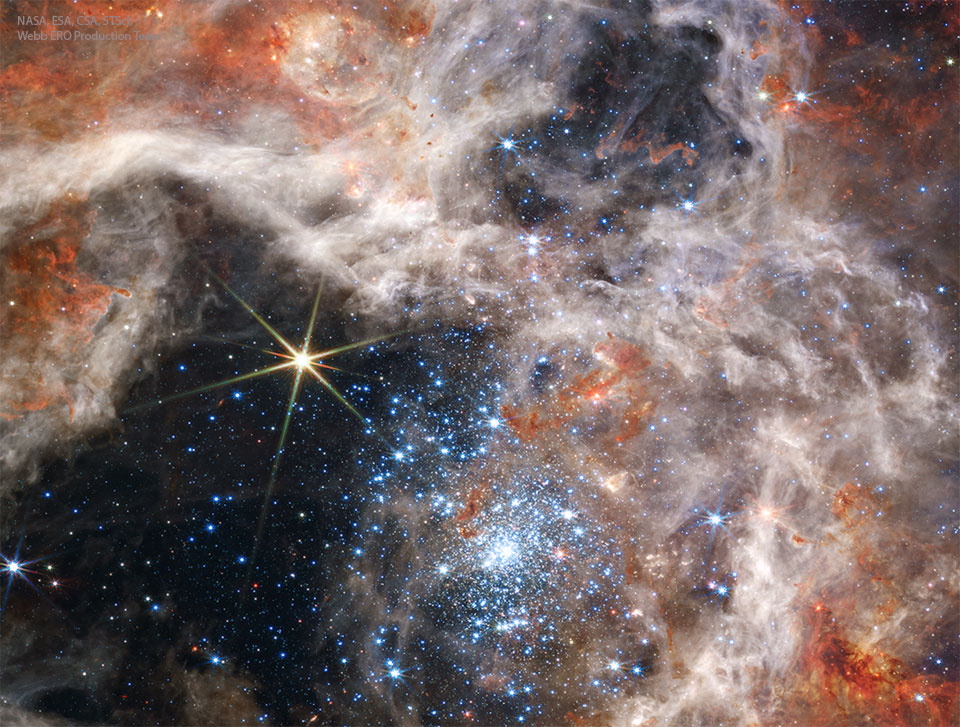
Near the center of a nearby star-forming region lies a massive cluster containing some of the largest and hottest stars known. Collectively known as star cluster NGC 2070, these stars are part of the vast Tarantula Nebula and were captured in two kinds of infrared light by the new Webb Space Telescope. The main image shows the group of stars at NGC 2070's center -- known as R136 -- in near-infrared, light just a bit too red for humans to see. In contrast, the rollover image captures the cluster center in mid-infrared light, light closer to radio waves. Since R136's brightest stars emit more of their light in the near infrared, they are much more prominent on that image. This LMC cluster's massive stars emit particle winds and energetic light that are evaporating the gas cloud from which they formed. The Webb images, released yesterday, shows details of R136 and its surroundings that have never been seen before, details that are helping humanity to better understanding of how all stars are born, evolve and die.

https://apod.nasa.gov/apod/ap220907.html ( September 07, 2022)

A Cosmic Tarantula, Caught by NASA’s Webb


from NASA http://www.nasa.gov/feature/goddard/2022/a-cosmic-tarantula-caught-by-nasa-s-webb
via IFTTT

Monday, September 5, 2022

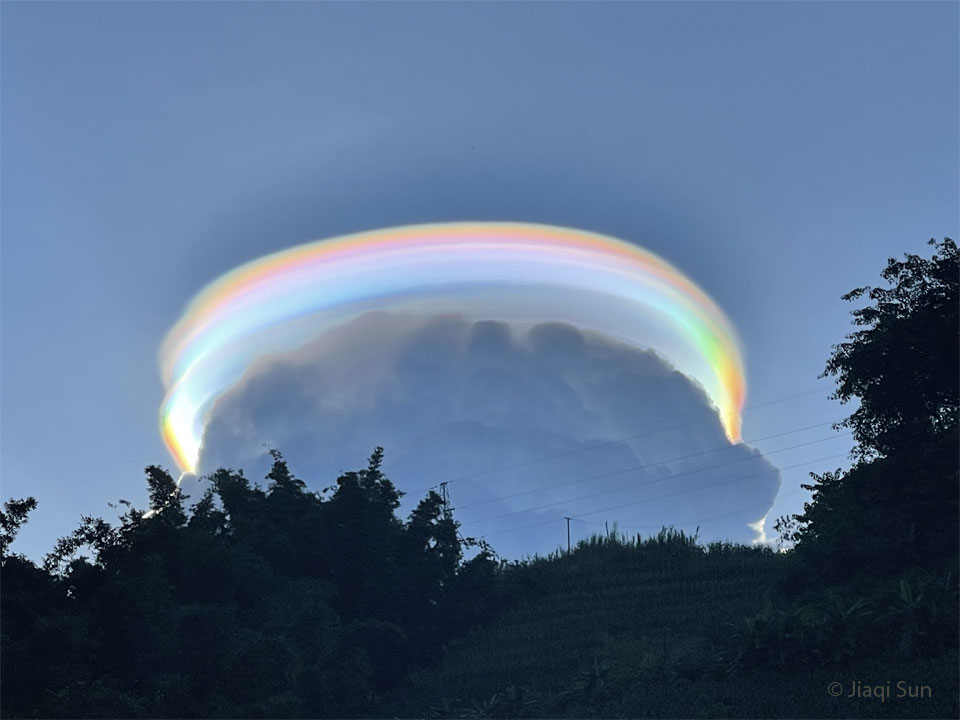
An Iridescent Pileus Cloud over China


Yes, but how many dark clouds have a multicolored lining? Pictured, behind this darker cloud, is a pileus iridescent cloud, a group of water droplets that have a uniformly similar size and so together diffract different colors of sunlight by different amounts. The featured image was taken last month in Pu'er, Yunnan Province, China. Also captured were unusual cloud ripples above the pileus cloud. The formation of a rare pileus cloud capping a common cumulus cloud is an indication that the lower cloud is expanding upward and might well develop into a storm.

https://apod.nasa.gov/apod/ap220906.html ( September 06, 2022)

Sunday, September 4, 2022

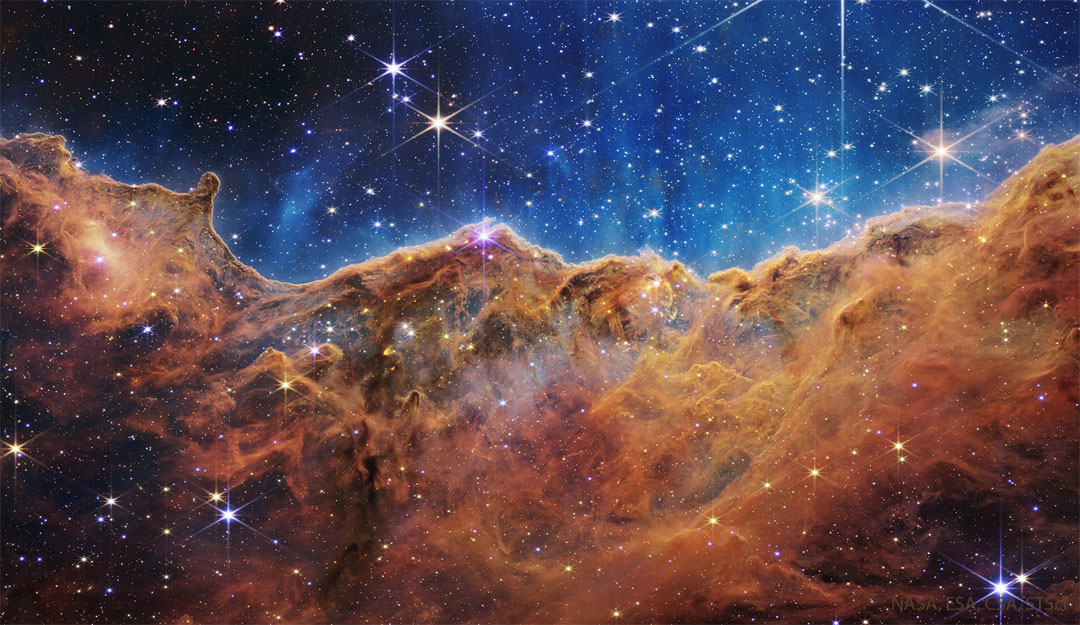
Carina Cliffs from the Webb Space Telescope


Stars created these cliffs. Specifically, the destructive winds and energetic light from the stars in the open cluster NGC 3324 eroded away part of a mountain of dark interstellar dust in the northern part of the Carina Nebula. Several of these stars are visible toward the top of this highly detailed image taken recently by the James Webb Space Telescope, the largest astronomical telescope ever launched. Webb's large mirror and ability to see dust-piercing infrared light has enabled it to capture fascinating details in the dust, hundreds of previously hidden stars, and even some galaxies far in the distance. The featured jagged cliffs occur in part of Carina known as the Gabriela Mistral Nebula -- because when viewed in another orientation, they appear similar to the facial profile of the famous Chilean poet. These nebular cliffs occur about 7,600 light years away toward the southern constellation of Carina.

https://apod.nasa.gov/apod/ap220905.html ( September 05, 2022)

Saturday, September 3, 2022

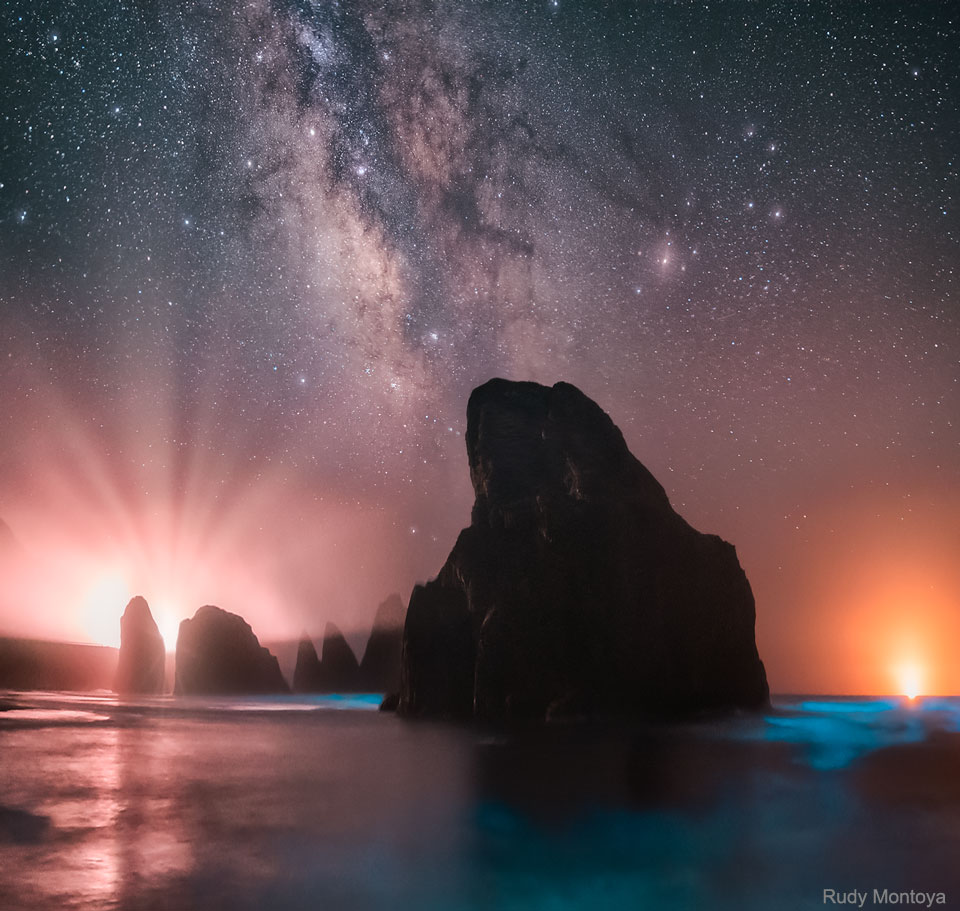
Sea and Sky Glows over the Oregon Coast


Every step caused the sand to light up blue. That glow was bioluminescence -- a blue radiance that also lights the surf in this surreal scene captured in mid-2018 at Meyer's Creek Beach in Oregon, USA. Volcanic stacks dot the foreground sea, while a thin fog layer scatters light on the horizon. The rays of light spreading from the left horizon were created by car headlights on the Oregon Coast Highway (US 101), while the orange light on the right horizon emanates from a fishing boat. Visible far in the distance is the band of our Milky Way Galaxy, appearing to rise from a dark rocky outcrop. Sixteen images were added together to bring up the background Milky Way and to reduce noise.

https://apod.nasa.gov/apod/ap220904.html ( September 04, 2022)

Friday, September 2, 2022

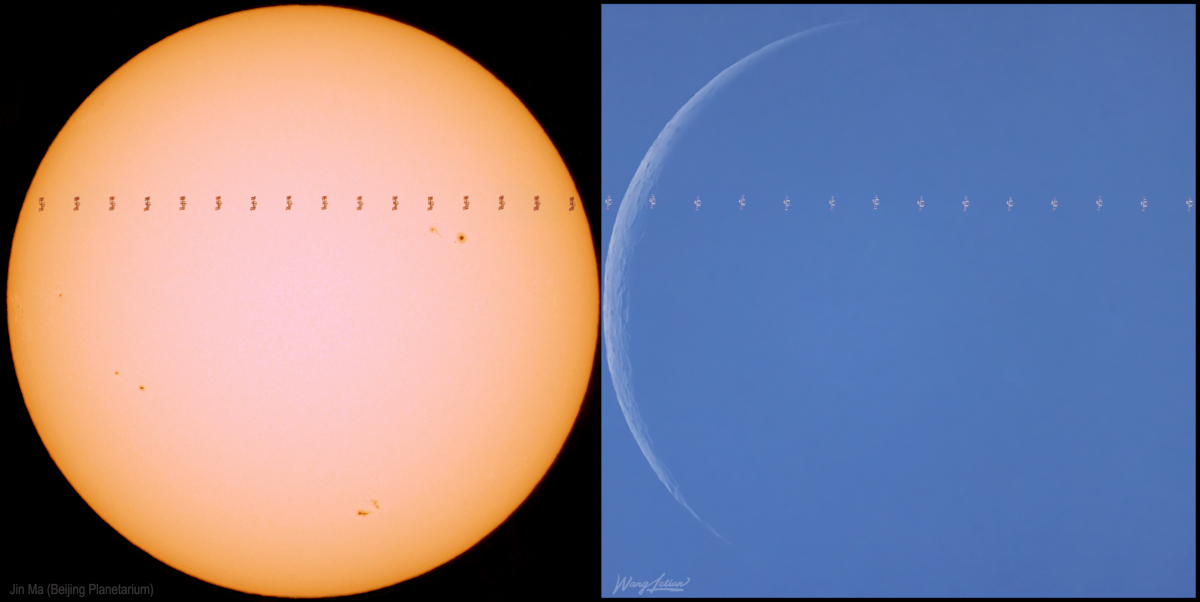
Sun and Moon and ISS


On August 25 Sun and Moon could both be seen in planet Earth's daytime skies. And so could the International Space Station. The ISS crossed the disk of the waning crescent Moon as seen from Shunyi district, Beijing, China at about 11:02 am local time. Some 40 kilometers to the southwest, in Fengtai district, the ISS was seen to cross the Sun's disk too. The solar transit was observed only 29 seconds later. Both transits are compared in these panels, composed of processed and stacked video frames from the two locations. The coordinated captures were made with different equipment, but adjusted to show the Sun and Moon at the same scale. The ISS was at a calculated range of 435 kilometers for the lunar transit and 491 kilometers when passing in front of the Sun.

https://apod.nasa.gov/apod/ap220903.html ( September 03, 2022)

ISS Daily Summary Report – 9/01/2022

iss-about-banner


Payloads: Nutrition Monitoring for the ISS (NutrISS): The crew performed an ESA Nutritional Assessment (ENA) in support of the NutrISS investigation. Long-duration spaceflight induces relevant changes in body composition and a loss of body mass. In the NutrISS investigation, a periodic assessment of body composition (body weight, fat mass, and fat-free mass) during spaceflight aboard … ...

September 01, 2022 at 12:00PM
From NASA: https://blogs.nasa.gov/stationreport/2022/09/01/iss-daily-summary-report-9-01-2022/

The Crater Farm


Three impact craters are displayed in this three-dimensional perspective view of the surface of Venus taken NASA's Magellan, the first deep space probe launched by a space shuttle.

from NASA http://www.nasa.gov/image-feature/the-crater-farm
via IFTTT

Thursday, September 1, 2022

M51: The Whirlpool Galaxy


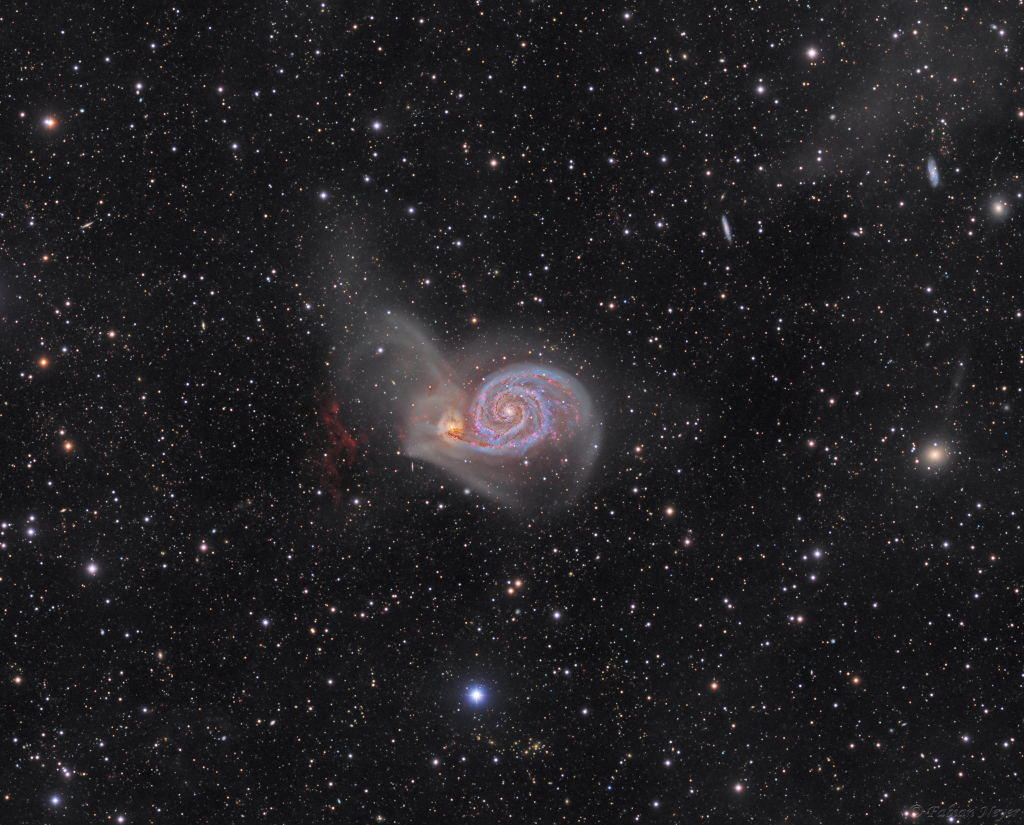
Find the Big Dipper and follow the handle away from the dipper's bowl until you get to the last bright star. Then, just slide your telescope a little south and west and you'll come upon this stunning pair of interacting galaxies, the 51st entry in Charles Messier's famous catalog. Perhaps the original spiral nebula, the large galaxy with well defined spiral structure is also cataloged as NGC 5194. Its spiral arms and dust lanes clearly sweep in front of its companion galaxy (left), NGC 5195. The pair are about 31 million light-years distant and officially lie within the angular boundaries of the small constellation Canes Venatici. In direct telescopic views, M51 looks faint and fuzzy to the eye. But this remarkably deep image shows off details of the interacting galaxy's striking colors and galactic tidal debris. The image includes nearly 90 hours of narrowband data that also reveals a vast glowing cloud of reddish ionized hydrogen gas discovered in the M51 system.

https://apod.nasa.gov/apod/ap220902.html ( September 02, 2022)

ISS Daily Summary Report – 8/31/2022

iss-about-banner


Payloads: eXposed Root On-Orbit Test System (XROOTS): The crew performed a manual fluid recovery and refilled the plant nutrient solution as needed. They also performed a plant check with the goal of reporting plant growth, as well as any algae or microbial growth that may be present. The XROOTS investigation uses hydroponic and aeroponic techniques … ...

August 31, 2022 at 12:00PM
From NASA: https://blogs.nasa.gov/stationreport/2022/08/31/iss-daily-summary-report-8-31-2022/