Thursday, May 5, 2022

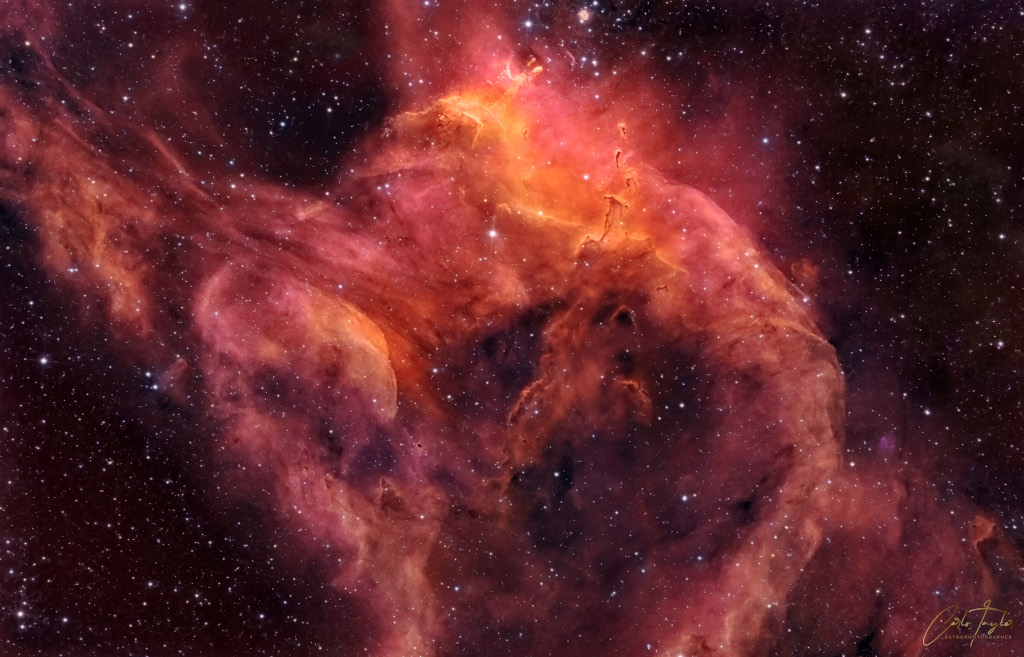
NGC 3572 and the Southern Tadpoles


This cosmic skyscape features glowing gas and dark dust clouds along side the young stars of NGC 3572. A beautiful emission nebula and star cluster it sails far southern skies within the nautical constellation Carina. Stars from NGC 3572 are toward top center in the telescopic frame that would measure about 100 light-years across at the cluster's estimated distance of 9,000 light-years. The visible interstellar gas and dust is part of the star cluster's natal molecular cloud. Dense streamers of material within the nebula, eroded by stellar winds and radiation, clearly trail away from the energetic young stars. They are likely sites of ongoing star formation with shapes reminiscent of the Tadpoles of IC 410 better known to northern skygazers. In the coming tens to hundreds of millions of years, gas and stars in the cluster will be dispersed though, by gravitational tides and by violent supernova explosions that end the short lives of the massive cluster stars.

https://apod.nasa.gov/apod/ap220506.html ( May 06, 2022)

ISS Daily Summary Report – 5/04/2022

iss-about-banner


Payloads: Myotones: The crew performed skin marking on the designated experiment target areas and took measurements using the Myotones device. The Muscle Tone in Space (Myotones) investigation observes the biochemical properties of muscles (e.g. muscle tone, stiffness, elasticity) during long-term exposure spaceflight environment. Results from this investigation can provide a better understanding of the principles … ...

May 04, 2022 at 12:00PM
From NASA: https://blogs.nasa.gov/stationreport/2022/05/04/iss-daily-summary-report-5-04-2022/

Crew-3 on the Way Home Aboard SpaceX Dragon Endurance


Dragon

from NASA http://www.nasa.gov/image-feature/crew-3-on-the-way-home-aboard-spacex-dragon-endurance
via IFTTT

Wednesday, May 4, 2022

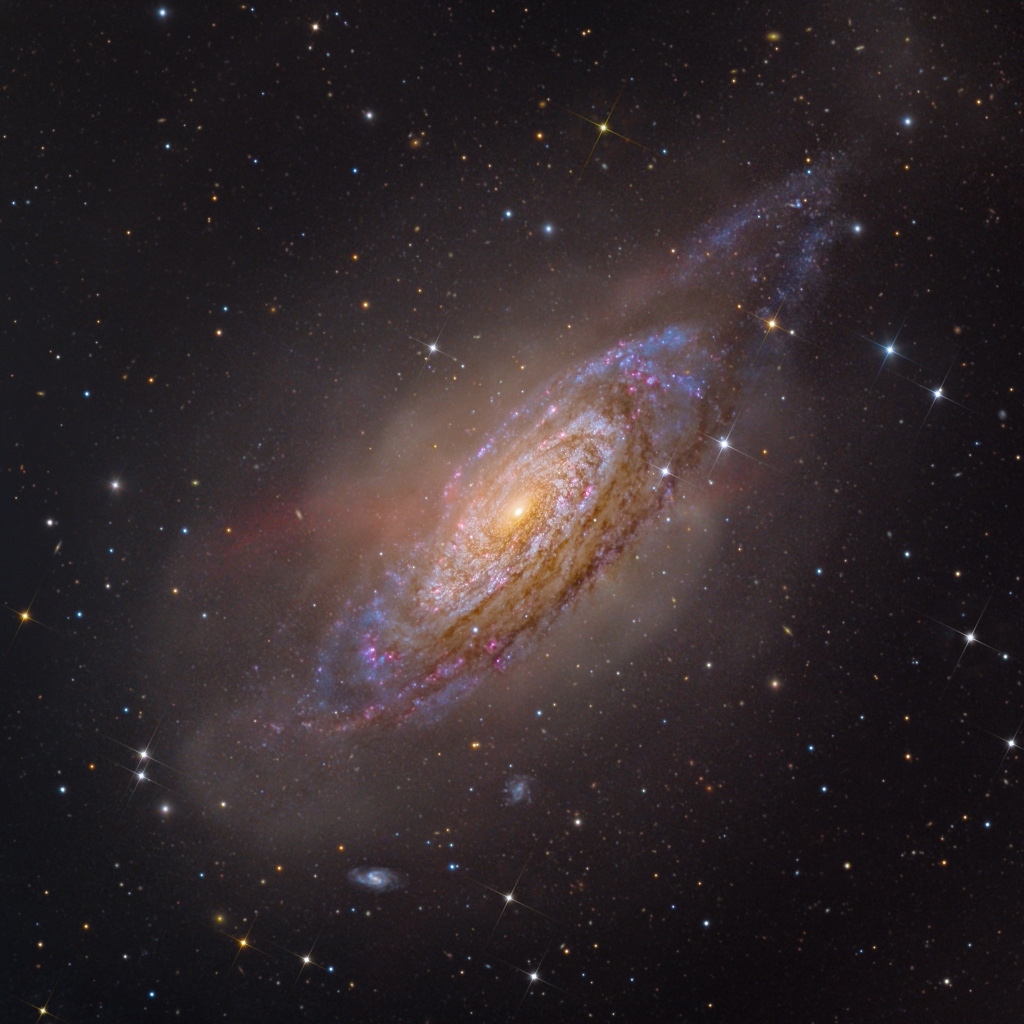
NGC 3521: Galaxy in a Bubble


Gorgeous spiral galaxy NGC 3521 is a mere 35 million light-years away, toward the northern springtime constellation Leo. Relatively bright in planet Earth's sky, NGC 3521 is easily visible in small telescopes but often overlooked by amateur imagers in favor of other Leo spiral galaxies, like M66 and M65. It's hard to overlook in this colorful cosmic portrait though. Spanning some 50,000 light-years the galaxy sports characteristic patchy, irregular spiral arms laced with dust, pink star forming regions, and clusters of young, blue stars. This deep image also finds NGC 3521 embedded in fainter, gigantic, bubble-like shells. The shells are likely tidal debris, streams of stars torn from satellite galaxies that have undergone mergers with NGC 3521 in the distant past.

https://apod.nasa.gov/apod/ap220505.html ( May 05, 2022)

ISS Daily Summary Report – 5/03/2022

iss-about-banner


Payloads: Behavioral Core Measures (BCM): The crew performed two BCM research sessions consisting of a set of 12 runs/tests each.  The Standardized Behavioral Measures for Detecting Behavioral Health Risks during Exploration Missions (Behavioral Core Measures) experiment initially examined a suite of measurements to reliably assess the risk of adverse cognitive or behavioral conditions and psychiatric disorders … ...

May 03, 2022 at 12:00PM
From NASA: https://blogs.nasa.gov/stationreport/2022/05/03/iss-daily-summary-report-5-03-2022/

Black Holes Are Hard to Find


Black holes are hard to find. They have such strong gravity that light can’t escape them, so scientists must rely on clues from their surroundings to find them.

from NASA http://www.nasa.gov/image-feature/black-holes-are-hard-to-find
via IFTTT

Tuesday, May 3, 2022

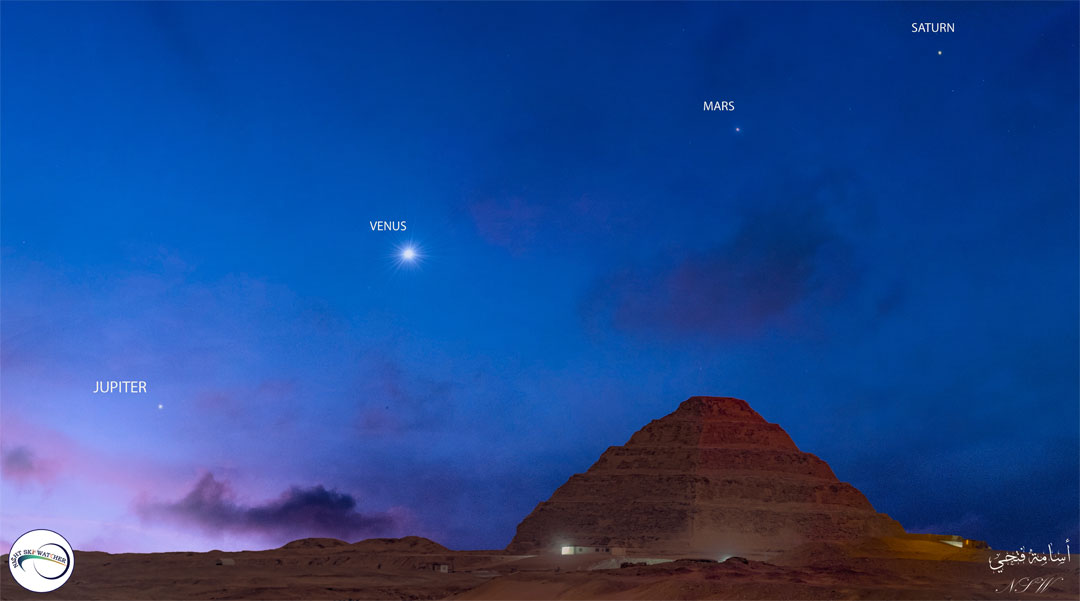
Planets Over Egyptian Pyramid


The early morning planet parade continues. Visible the world over, the planets Jupiter, Venus, Mars and Saturn have been lining up in the pre-dawn sky since mid-April. In the featured image taken last month, these planets were captured over the Step Pyramid of Djoser, a UNESCO World Heritage Site. Located in the Saqqara necropolis of Egypt, the pyramid was constructed in the 27th century BC and is one of the oldest pyramids known. The two-image composite includes a foreground image taken during evening blue hour, and a background image captured from the same location the following morning. The morning planet line-up is slowly changing. At the end of last month, planets Jupiter and Venus switched places, while at the end of this month, Jupiter and Mars will switch after passing within one-degree of each other. Of course, this picturesque planetary angular alignment is a coincidence, as all of these worlds continue to orbit the Sun as they have for billions of years, well before even the ancient Pyramid of Djoser was built.

https://apod.nasa.gov/apod/ap220504.html ( May 04, 2022)

ISS Daily Summary Report – 5/02/2022

iss-about-banner


Payloads: Cold Atom Lab (CAL): A crewmember performed a visual inspection of the CAL Moderate Temperature Loop (MTL) Jumper to check for leaks and reported the observed leakage. The MTL Jumper has been experiencing a small leak and periodic crew monitoring has been implemented while the ground assesses future remediation options. The CAL produces clouds … ...

May 02, 2022 at 12:00PM
From NASA: https://blogs.nasa.gov/stationreport/2022/05/02/iss-daily-summary-report-5-02-2022/

NASA Celebrates Teachers!


May 2-6, 2022, is Teacher Appreciation Week! At NASA, we know the importance of STEM (science, technology, engineering, and math) education.

from NASA http://www.nasa.gov/image-feature/nasa-celebrates-teachers
via IFTTT

Monday, May 2, 2022

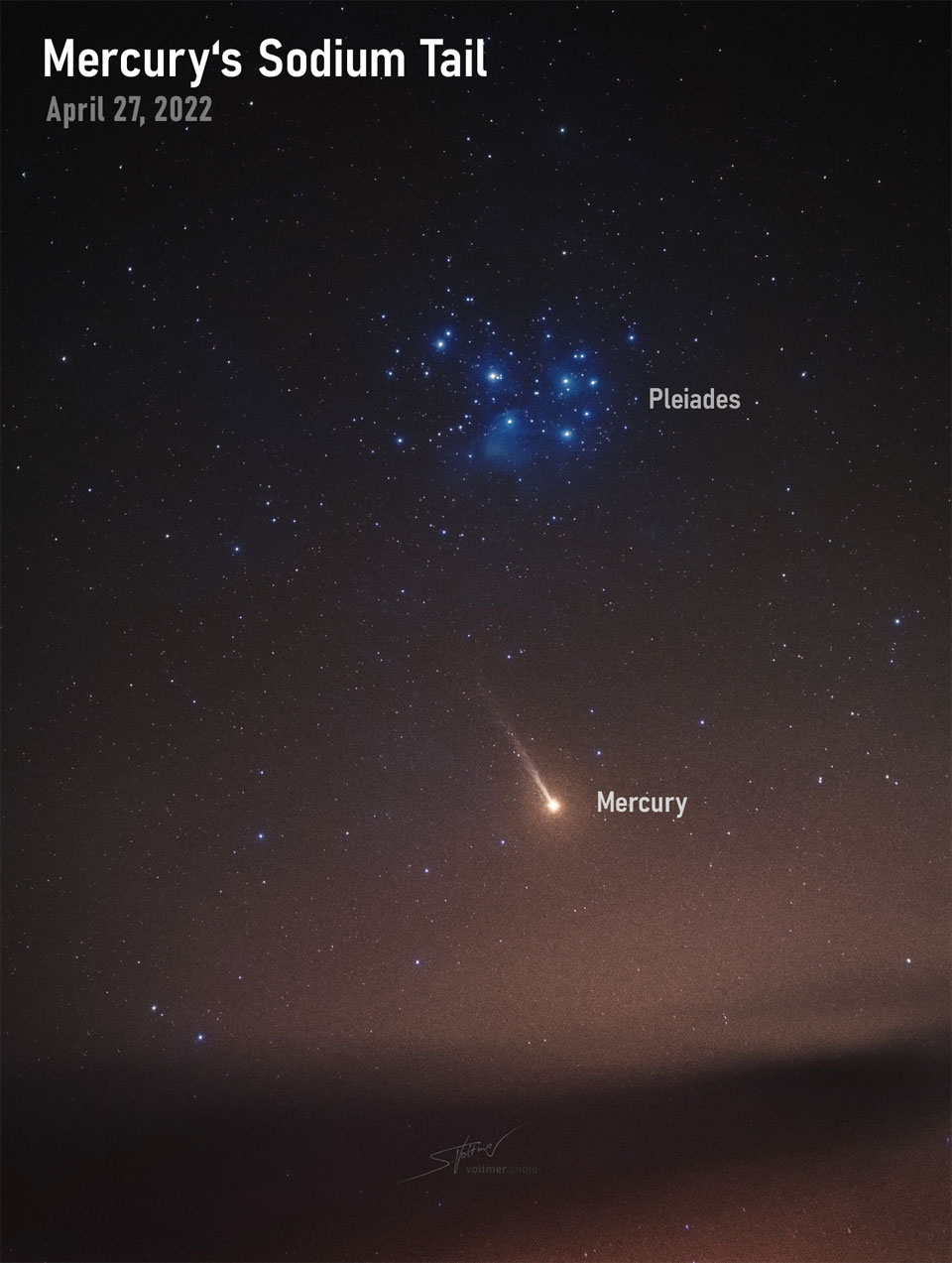
Mercurys Sodium Tail


That's no comet. Below the Pleiades star cluster is actually a planet: Mercury. Long exposures of our Solar System's innermost planet may reveal something unexpected: a tail. Mercury's thin atmosphere contains small amounts of sodium that glow when excited by light from the Sun. Sunlight also liberates these molecules from Mercury's surface and pushes them away. The yellow glow from sodium, in particular, is relatively bright. Pictured, Mercury and its sodium tail are visible in a deep image taken last week from La Palma, Spain through a filter that primarily transmits yellow light emitted by sodium. First predicted in the 1980s, Mercury's tail was first discovered in 2001. Many tail details were revealed in multiple observations by NASA's robotic MESSENGER spacecraft that orbited Mercury between 2011 and 2015. Tails, of course, are usually associated with comets.

https://apod.nasa.gov/apod/ap220503.html ( May 03, 2022)