Friday, November 5, 2021

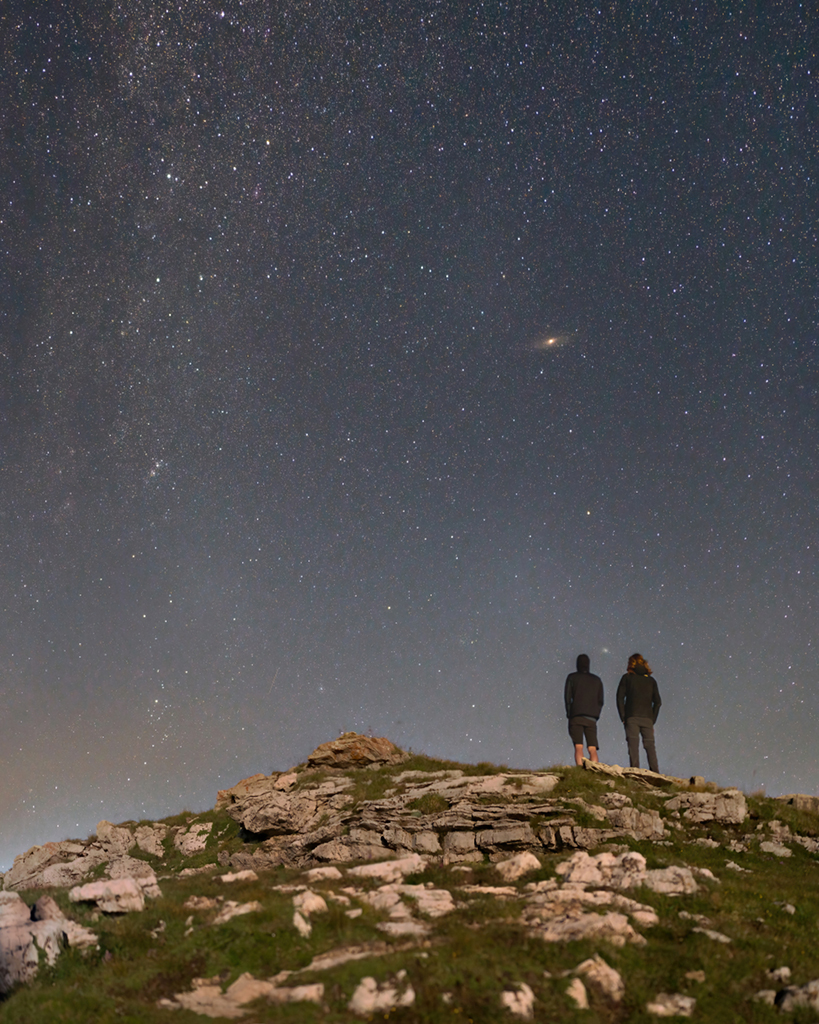
The Galaxy Between Two Friends


On an August night two friends enjoyed this view after a day's hike on the Plateau d'Emparis in the French Alps. At 2400 meters altitude the sky was clear. Light from a setting moon illuminates the foreground captured in the simple vertical panorama of images. Along the plane of our Milky Way galaxy stars of Cassiopeia and Perseus shine along the panorama's left edge. But seen as a faint cloud with a brighter core, the Andromeda galaxy, stands directly above the two friends in the night. The nearest large spiral galaxy, Andromeda is about 2.5 million light-years beyond the stars of the Milky Way. Adding to the evening's shared extragalactic perspective, the fainter fuzzy spot in the sky right between them is M33, also known as the Triangulum galaxy. Third largest in the local galaxy group, after Andromeda and Milky Way, the Triangulum galaxy is about 3 million light-years distant. On that night, the two friends stood about 3 light-nanoseconds apart.

https://apod.nasa.gov/apod/ap211106.html ( November 06, 2021)

Particles From the Sun Produce Light Show on Earth


The aurora borealis glow on the northern horizon while stars wheel overhead in this long exposure, taken near the Bonneville Salt Flats in Utah on Nov. 4, 2021.

from NASA http://www.nasa.gov/image-feature/particles-from-the-sun-produce-light-show-on-earth
via IFTTT

ISS Daily Summary Report – 11/04/2021

iss-about-banner


Payloads: Sally Ride Earth Knowledge Acquired by Middle Schools (EarthKAM):  A crewmember performed a lens configuration to the 180mm lens on the EarthKAM camera. EarthKAM allows thousands of students to photograph and examine Earth from a space crew’s perspective. Using the Internet, the students control a special digital camera mounted on-board the ISS. This enables … ...

November 04, 2021 at 12:00PM
From NASA: https://blogs.nasa.gov/stationreport/2021/11/04/iss-daily-summary-report-11-04-2021/

Thursday, November 4, 2021

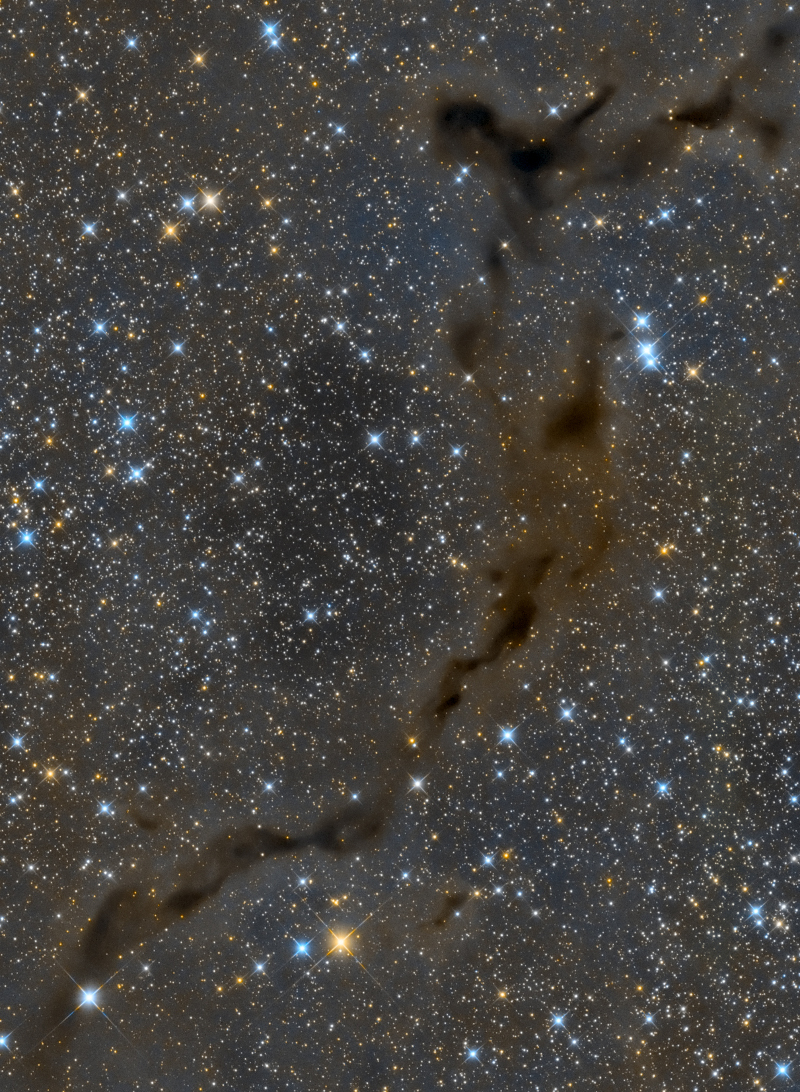
The Dark Seahorse in Cepheus


Light-years across, this suggestive shape known as the Seahorse Nebula appears in silhouette against a rich, luminous background of stars. Seen toward the royal northern constellation of Cepheus, the dusty, obscuring clouds are part of a Milky Way molecular cloud some 1,200 light-years distant. It is also listed as Barnard 150 (B150), one of 182 dark markings of the sky cataloged in the early 20th century by astronomer E. E. Barnard. Packs of low mass stars are forming within, but their collapsing cores are only visible at long infrared wavelengths. Still, the colorful stars of Cepheus add to this pretty, galactic skyscape.

https://apod.nasa.gov/apod/ap211105.html ( November 05, 2021)

ISS Daily Summary Report – 11/03/2021

iss-about-banner


Payloads: ACME (Advanced Combustion via Microgravity Experiments):  A crewmember performed the second part of configuration for Flame Design part 2 by replacing two ACME controllers and setting the CIR Valve Timers to limit oxygen flow.  The ACME project is a set of six independent studies of gaseous flames to be conducted in the Combustion Integrated … ...

November 03, 2021 at 12:00PM
From NASA: https://blogs.nasa.gov/stationreport/2021/11/03/iss-daily-summary-report-11-03-2021/

Hubble Images Colorful Planetary Nebula Ringed by Hazy Halo


The colorful planetary nebula, NGC 2438, formed after the death of a Sun-like star. It appears to lie on the outskirts of the open star cluster, M46 (NGC 2437), when in fact it is in the foreground between us and the star cluster.

from NASA http://www.nasa.gov/image-feature/goddard/2021/hubble-images-colorful-planetary-nebula-ringed-by-hazy-halo
via IFTTT

Wednesday, November 3, 2021

NGC 147 and NGC 185


Dwarf galaxies NGC 147 (left) and NGC 185 stand side by side in this sharp telescopic portrait. The two are not-often-imaged satellites of M31, the great spiral Andromeda Galaxy, some 2.5 million light-years away. Their separation on the sky, less than one degree across a pretty field of view, translates to only about 35 thousand light-years at Andromeda's distance, but Andromeda itself is found well outside this frame. Brighter and more famous satellite galaxies of Andromeda, M32 and M110, are seen closer to the great spiral. NGC 147 and NGC 185 have been identified as binary galaxies, forming a gravitationally stable binary system. But recently discovered faint dwarf galaxy Cassiopeia II also seems to be part of their system, forming a gravitationally bound group within Andromeda's intriguing population of small satellite galaxies.

https://apod.nasa.gov/apod/ap211104.html ( November 04, 2021)

Mariner 10: First Mission to Use an Interplanetary Gravity Assist


​An artists' impression of the Mariner 10 mission, the first mission to perform an interplanetary gravity assist.

from NASA http://www.nasa.gov/image-feature/mariner-10-first-mission-to-use-an-interplanetary-gravity-assist
via IFTTT

Tuesday, November 2, 2021

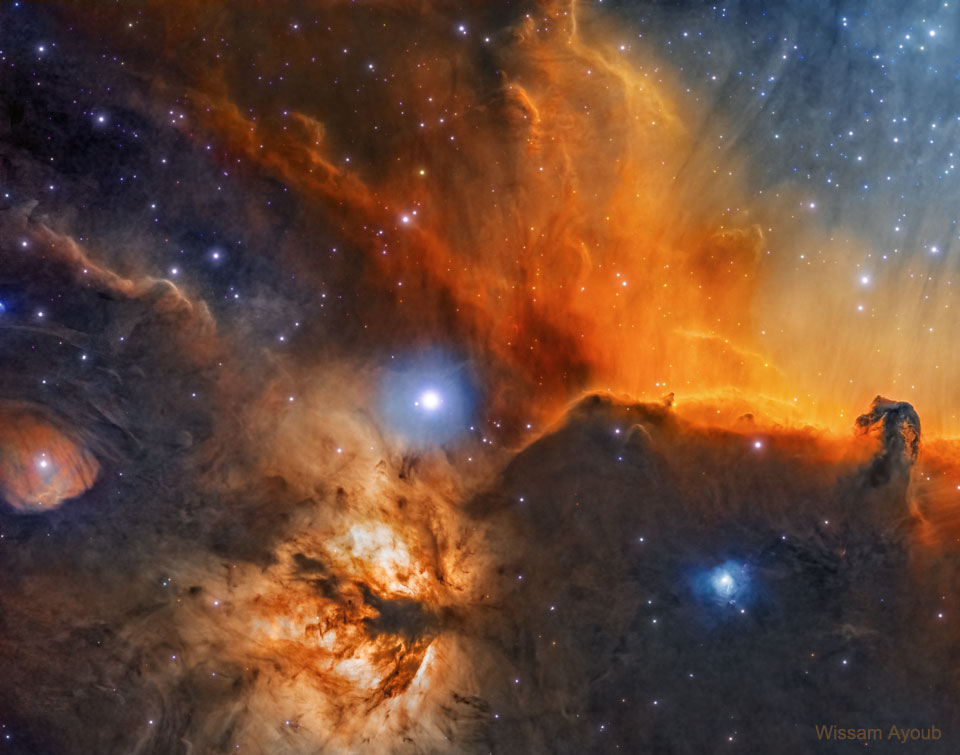
The Horsehead and Flame Nebulas


The Horsehead Nebula is one of the most famous nebulae on the sky. It is visible as the dark indentation to the orange emission nebula at the far right of the featured picture. The horse-head feature is dark because it is really an opaque dust cloud that lies in front of the bright emission nebula. Like clouds in Earth's atmosphere, this cosmic cloud has assumed a recognizable shape by chance. After many thousands of years, the internal motions of the cloud will surely alter its appearance. The emission nebula's orange color is caused by electrons recombining with protons to form hydrogen atoms. Toward the lower left of the image is the Flame Nebula, an orange-tinged nebula that also contains intricate filaments of dark dust. Two prominent reflection nebulas are visible: round IC 432 on the far left, and blue NGC 2023 just to the lower left of the Horsehead nebula. Each glows primarily by reflecting the light of their central star.

https://apod.nasa.gov/apod/ap211103.html ( November 03, 2021)

ISS Daily Summary Report – 11/01/2021

iss-about-banner


Payloads: Exploration ECLSS-TOILET:  A crewmember completed a weekly survey on the Toilet System to provide feedback on system functionality and crew observations. The Toilet ЕДВ was also changed out and the crewmember checked the Toilet System for adequate Pretreat dosing from the Dose Pump.  The Toilet System is an Exploration Tech Demo that has evolved … ...

November 01, 2021 at 12:00PM
From NASA: https://blogs.nasa.gov/stationreport/2021/11/01/iss-daily-summary-report-11-01-2021/