Wednesday, September 8, 2021

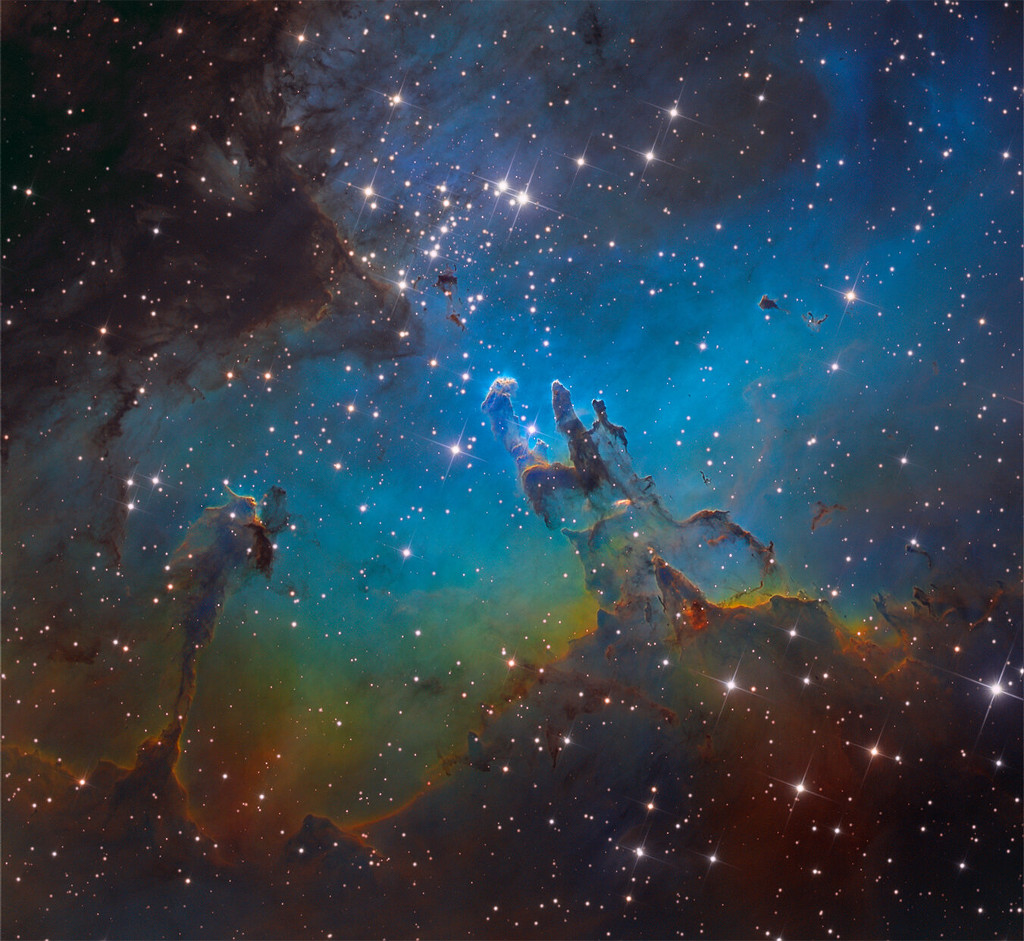
M16 Close Up


A star cluster around 2 million years young surrounded by natal clouds of dust and glowing gas, M16 is also known as The Eagle Nebula. This beautifully detailed image of the region adopts the colorful Hubble palette and includes cosmic sculptures made famous in Hubble Space Telescope close-ups of the starforming complex. Described as elephant trunks or Pillars of Creation, dense, dusty columns rising near the center are light-years in length but are gravitationally contracting to form stars. Energetic radiation from the cluster stars erodes material near the tips, eventually exposing the embedded new stars. Extending from the ridge of bright emission left of center is another dusty starforming column known as the Fairy of Eagle Nebula. M16 lies about 7,000 light-years away, an easy target for binoculars or small telescopes in a nebula rich part of the sky toward the split constellation Serpens Cauda (the tail of the snake).

https://apod.nasa.gov/apod/ap210909.html ( September 09, 2021)

ISS Daily Summary Report – 9/07/2021

iss-about-banner


Payloads: Four Bed CO2 Scrubber:  The crew routed the MSG Aux Power Cable from LAB1O5 UIP to LAB1P4 UIP to provide power to Four Bed CO2 Scrubber.  Four Bed CO2 Scrubber demonstrates a technology for removing carbon dioxide (CO2) from the atmosphere on a spacecraft.  The technology is based on the current system in use … ...

September 07, 2021 at 12:00PM
From NASA: https://blogs.nasa.gov/stationreport/2021/09/07/iss-daily-summary-report-9-07-2021/

Apurva Varia: Studying the Heat of Our Sun


Apurva Varia joined the Goddard Space Flight Center in 2002 as a propulsion engineer.

from NASA http://www.nasa.gov/image-feature/apurva-varia-studying-the-heat-of-our-sun
via IFTTT

Tuesday, September 7, 2021

The Deep Sky Toward Andromeda


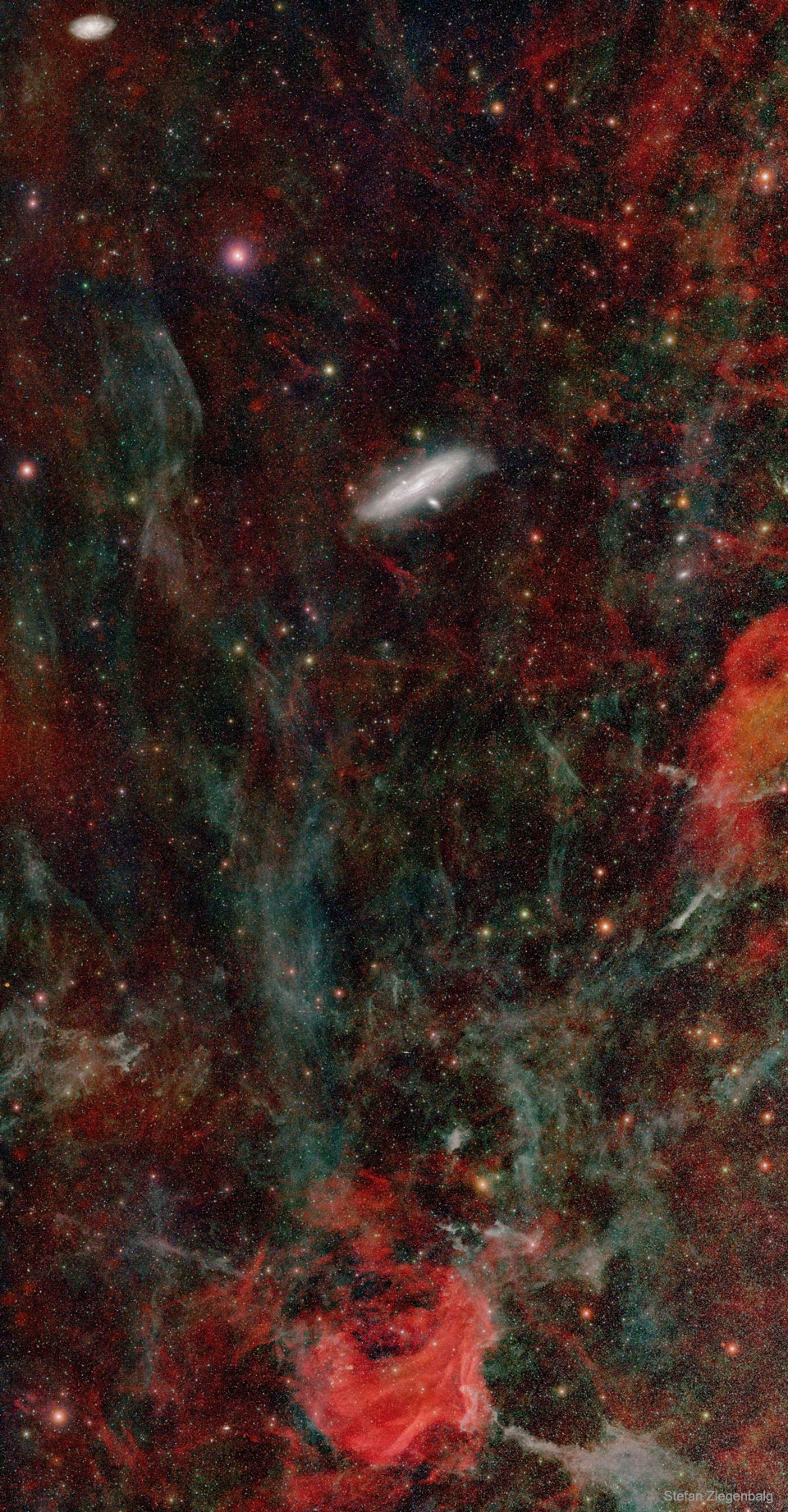
What surrounds the Andromeda galaxy? Out in space, Andromeda (M31) is closely surrounded by several small satellite galaxies, and further out it is part of the Local Group of Galaxies -- of which our Milky Way galaxy is also a member. On the sky, however, gas clouds local to our Milky Way appear to surround M31 -- not unlike how water clouds in Earth's atmosphere may appear to encompass our Moon. The gas clouds toward Andromeda, however, are usually too faint to see. Enter the featured 45-degree long image -- one of the deeper images yet taken of the broader Andromeda region. This image, sensitive to light specifically emitted by hydrogen gas, shows these faint and unfamiliar clouds in tremendous detail. But the image captures more. At the image top is the Triangulum galaxy (M33), the third largest galaxy in the Local Group and the furthest object that can be seen with the unaided eye. Below M33 is the bright Milky-Way star Mirach. The image is the digital accumulation of several long exposures taken from 2018 to 2021 from Pulsnitz, Germany.

https://apod.nasa.gov/apod/ap210908.html ( September 08, 2021)

ISS Daily Summary Report – 9/06/2021

iss-about-banner


Payloads Genes in Space-8:  The crew performed the setup of the Fluorescence Viewer and mini-PCR and performed Freeze and Fly Ops #3 to demonstrate the heating and fluorescent visualization functions of the Genes in Space experiment.  Some pharmaceuticals used to maintain astronaut health do not work as well in space, which may be linked to … ...

September 06, 2021 at 12:00PM
From NASA: https://blogs.nasa.gov/stationreport/2021/09/06/iss-daily-summary-report-9-06-2021/

Trans-Sonic Truss-Braced Wing May Help Reduce Fuel Consumption


Instrumentation technician Michael Hodgins performs installation measures on the trans-sonic truss-braced wing model at Langley Research Center’s 14x22 subsonic wind tunnel.

from NASA http://www.nasa.gov/image-feature/trans-sonic-truss-braced-wing-may-help-reduce-fuel-consumption
via IFTTT

Monday, September 6, 2021

NGC 520: Colliding Galaxies from Hubble


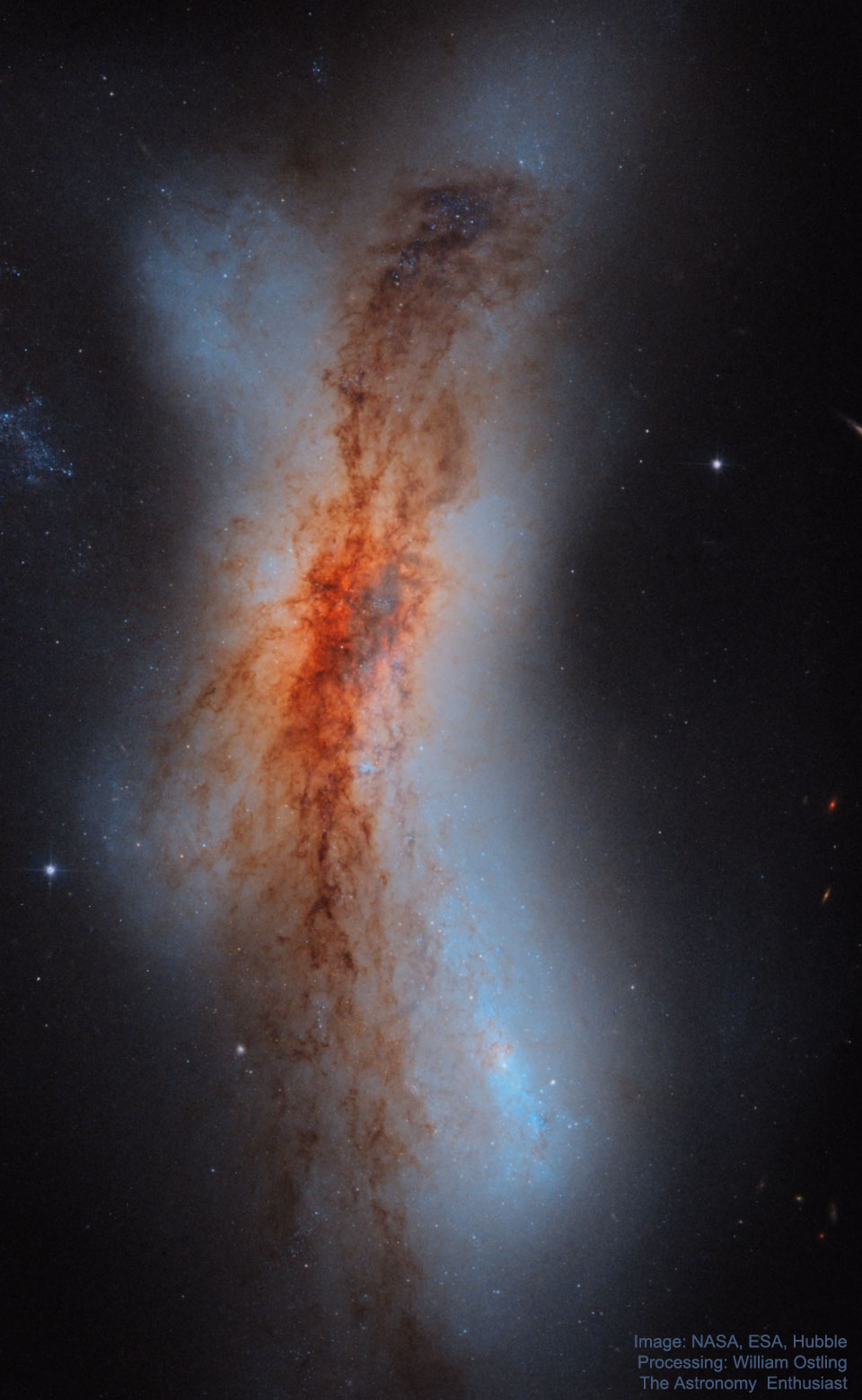
Is this one galaxy or two? The jumble of stars, gas, and dust that is NGC 520 is now thought to incorporate the remains of two separate disk galaxies. A defining component of NGC 520 -- as seen in great detail in the featured image from the Hubble Space Telescope -- is its band of intricately interlaced dust running vertically down the spine of the colliding galaxies. A similar looking collision might be expected in a few billion years when our disk Milky Way Galaxy to collides with our large-disk galactic neighbor Andromeda (M31). The collision that defines NGC 520 started about 300 million years ago. Also known as Arp 157, NGC 520 lies about 100 million light years distant, spans about 100 thousand light years, and can be seen with a small telescope toward the constellation of the Fish (Pisces). Although the speeds of stars in NGC 520 are fast, the distances are so vast that the battling pair will surely not change its shape noticeably during our lifetimes.

https://apod.nasa.gov/apod/ap210907.html ( September 07, 2021)

Sunday, September 5, 2021

Firefly Milky Way over Russia


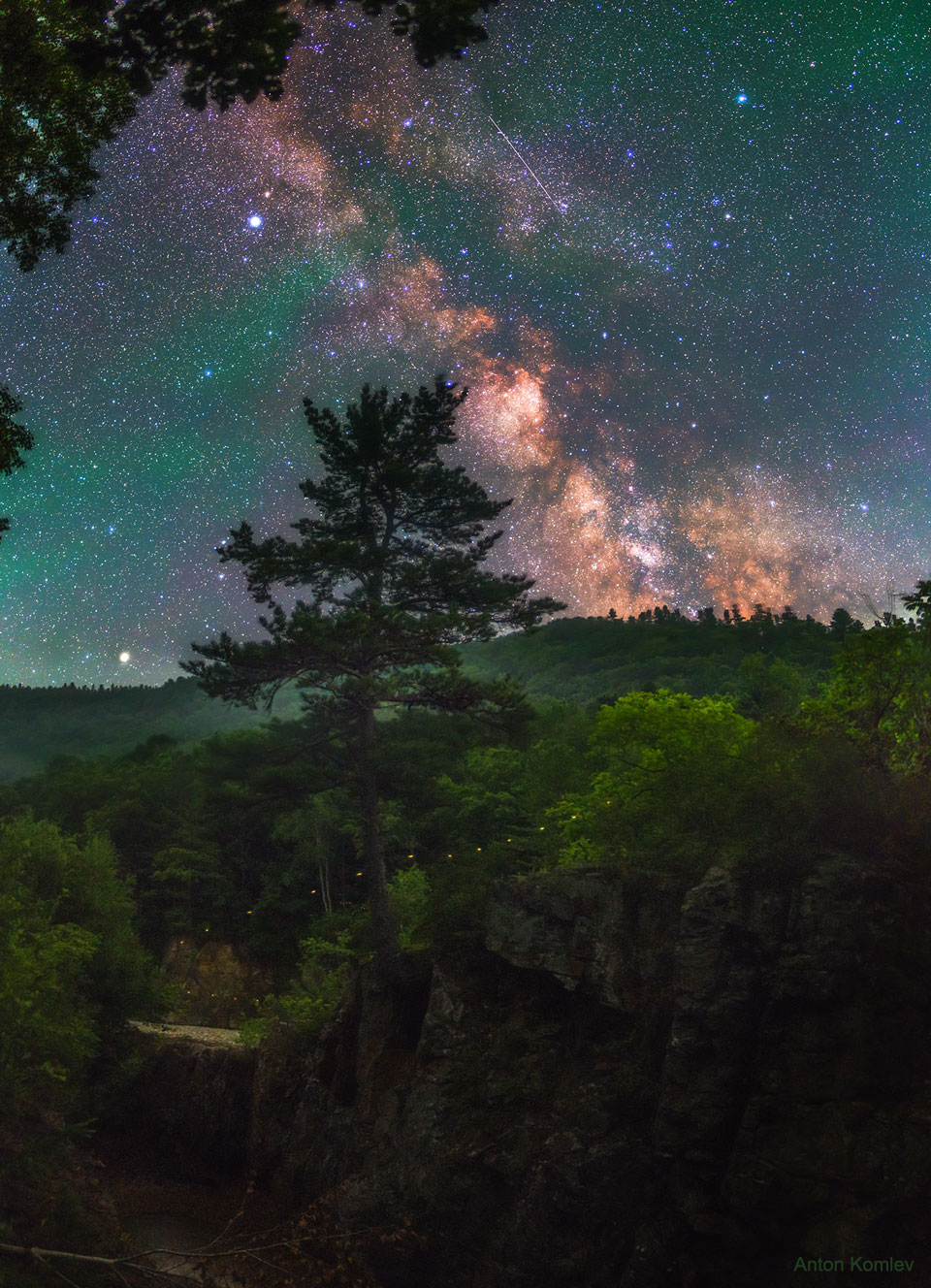
It started with a pine tree. The idea was to photograph a statuesque pine in front of the central band of our Milky Way Galaxy. And the plan, carried out two months ago, was successful -- they both appear prominently. But the resulting 3-frame panorama captured much more. Colorful stars, for example, dot the distant background, with bright Altair visible on the upper left. The planet Saturn, a bit closer, was captured just over the horizon on the far left. Just beyond the Earth's atmosphere, seen in the upper right, an Earth-orbiting satellite was caught leaving a streak during the 25-second exposure. The Earth's atmosphere itself was surprisingly visible -- as green airglow across the image top. Finally, just by chance, there was a firefly. Do you see it? Near the image bottom, the firefly blinked in yellow several times as it fluttered before the rolling hills above Milogradovka River in Primorsky Krai, Russia.

https://apod.nasa.gov/apod/ap210906.html ( September 06, 2021)

Saturday, September 4, 2021

Earth and Moon


The Earth and Moon are rarely photographed together. One of most spectacular times this occurred was about 30 years ago when the Jupiter-bound Galileo spacecraft zoomed past our home planetary system. Then, robotic Galileo watched from about 15-times the Earth-Moon separation as our only natural satellite glided past our home world. The featured video combines 52 historic color-enhanced images. Although our Moon may appear small next to the Earth, no other planet in our Solar System has a satellite so comparable in size . The Sun, far off to the right, illuminated about half of each sphere, and shows the spinning Earth's white clouds, blue oceans, and tan continents.

https://apod.nasa.gov/apod/ap210905.html ( September 05, 2021)

Friday, September 3, 2021

A Falcon 9 Nebula


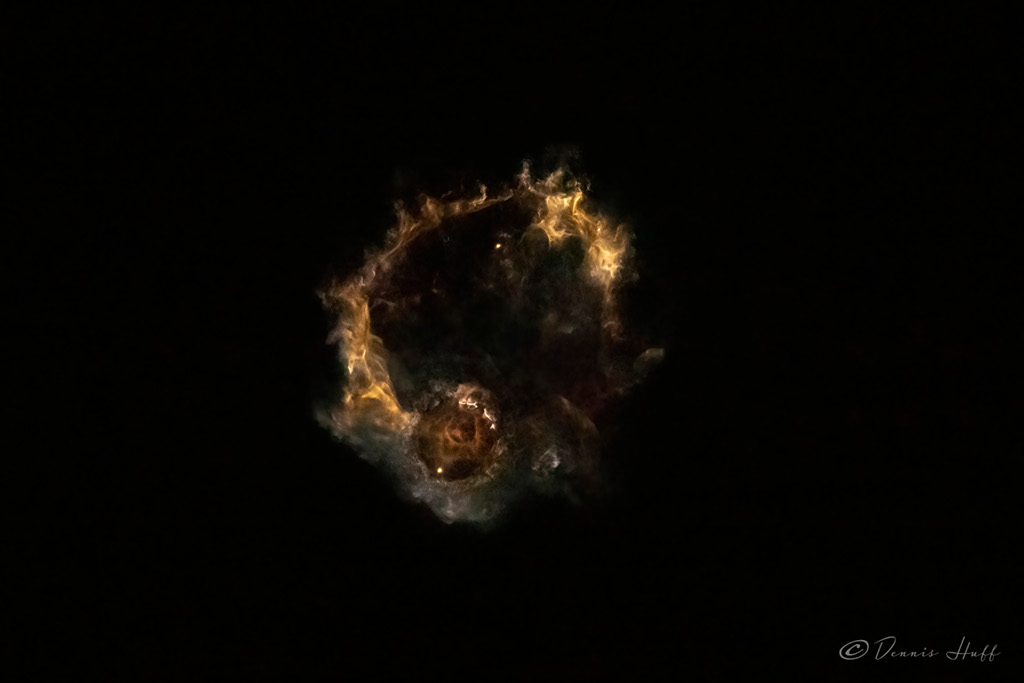
Not the Hubble Space Telescope's latest view of a distant galactic nebula, this illuminated cloud of gas and dust dazzled early morning spacecoast skygazers on August 29. The snapshot was taken at 3:17am from Space View Park in Titusville, Florida. That's about 3 minutes after the launch of a SpaceX Falcon 9 rocket on the CRS-23 mission to resupply the International Space Station. It captures drifting plumes and exhaust from the separated first and second stage of the rocket rising through still dark skies. The lower bright dot is the second stage continuing on to low Earth orbit. The upper one is the rocket's first stage performing a boostback burn. Of course the first stage booster returned to make the first landing on the latest autonomous drone ship to arrive in the Atlantic, A Short Fall of Gravitas.

https://apod.nasa.gov/apod/ap210904.html ( September 04, 2021)