Friday, September 20, 2024

Sunrise Shadows in the Sky


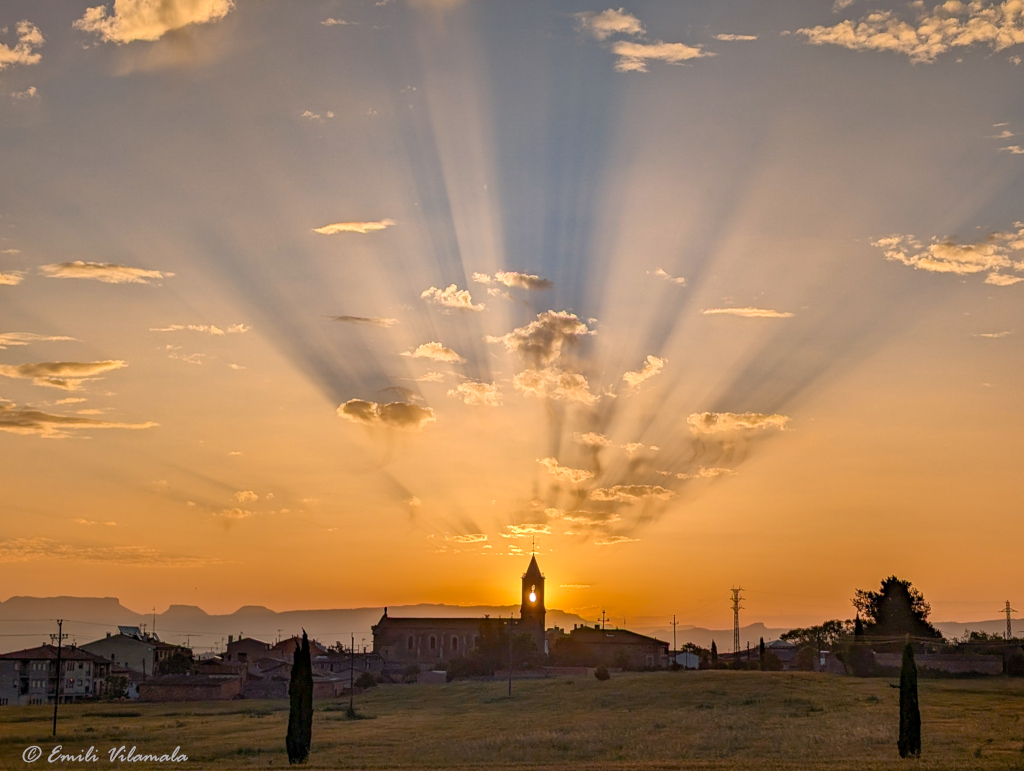
The defining astronomical moment of this September's equinox is at 12:44 UTC on September 22, when the Sun crosses the celestial equator moving south in its yearly journey through planet Earth's sky. That marks the beginning of fall for our fair planet in the northern hemisphere and spring in the southern hemisphere, when day and night are nearly equal around the globe. Of course, if you celebrate the astronomical change of seasons by watching a sunrise you can also look for crepuscular rays. Outlined by shadows cast by clouds, crepuscular rays can have a dramatic appearance in the twilight sky during any sunrise (or sunset). Due to perspective, the parallel cloud shadows will seem to point back to the rising Sun and a place due east on your horizon on the equinox date. But in this spectacular sunrise skyscape captured in early June, the parallel shadows and crepuscular rays appear to converge toward an eastern horizon's more northerly sunrise. The well-composed photo places the rising Sun just behind the bell tower of a church in the town of Vic, province of Barcelona, Catalonia, Spain.

https://apod.nasa.gov/apod/ap240921.html ( September 21, 2024)

Thursday, September 19, 2024

A Hazy Harvest Moon


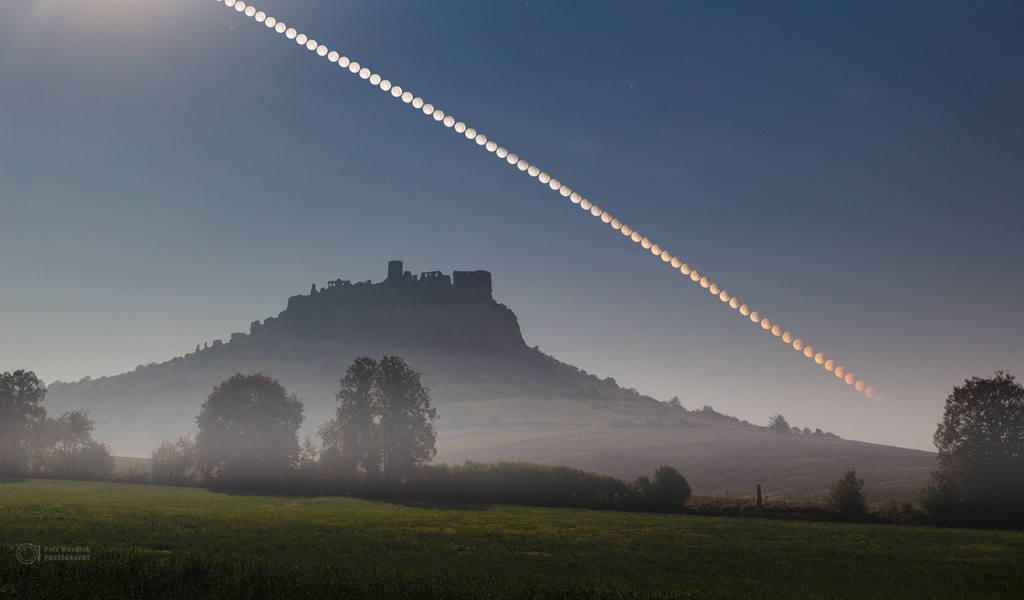
For northern hemisphere dwellers, September's Full Moon was the Harvest Moon. On September 17/18 the sunlit lunar nearside passed into shadow, just grazing Earth's umbra, the planet's dark, central shadow cone, in a partial lunar eclipse. Over the two and half hours before dawn a camera fixed to a tripod was used to record this series of exposures as the eclipsed Harvest Moon set behind Spiš Castle in the hazy morning sky over eastern Slovakia. Famed in festival, story, and song, Harvest Moon is just the traditional name of the full moon nearest the autumnal equinox. According to lore the name is a fitting one. Despite the diminishing daylight hours as the growing season drew to a close, farmers could harvest crops by the light of a full moon shining on from dusk to dawn. This September's Harvest Moon was also known to some as a supermoon, a term becoming a traditional name for a full moon near perigee.

https://apod.nasa.gov/apod/ap240920.html ( September 20, 2024)

Wednesday, September 18, 2024

The Dark Seahorse of Cepheus


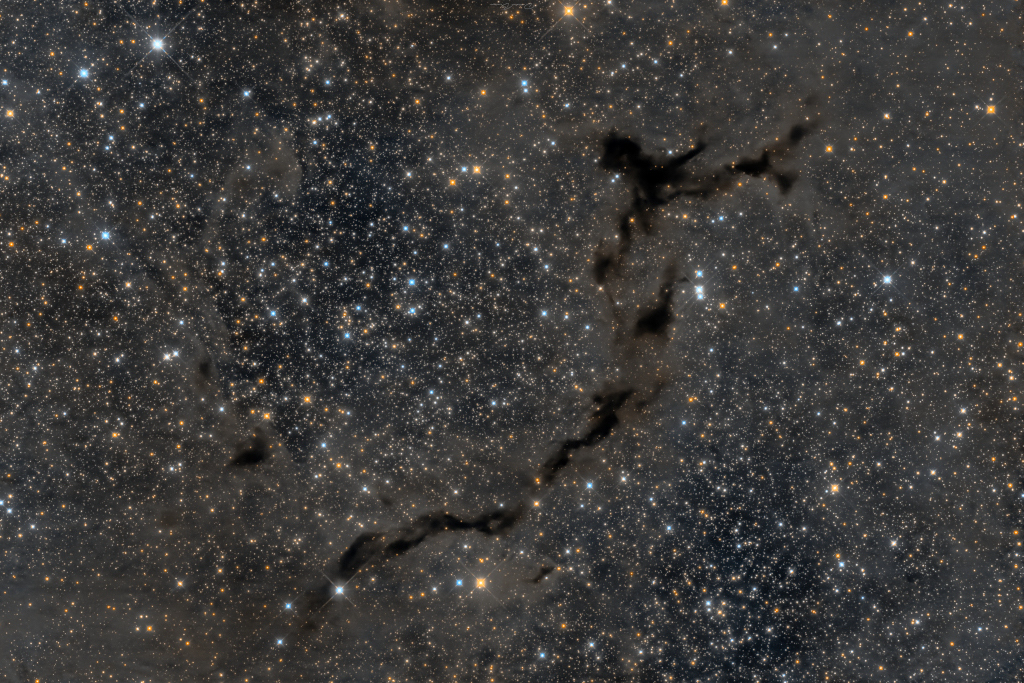
Spanning light-years, this suggestive shape known as the Seahorse Nebula floats in silhouette against a rich, luminous background of stars. Seen toward the royal northern constellation of Cepheus, the dusty, dark nebula is part of a Milky Way molecular cloud some 1,200 light-years distant. It is also listed as Barnard 150 (B150), one of 182 dark markings of the sky cataloged in the early 20th century by astronomer E. E. Barnard. Packs of low mass stars are forming within, but their collapsing cores are only visible at long infrared wavelengths. Still, the colorful Milky Way stars of Cepheus add to this stunning galactic skyscape.

https://apod.nasa.gov/apod/ap240919.html ( September 19, 2024)

Tuesday, September 17, 2024


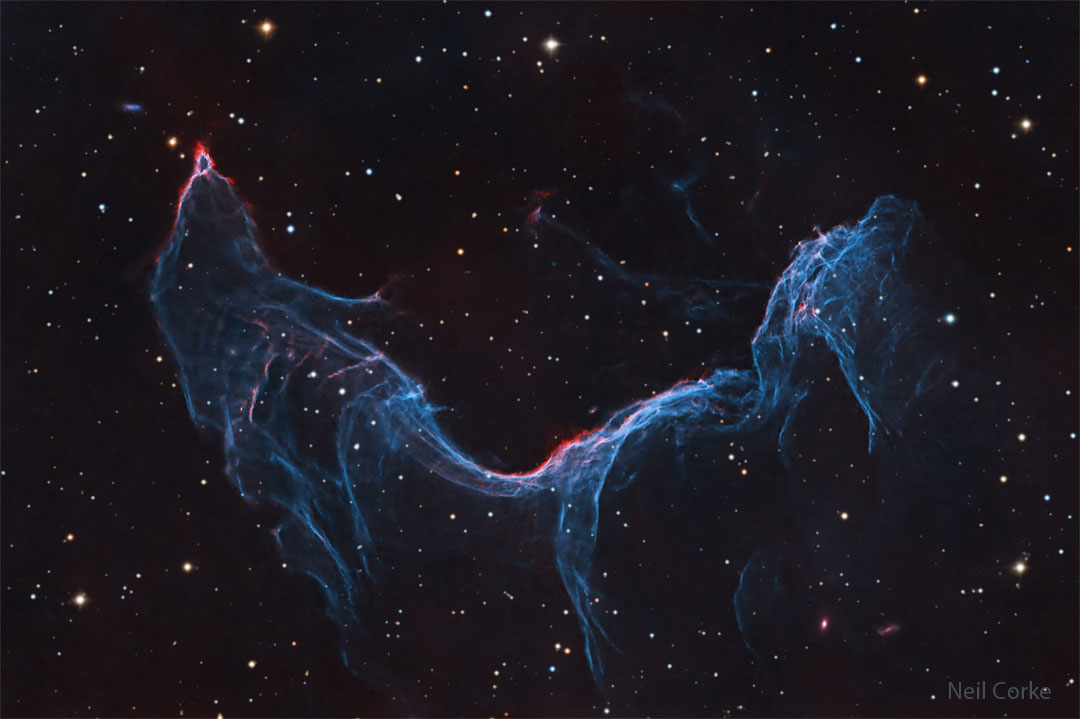
New stars are born from the remnants of deadstars. The gaseous remnant of the gravitational collapse and subsequent death of a very massive star in our Milky Way created the G296.5+10.0supernova remnant, of which the featured Mermaid Nebula is part. Also known as the Betta Fish Nebula, the Mermaid Nebula makes up part of an unusual subclass of supernova remnants that are two-sided and nearly circular. Originally discovered in X-rays, the filamentary nebula is a frequently studied source also in radio and gamma-ray light. The blue color visible here originates from doubly ionized oxygen (OIII), while the deep red is emitted by hydrogen gas. The nebula's mermaid-like shape has proven to be useful for measurements of the interstellar magnetic field.

https://apod.nasa.gov/apod/ap240918.html ( September 18, 2024)

Monday, September 16, 2024


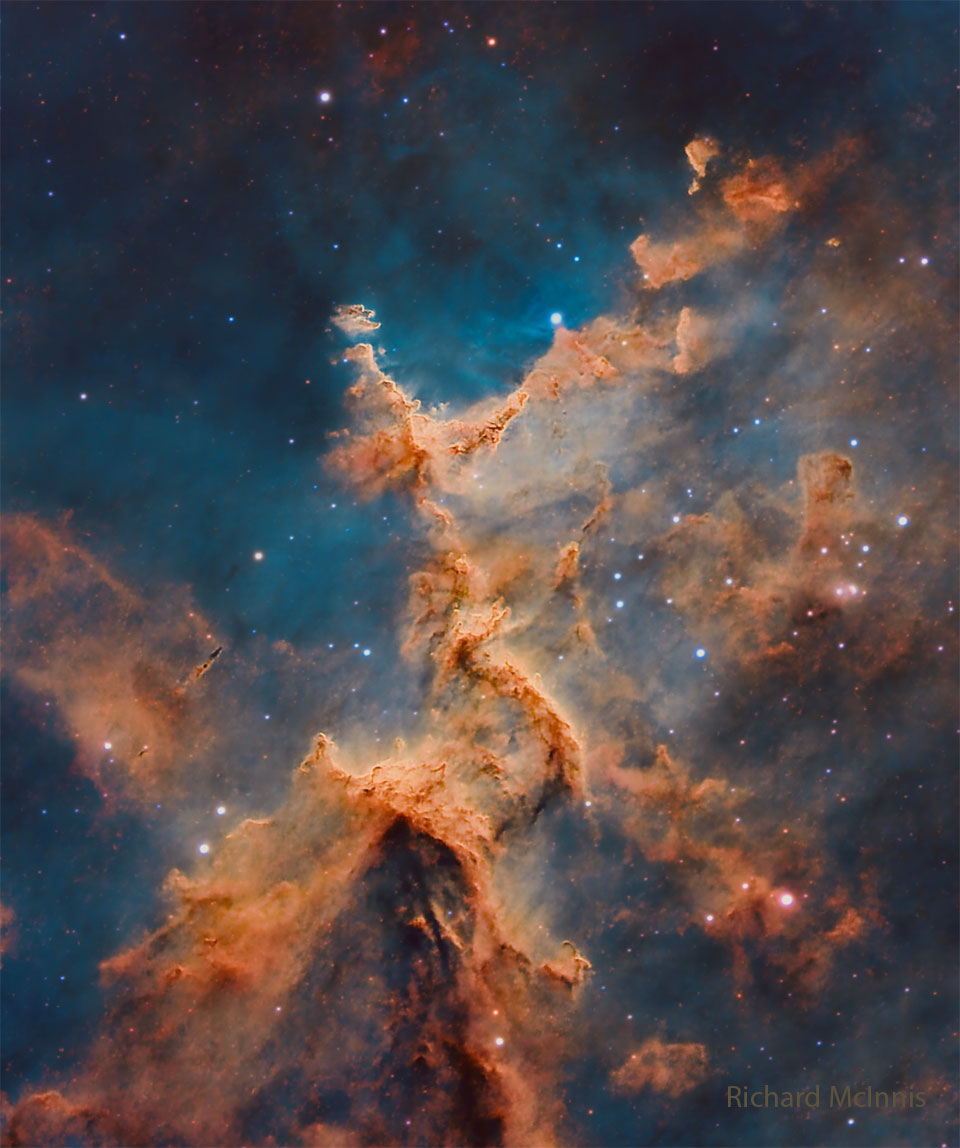
Cosmic clouds form fantastic shapes in the central regions of emission nebula IC 1805. The clouds are sculpted by stellar winds and radiation from massive hot stars in the nebula's newborn star cluster, Melotte 15. About 1.5 million years young, the cluster stars are scattered in this colorful skyscape, along with dark dust clouds in silhouette against glowing atomic gas. A composite of narrowband and broadband telescopic images, the view spans about 15 light-years and includes emission from ionized hydrogen, sulfur, and oxygen atoms mapped to green, red, and blue hues in the popular Hubble Palette. Wider field images reveal that IC 1805's simpler, overall outline suggests its popular name - the Heart Nebula. IC 1805 is located about 7,500 light years away toward the boastful constellation Cassiopeia.

https://apod.nasa.gov/apod/ap240917.html ( September 17, 2024)

Sunday, September 15, 2024


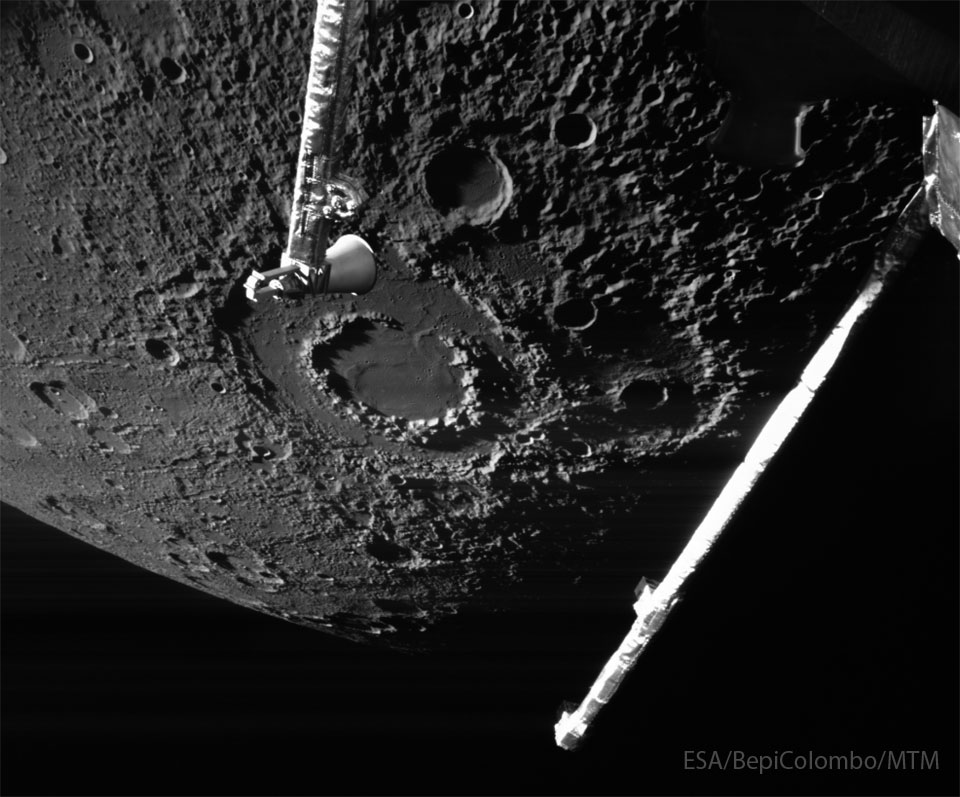
Why does this large crater on Mercury have two rings and a smooth floor? No one is sure. The unusual feature called Vivaldi Crater spans 215 kilometers and was imaged again in great detail by ESA's and JAXA's robotic BepiColombo spacecraft on a flyby earlier this month. A large circular feature on a rocky planet or moon is usually caused by either an impact by a small asteroid or a comet fragment, or a volcanic eruption. In the case of Vivaldi, it is possible that both occurred -- a heavy strike that caused a smooth internal lava flow. Double-ringed craters are rare, and the cause of the inner rings remains a topic of research. The speed-slowing gravity-assisted flyby of Mercury by BepiColombo was in preparation for the spacecraft entering orbit around the Solar System's innermost planet in 2026.

https://apod.nasa.gov/apod/ap240916.html ( September 16, 2024)

Saturday, September 14, 2024


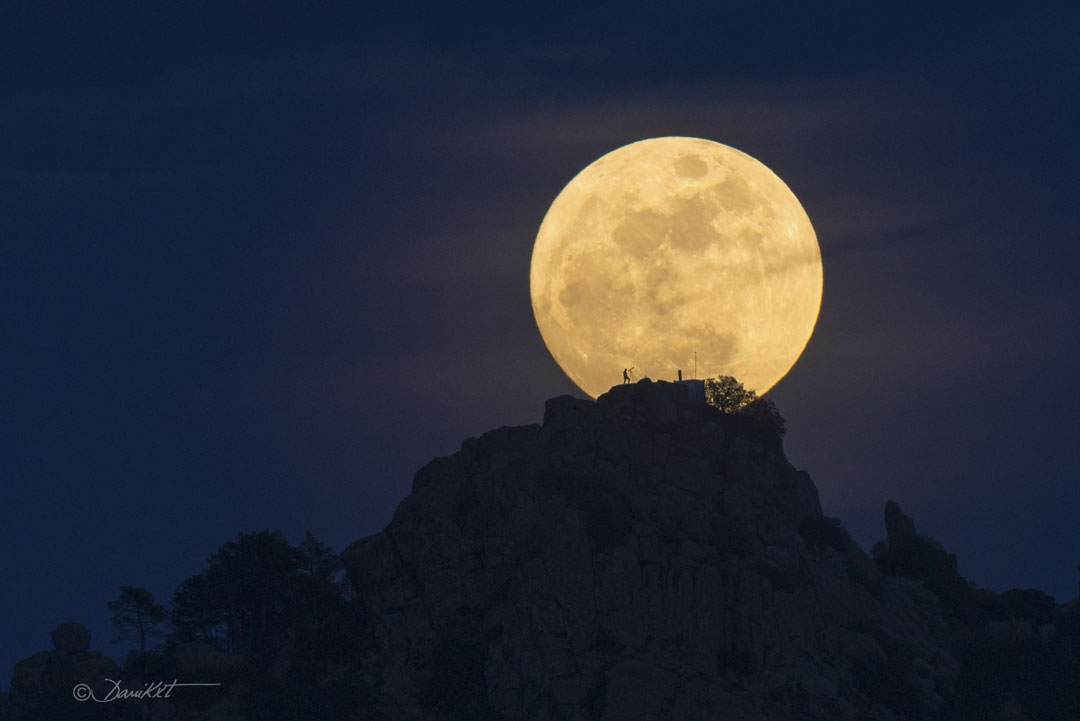
Have you ever seen the Man in the Moon? This common question plays on the ability of humans to see pareidolia -- imagining familiar icons where they don't actually exist. The textured surface of Earth's full Moon is home to numerous identifications of iconic objects, not only in modern western culture but in world folklore throughout history. Examples, typically dependent on the Moon's perceived orientation, include the Woman in the Moon and the Rabbit in the Moon. One facial outline commonly identified as the Man in the Moon starts by imagining the two dark circular areas -- lunar maria -- here just above the Moon's center, to be the eyes. Surprisingly, there actually is a man in this Moon image -- a close look will reveal a real person -- with a telescope -- silhouetted against the Moon. This well-planned image was taken in 2016 in Cadalso de los Vidrios in Madrid, Spain.

https://apod.nasa.gov/apod/ap240915.html ( September 15, 2024)

Friday, September 13, 2024

The Moona Lisa


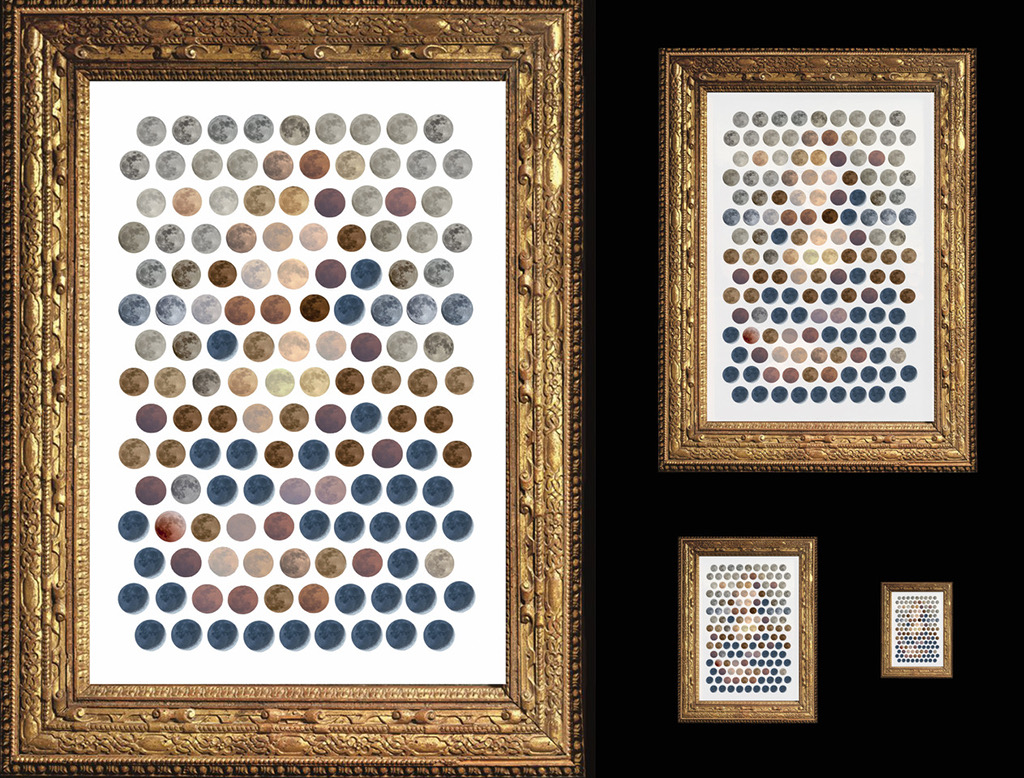
Only natural colors of the Moon in planet Earth's sky appear in this creative visual presentation. Arranged as pixels in a framed image, the lunar disks were photographed at different times. Their varying hues are ultimately due to reflected sunlight affected by changing atmospheric conditions and the alignment geometry of Moon, Earth, and Sun. Here, the darkest lunar disks are the colors of earthshine. A description of earthshine, in terms of sunlight reflected by Earth's oceans illuminating the Moon's dark surface, was written over 500 years ago by Leonardo da Vinci. But stand farther back from your screen or just shift your gaze to the smaller versions of the image. You might also see one of da Vinci's most famous works of art.

https://apod.nasa.gov/apod/ap240914.html ( September 14, 2024)

Thursday, September 12, 2024

Aurora Australis and the International Space Station


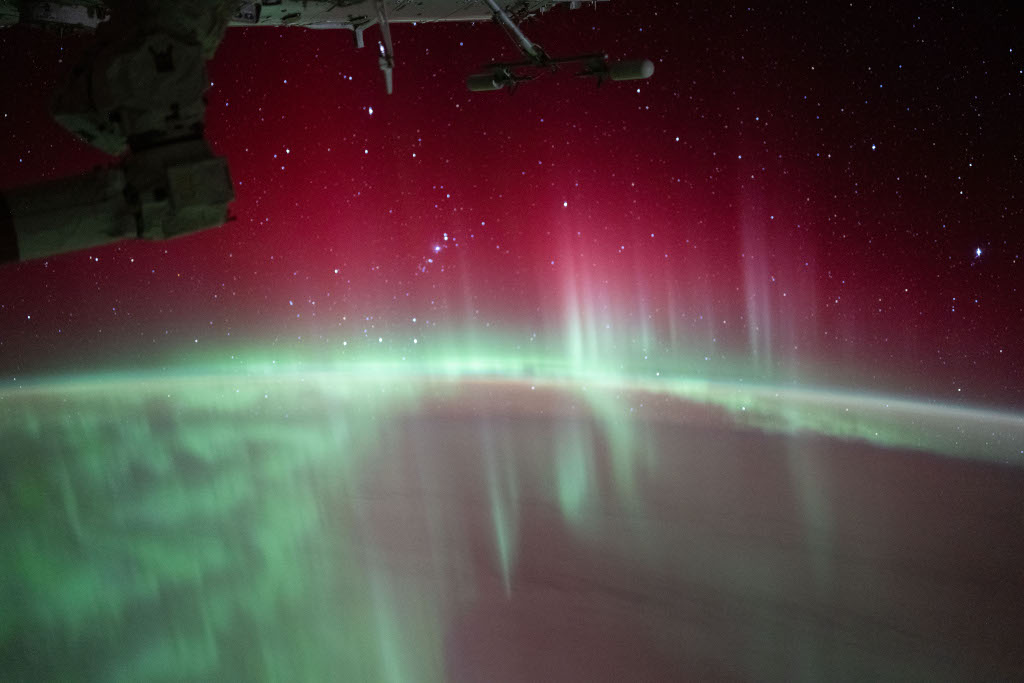
This snapshot from the International Space Station was taken on August 11 while orbiting about 430 kilometers above the Indian Ocean, Southern Hemisphere, planet Earth. The spectacular view looks south and east, down toward the planet's horizon and through red and green curtains of aurora australis. The auroral glow is caused by emission from excited oxygen atoms in the extremely rarefied upper atmosphere still present at the level of the orbiting outpost. Green emission from atomic oxygen dominates this scene at altitudes of 100 to 250 kilometers, while red emission from atomic oxygen can extend as high as 500 kilometers altitude. Beyond the glow of these southern lights, this view from low Earth orbit reveals the starry sky from a southern hemisphere perspective. Stars in Orion's belt and the Orion Nebula are near the Earth's limb just left of center. Sirius, alpha star of Canis Major and brightest star in planet Earth's night is above center along the right edge of the southern orbital skyscape.

https://apod.nasa.gov/apod/ap240913.html ( September 13, 2024)

Wednesday, September 11, 2024

Young Star Cluster NGC 1333


This spectacular mosaic of images from the James Webb Space Telescope peers into the heart of young star cluster NGC 1333. A mere 1,000 light-years distant toward the heroic constellation Perseus, the nearby star cluster lies at the edge of the large Perseus molecular cloud. Part of Webb's deep exploration of the region to identify low mass brown dwarf stars and free floating planets, the space telescope's combined field of view spans nearly 2 light-years across the dusty cluster's turbulent stellar nursery. In fact, NGC 1333 is known to harbor stars less than a million years old, though most are hidden from optical telescopes by the pervasive stardust. The chaotic environment may be similar to one in which our own Sun formed over 4.5 billion years ago.

https://apod.nasa.gov/apod/ap240912.html ( September 12, 2024)