Tuesday, April 9, 2024

ISS Daily Summary Report – 4/08/2024

iss-about-banner


PrK Hatch Open: This morning, the crew opened hatches to the PrK and Progress 87P according to the plan. After the hatches were open, the crew completed transfers of gas and water from Progress 87P to the ISS. The PrK hatch will remain open until tomorrow afternoon. Payloads: ADvanced Space Experiment Processor-2 Pharmaceutical In-space Laboratory-02 … ...

April 08, 2024 at 12:00PM
From NASA: https://blogs.nasa.gov/stationreport/2024/04/08/iss-daily-summary-report-4-08-2024/

Monday, April 8, 2024


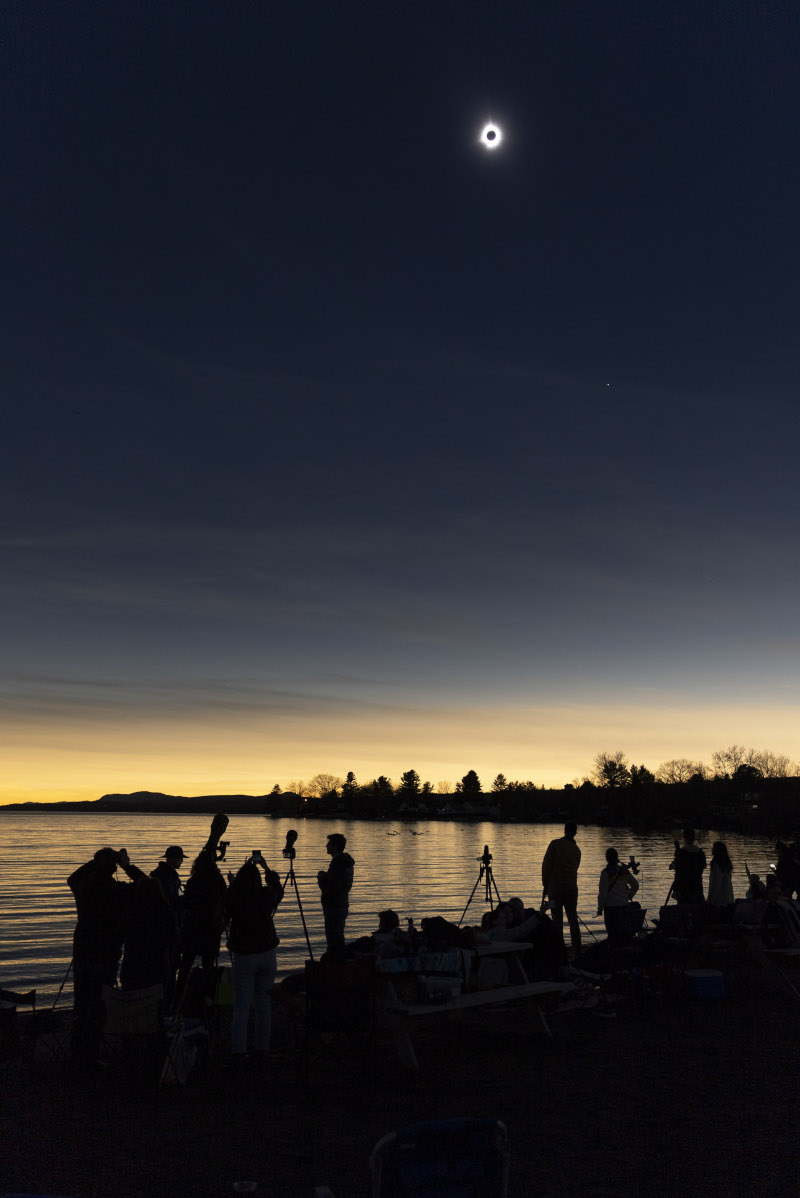
Captured in this snapshot, the shadow of the Moon came to Lake Magog, Quebec, North America, planet Earth on April 8. For the lakeside eclipse chasers, the much anticipated total solar eclipse was spectacle to behold in briefly dark, but clear skies. Of course Lake Magog was one of the last places to be visited by the Moon's shadow. The narrow path of totality for the 2024 total solar eclipse swept from Mexico's Pacific Coast north and eastward through the US and Canada. But a partial eclipse was visible across the entire North American continent.

https://apod.nasa.gov/apod/ap240409.html ( April 09, 2024)

ISS Daily Summary Report – 4/03/2024

iss-about-banner


Payloads: ADvanced Space Experiment Processor-2 Pharmaceutical In-space Laboratory-03 (ADSEP-PIL-03): The crew gained access to the ADSEP-2 facility and exchanged the experiment cassettes in Module C. The crew also took photos of these experiment activities being performed. ADSEP-PIL-03 grows crystals of several commercially relevant small molecules, each having various structures that may be altered by a … ...

April 08, 2024 at 11:10AM
From NASA: https://blogs.nasa.gov/stationreport/2024/04/08/iss-daily-summary-report-4-03-2024/

Sunday, April 7, 2024


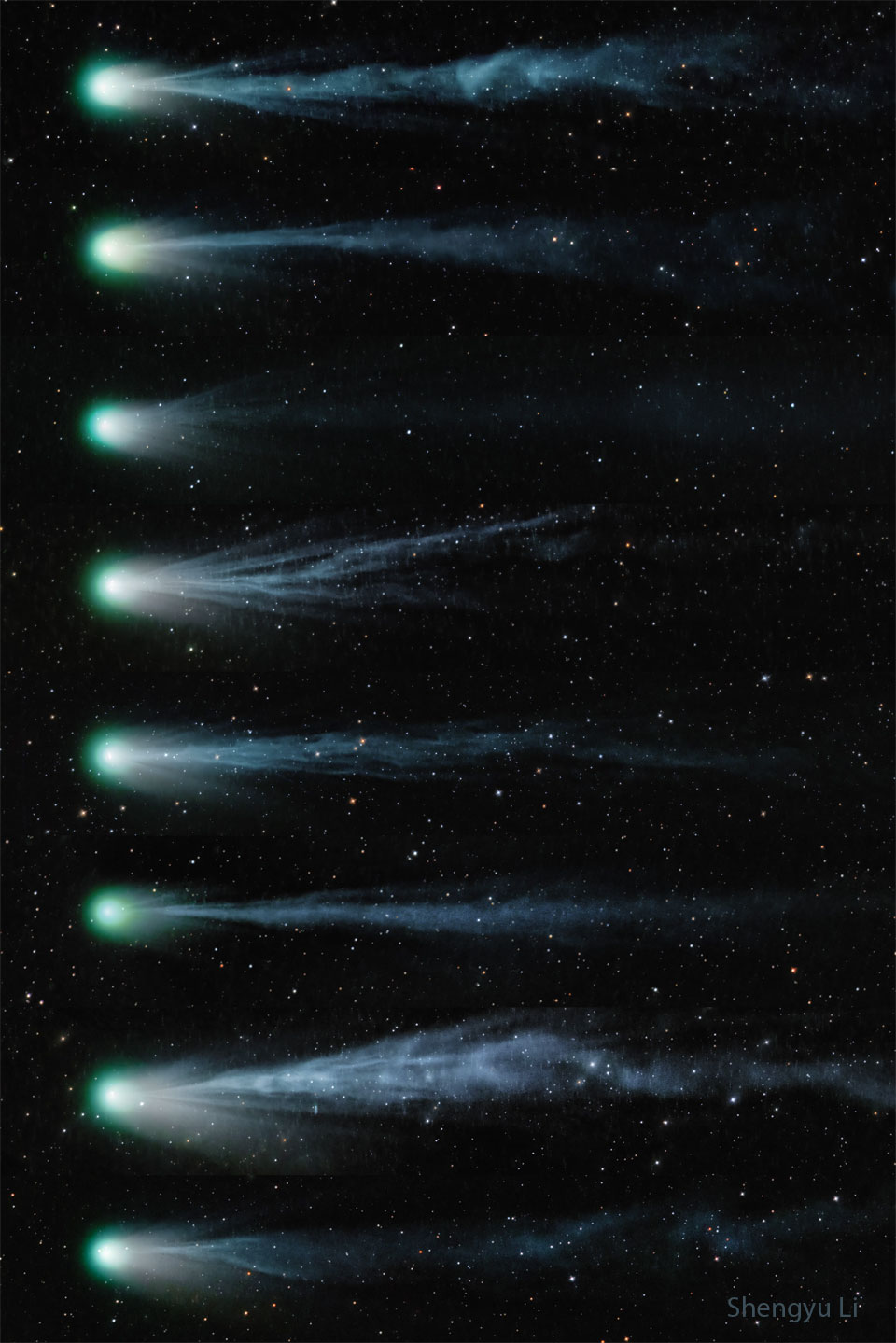
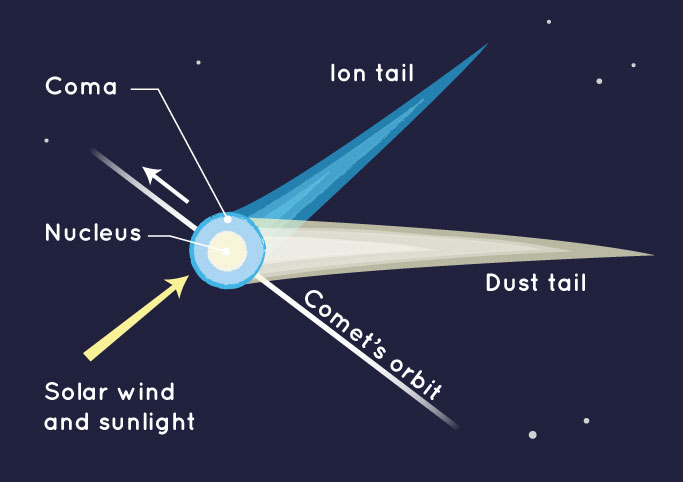
How does a comet tail change? It depends on the comet. The ion tail of Comet 12P/Pons–Brooks has been changing markedly, as detailed in the featured image sequenced over nine days from March 6 to 14 (top to bottom). On some days, the comet's ion tail was relatively long and complex, but not every day. Reasons for tail changes include the rate of ejection of material from the comet's nucleus, the strength and complexity of the passing solar wind, and the rotation rate of the comet. Over the course of a week, apparent changes even include a change of perspective from the Earth. In general, a comet's ion tail will point away from the Sun, as gas expelled is pushed out by the Sun's wind. Today, Pons-Brooks may become a rare comet suddenly visible in the middle of the day for those able to see the Sun totally eclipsed by the Moon.

https://apod.nasa.gov/apod/ap240408.html ( April 08, 2024)

Saturday, April 6, 2024


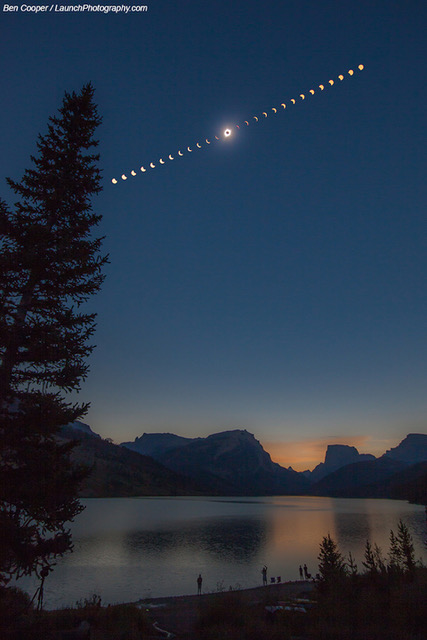
Will the sky be clear enough to see the eclipse? This question is already on the minds of many North Americans hoping to see tomorrow's solar eclipse. This question was also on the mind of many people attempting to see the total solar eclipse that crossed North America in August 2017. Then, the path of total darkness shot across the mainland of the USA from coast to coast, from Oregon to South Carolina -- but, like tomorrow's event, a partial eclipse occurred above most of North America. Unfortunately, in 2017, many locations saw predominantly clouds. One location that did not was a bank of the Green River Lakes, Wyoming. Intermittent clouds were far enough away to allow the center image of the featured composite sequence to be taken, an image that shows the corona of the Sun extending out past the central dark Moon that blocks our familiar Sun. The surrounding images show the partial phases of the solar eclipse both before and after totality.

https://apod.nasa.gov/apod/ap240407.html ( April 07, 2024)

Friday, April 5, 2024

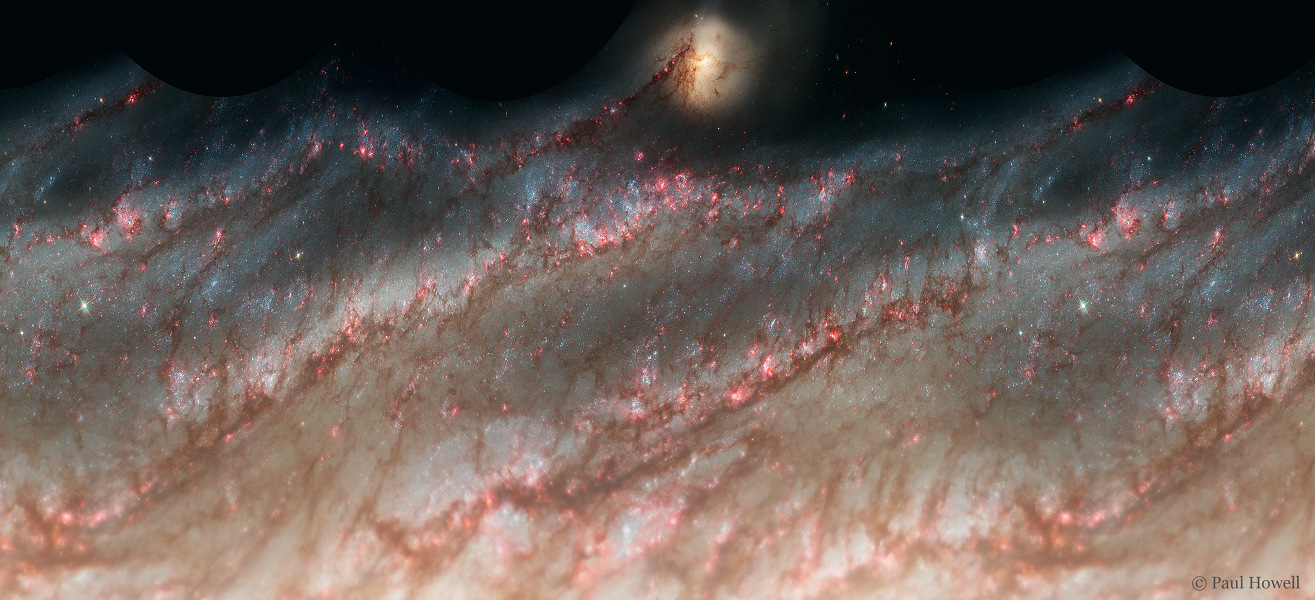
Unwinding M51


The arms of a grand design spiral galaxy 60,000 light-years across are unwound in this digital transformation of the magnificent 2005 Hubble Space Telescope portrait of M51. In fact, M51 is one of the original spiral nebulae, its winding arms described by a mathematical curve known as a logarithmic spiral, a spiral whose separation grows in a geometric way with increasing distance from the center. Applying logarithms to shift the pixel coordinates in the Hubble image relative to the center of M51 maps the galaxy's spiral arms into diagonal straight lines. The transformed image dramatically shows the arms themselves are traced by star formation, lined with pinkish starforming regions and young blue star clusters. Companion galaxy NGC 5195 (top) seems to alter the track of the arm in front of it though, and itself remains relatively unaffected by this unwinding of M51. Also known as the spira mirabilis, logarthimic spirals can be found in nature on all scales. For example, logarithmic spirals can also describe hurricanes, the tracks of subatomic particles in a bubble chamber and, of course, cauliflower.

https://apod.nasa.gov/apod/ap240406.html ( April 06, 2024)

Thursday, April 4, 2024

The Solar Corona Unwrapped


Changes in the alluring solar corona are detailed in this creative composite image mapping the dynamic outer atmosphere of the Sun during two separate total solar eclipses. Unwrapped from the complete circle of the eclipsed Sun's edge to a rectangle and mirrored, the entire solar corona is shown during the 2017 eclipse (bottom) seen from Jackson Hole, Wyoming, and the 2023 eclipse from Exmouth, Western Australia. While the 2017 eclipse was near a minimum in the Sun's 11 year activity cycle, the 2023 eclipse was closer to solar maximum. The 2023 solar corona hints at the dramatically different character of the active Sun, with many streamers and pinkish prominences arising along the solar limb. Of course, the solar corona is only easily visible to the eye while standing in the shadow of the Moon.

https://apod.nasa.gov/apod/ap240405.html ( April 05, 2024)

Wednesday, April 3, 2024

Comet Pons-Brooks at Night


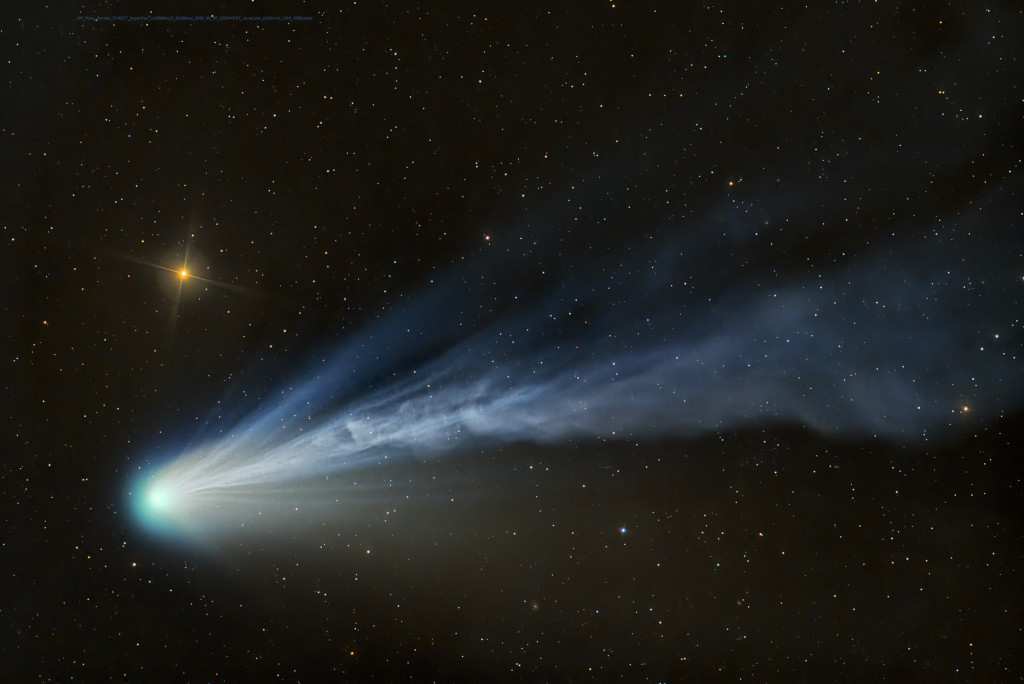
In dark evening skies over June Lake, northern hemisphere, planet Earth, Comet 12P/Pons-Brooks stood just above the western horizon on March 30. Its twisted turbulent ion tail and diffuse greenish coma are captured in this two degree wide telescopic field of view along with bright yellowish star Hamal also known as Alpha Arietis. Now Pons-Brooks has moved out of the northern night though, approaching perihelion on April 21. On April 8 you might still spot the comet in daytime skies. But to do it, you will have to stand in the path of totality and look away from the spectacle of an alluring solar corona and totally eclipsed Sun.

https://apod.nasa.gov/apod/ap240404.html ( April 04, 2024)

Tuesday, April 2, 2024


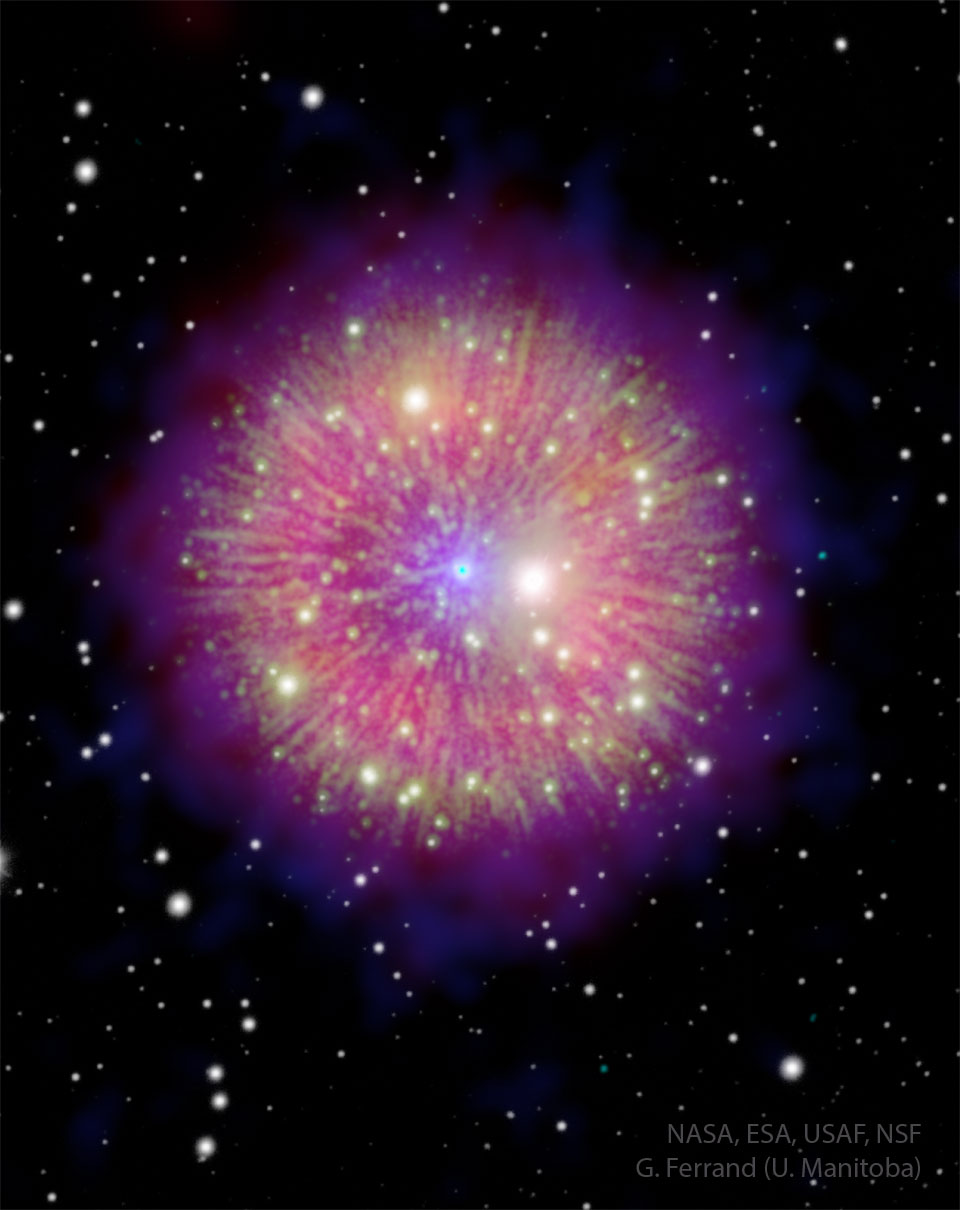
What created this unusual celestial firework? The nebula, dubbed Pa 30, appears in the same sky direction now as a bright "guest star" did in the year 1181. Although Pa 30's filaments look similar to that created by a nova (for example GK Per), and a planetary nebula (for example NGC 6751), some astronomers now propose that it was created by a rare type of supernova: a thermonuclear Type Iax, and so is (also) named SN 1181. In this model, the supernova was not the result of the detonation of a single star, but rather a blast that occurred when two white dwarf stars spiraled together and merged. The blue dot in the center is hypothesized to be a zombie star, the remnant white dwarf that somehow survived this supernova-level explosion. The featured image combines images and data obtained with infrared (WISE), visible (MDM, Pan-STARRS), and X-ray (Chandra, XMM) telescopes. Future observations and analyses may tell us more.

https://apod.nasa.gov/apod/ap240403.html ( April 03, 2024)

Monday, April 1, 2024


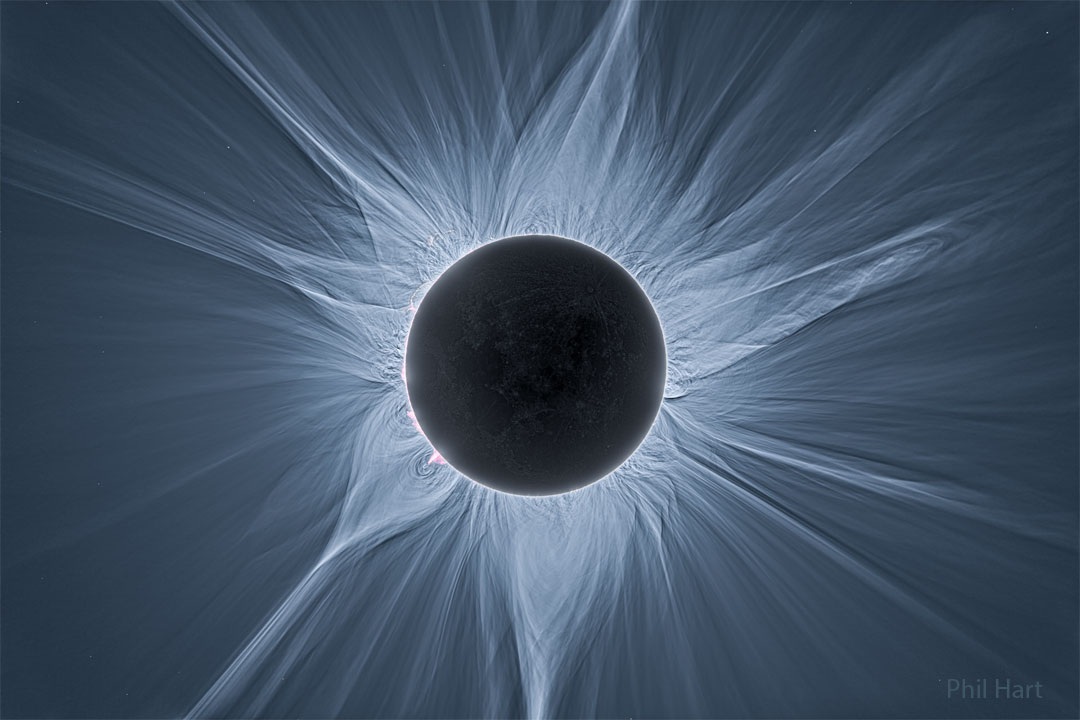
Only in the fleeting darkness of a total solar eclipse is the light of the solar corona easily visible. Normally overwhelmed by the bright solar disk, the expansive corona, the sun's outer atmosphere, is an alluring sight. But the subtle details and extreme ranges in the corona's brightness, although discernible to the eye, are notoriously difficult to photograph. Pictured here, however, using multiple images and digital processing, is a detailed image of the Sun's corona taken during the April 20, 2023 total solar eclipse from Exmouth, Australia. Clearly visible are intricate layers and glowing caustics of an ever changing mixture of hot gas and magnetic fields. Bright looping prominences appear pink just around the Sun's limb. A similar solar corona might be visible through clear skies in a narrow swath across the North America during the total solar eclipse that occurs just six days from today

https://apod.nasa.gov/apod/ap240402.html ( April 02, 2024)