Tuesday, September 12, 2023

Frank Rubio Breaks NASA’s Single Spaceflight Record


In this image from July 24, 2023, astronaut Frank Rubio completes a session on the Surface Avatar Remote Control Terminal, which investigates how haptic controls, user interfaces, and virtual reality could command and control surface-bound robots from long distances.

from NASA http://www.nasa.gov/image-feature/frank-rubio-breaks-nasa-s-single-spaceflight-record
via IFTTT

Monday, September 11, 2023

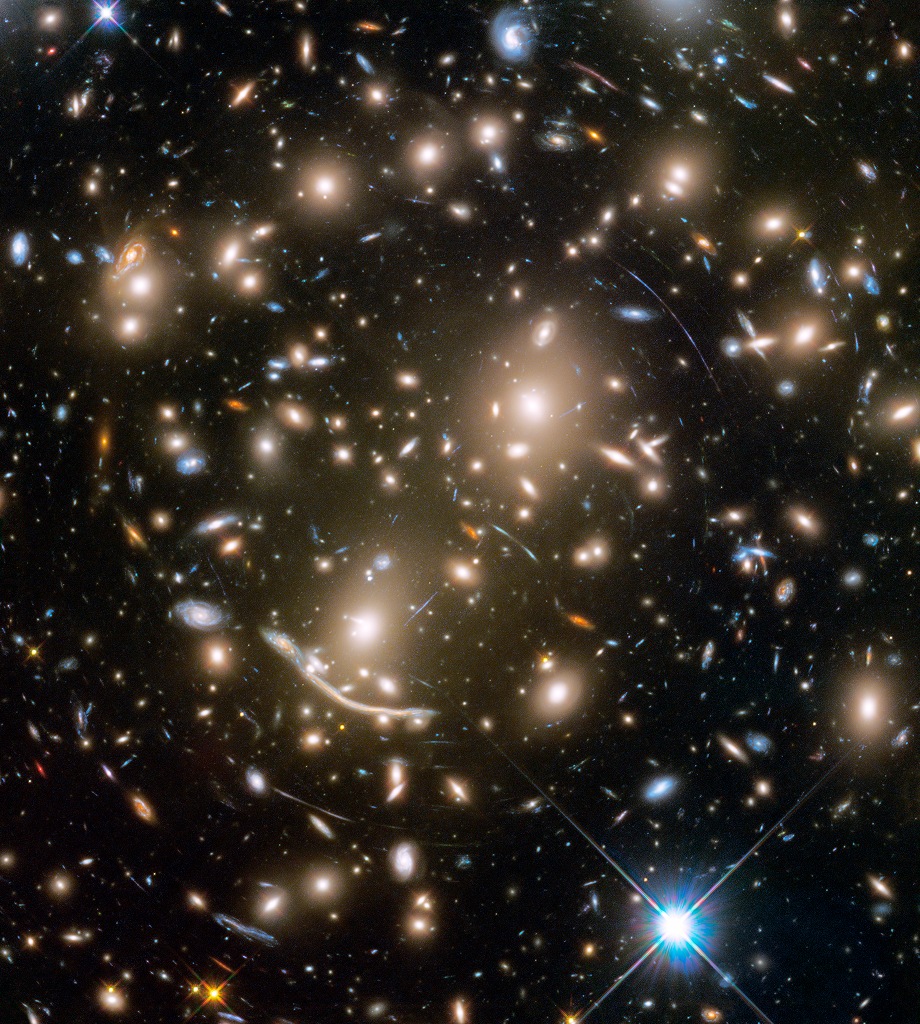
Galaxy Cluster Abell 370 and Beyond


Some 4 billion light-years away, massive galaxy cluster Abell 370 is captured in this sharp Hubble Space Telescope snapshot. The cluster of galaxies only appears to be dominated by two giant elliptical galaxies and infested with faint arcs. In reality, the fainter, scattered bluish arcs, along with the dramatic dragon arc below and left of center, are images of galaxies that lie far beyond Abell 370. About twice as distant, their otherwise undetected light is magnified and distorted by the cluster's enormous gravitational mass, overwhelmingly dominated by unseen dark matter. Providing a tantalizing glimpse of galaxies in the early universe, the effect is known as gravitational lensing. A consequence of warped spacetime, lensing was predicted by Einstein almost a century ago. Far beyond the spiky foreground Milky Way star at lower right, Abell 370 is seen toward the constellation Cetus, the Sea Monster. It was the last of six galaxy clusters imaged in the Frontier Fields project.

https://apod.nasa.gov/apod/ap230912.html ( September 12, 2023)

Snowy Egret Searches the Waters


A snowy egret, identifiable by its slender black bill, black legs and yellow feet, marches through a pond near NASA’s Kennedy Space Center, looking for food in this image from March 29, 2007.

from NASA http://www.nasa.gov/image-feature/snowy-egret-searches-the-waters
via IFTTT

Sunday, September 10, 2023


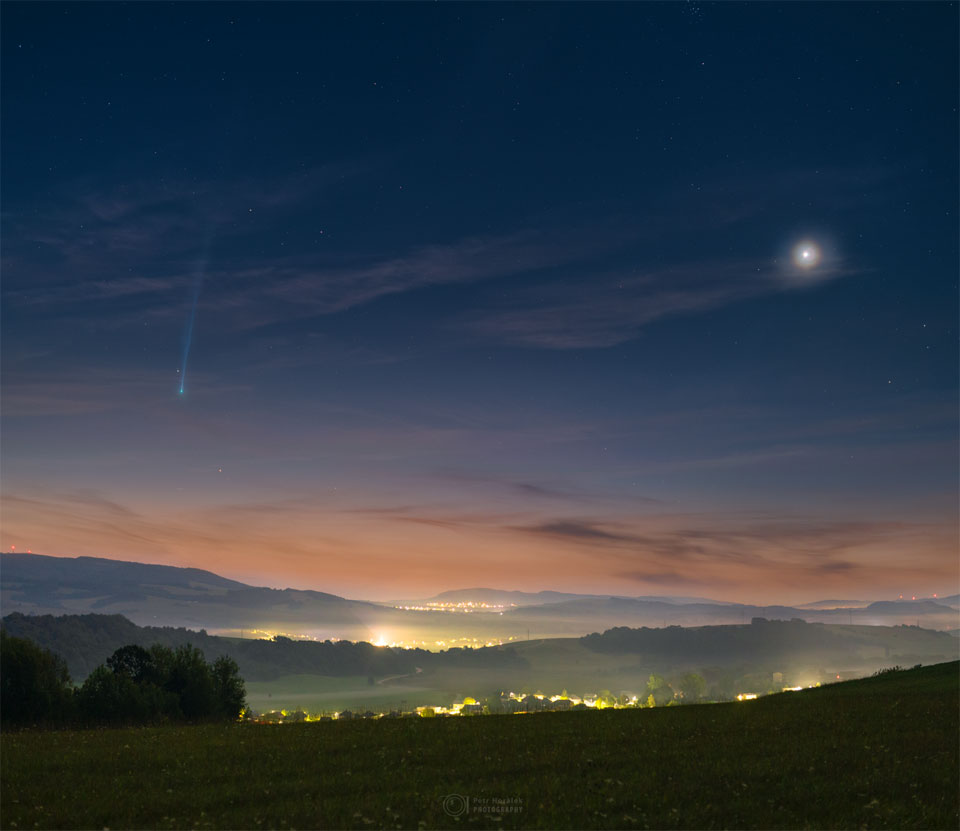
This scene would be beautiful even without the comet. By itself, the sunrise sky is an elegant deep blue on high, with faint white stars peeking through, while near the horizon is a pleasing tan. By itself, the foreground hills of eastern Slovakia are appealingly green, with the Zadňa hura and Veľká hora hills in the distance, and with the lights of small towns along the way. Venus, by itself on the right, appears unusually exquisite, surrounded by a colorful atmospheric corona. But what attracts the eye most is the comet. On the left, in this composite image taken just before dawn yesterday morning, is Comet Nishimura. On recent mornings around the globe, its bright coma and long ion tail make many a morning panoramic photo unusually beautiful. Tomorrow, C/2023 P1 (Nishimura) will pass its nearest to the Earth for about the next 434 years.

https://apod.nasa.gov/apod/ap230911.html ( September 11, 2023)

Saturday, September 9, 2023


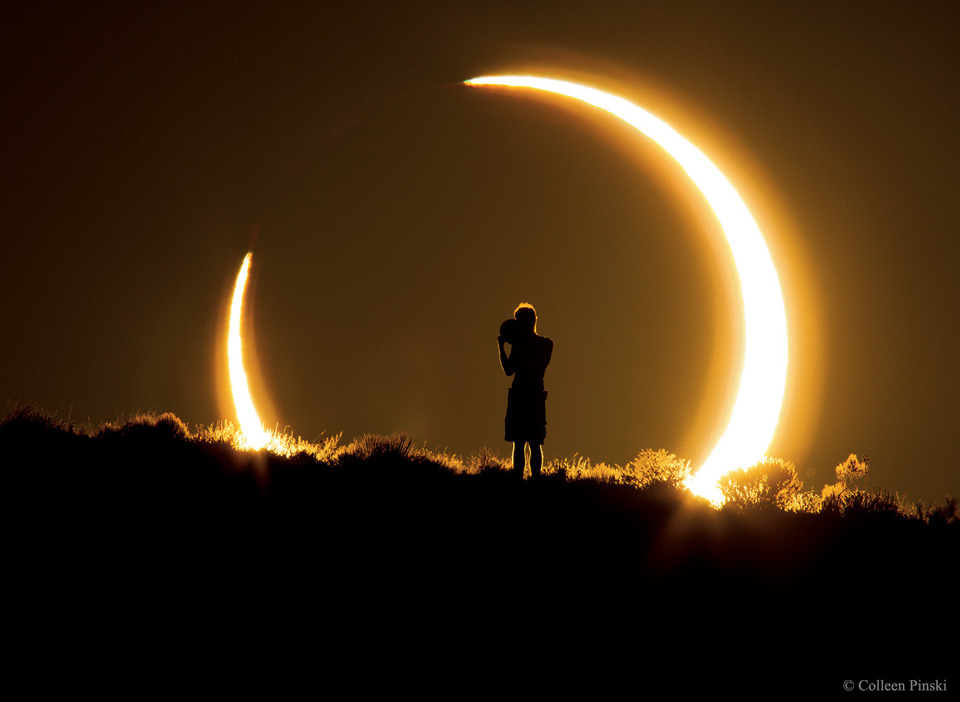
What is this person doing? In 2012, an annular eclipse of the Sun was visible over a narrow path that crossed the northern Pacific Ocean and several western US states. In an annular solar eclipse, the Moon is too far from the Earth to block out the entire Sun, leaving the Sun peeking out over the Moon's disk in a ring of fire. To capture this unusual solar event, an industrious photographer drove from Arizona to New Mexico to find just the right vista. After setting up and just as the eclipsed Sun was setting over a ridge about 0.5 kilometers away, a person unknowingly walked right into the shot. Although grateful for the unexpected human element, the photographer never learned the identity of the silhouetted interloper. It appears likely that the person is holding a circular device that would enable them to get their own view of the eclipse. The shot was taken at sunset on 2012 May 20 at 7:36 pm local time from a park near Albuquerque. Next month, on October 14, a different narrow swath across North and South America will be exposed to a different annular solar eclipse, if the sky is clear. Simultaneously, cloud-free observers almost anywhere on either continent will be able to see a partial solar eclipse.

https://apod.nasa.gov/apod/ap230910.html ( September 10, 2023)

Friday, September 8, 2023


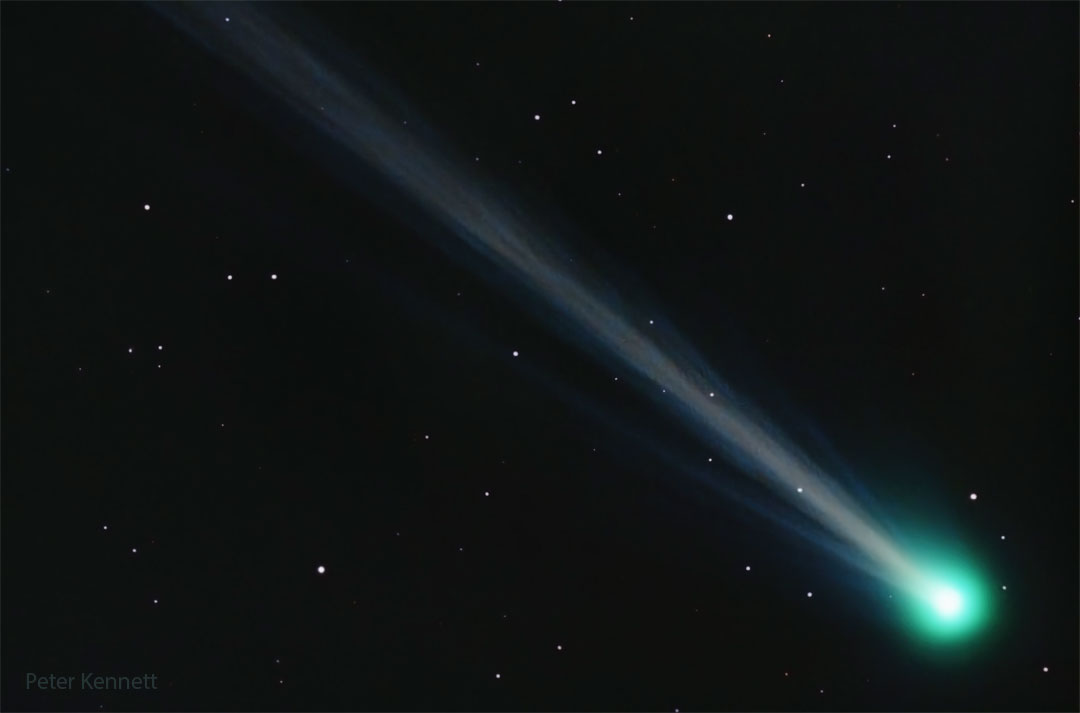
Comet Nishimura is growing. More precisely, the tails C/2023 P1 (Nishimura) are growing as it nears the Sun. Discovered only last month, the comet is already near naked eye brightness as it now moves inside the Earth's orbit. The comet will be nearest the Earth next week, but nearest the Sun the week after -- on September 17. Speculation holds that expelled ice and dust from Comet Nishimura's last visit to the inner Solar System may have created the Sigma Hydrids meteor shower which peaks yearly in December. If so, then this meteor shower may become more active, refreshed with new comet debris. Pictured, Comet Nishimura was captured from Edgewood, New Mexico, USA four nights ago, showing a long ion tail structured by interactions with the Sun's wind. Look for this comet near your eastern horizon just before sunrise for the next few mornings, but very near your western horizon just after sunset next week -- as its coma continues to brighten and its tails continue to grow.

https://apod.nasa.gov/apod/ap230909.html ( September 09, 2023)

Opening the Hatch: Crew-6 Splashdown


Support teams onboard the SpaceX recovery ship MEGAN work to open the hatch of the SpaceX Dragon Endeavour spacecraft shortly after it landed in the Atlantic Ocean on Sept. 4, 2023, with NASA astronauts Stephen Bowen and Woody Hoburg, United Arab Emirates (UAE) astronaut Sultan Alneyadi, and Roscosmos cosmonaut Andrey Fedyaev aboard.

from NASA http://www.nasa.gov/image-feature/opening-the-hatch-crew-6-splashdown
via IFTTT

ISS Daily Summary Report – 9/07/2023

iss-about-banner


Payloads: Astrobee: The JEM was prepared for Astrobee flyer remote operations. Astrobee is made up of three free-flying, cube-shaped robots. These robots are designed to help scientists and engineers develop and test technologies for use in microgravity to assist astronauts with routine chores, and give ground controllers additional eyes and ears on the space station. … ...

September 07, 2023 at 12:00PM
From NASA: https://blogs.nasa.gov/stationreport/2023/09/07/iss-daily-summary-report-9-07-2023/

Thursday, September 7, 2023

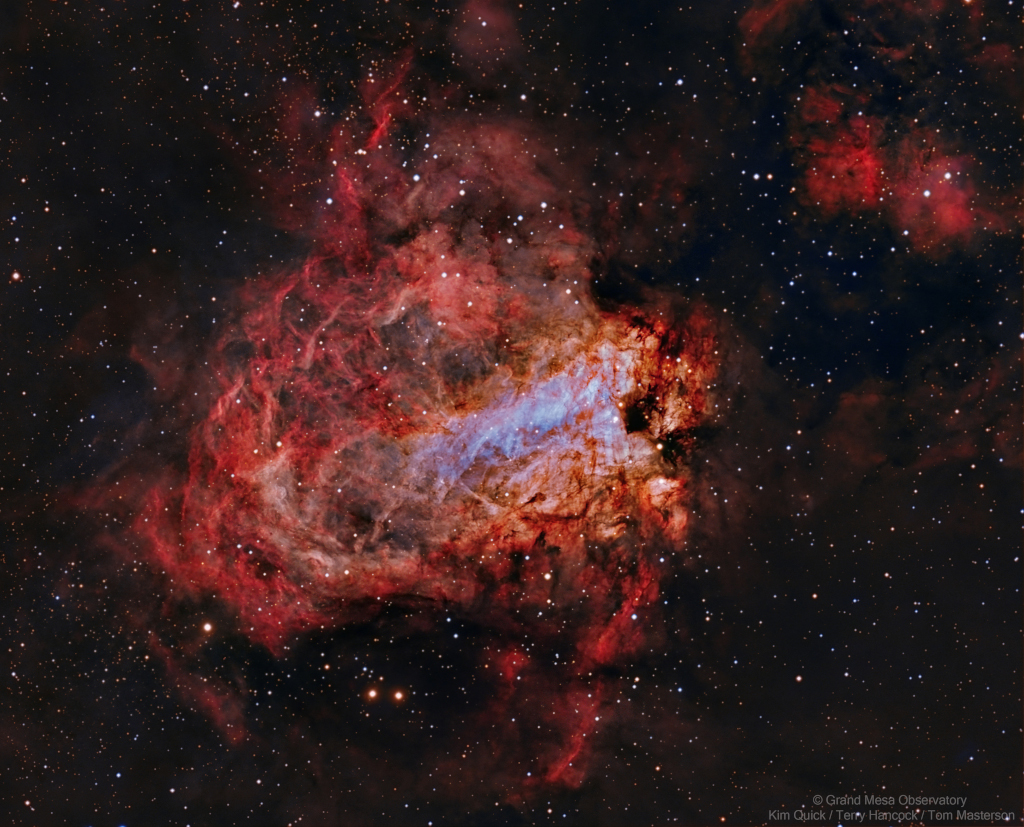
Star Factory Messier 17


Sculpted by stellar winds and radiation, the star factory known as Messier 17 lies some 5,500 light-years away in the nebula-rich constellation Sagittarius. At that distance, this 1/3 degree wide field of view spans over 30 light-years. The sharp composite, color image highlights faint details of the region's gas and dust clouds against a backdrop of central Milky Way stars. Stellar winds and energetic light from hot, massive stars formed from M17's stock of cosmic gas and dust have slowly carved away at the remaining interstellar material, producing the cavernous appearance and undulating shapes. M17 is also known as the Omega Nebula or the Swan Nebula.

https://apod.nasa.gov/apod/ap230908.html ( September 08, 2023)

ISS Daily Summary Report – 9/06/2023

iss-about-banner


Payloads: Actiwatch-Plus: Actiwatch units were hooked up to Human Research Facility 1 (HRF-1) for charging and data downlinks. The Actiwatch-Plus is a waterproof, non-intrusive, sleep-wake activity monitor worn on the wrist of a crewmember and contains a miniature uniaxial accelerometer that produces a signal as the subject moves. The data is stored in non-volatile memory … ...

September 06, 2023 at 12:00PM
From NASA: https://blogs.nasa.gov/stationreport/2023/09/06/iss-daily-summary-report-9-06-2023/