Monday, August 14, 2023

Artemis II Crew, Meet Orion


While wearing clean room suits, the Artemis II crew members check out their Orion crew module inside the Neil Armstrong Operations and Checkout Building at NASA’s Kennedy Space Center in Florida on Aug. 7, 2023.

from NASA http://www.nasa.gov/image-feature/artemis-ii-crew-meet-orion
via IFTTT

Sunday, August 13, 2023


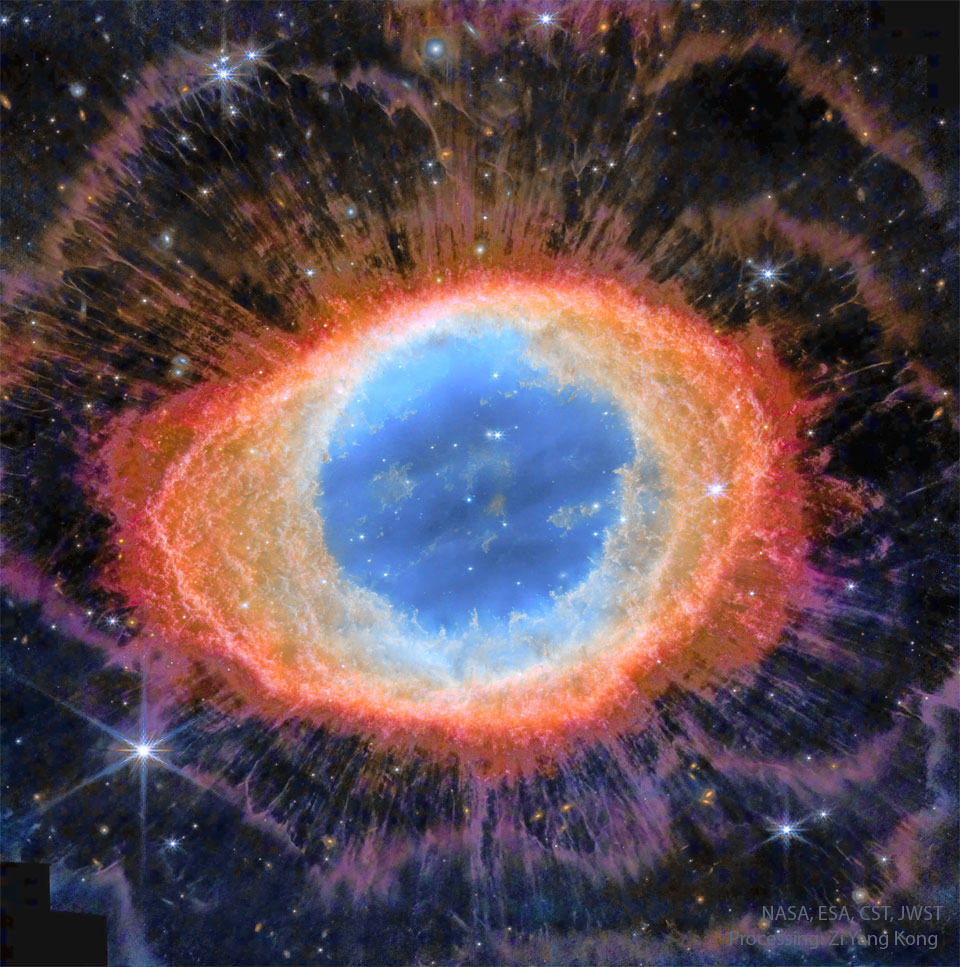
The Ring Nebula (M57), is more complicated than it appears through a small telescope. The easily visible central ring is about one light-year across, but this remarkable exposure by the James Webb Space Telescope explores this popular nebula with a deep exposure in infrared light. Strings of gas, like eyelashes around a cosmic eye, become evident around the Ring in this digitally enhanced featured image in assigned colors. These long filaments may be caused by shadowing of knots of dense gas in the ring from energetic light emitted within. The Ring Nebula is an elongated planetary nebula, a type of gas cloud created when a Sun-like star evolves to throw off its outer atmosphere to become a white dwarf star. The central oval in the Ring Nebula lies about 2,500 light-years away toward the musical constellation Lyra.

https://apod.nasa.gov/apod/ap230814.html ( August 14, 2023)

Saturday, August 12, 2023


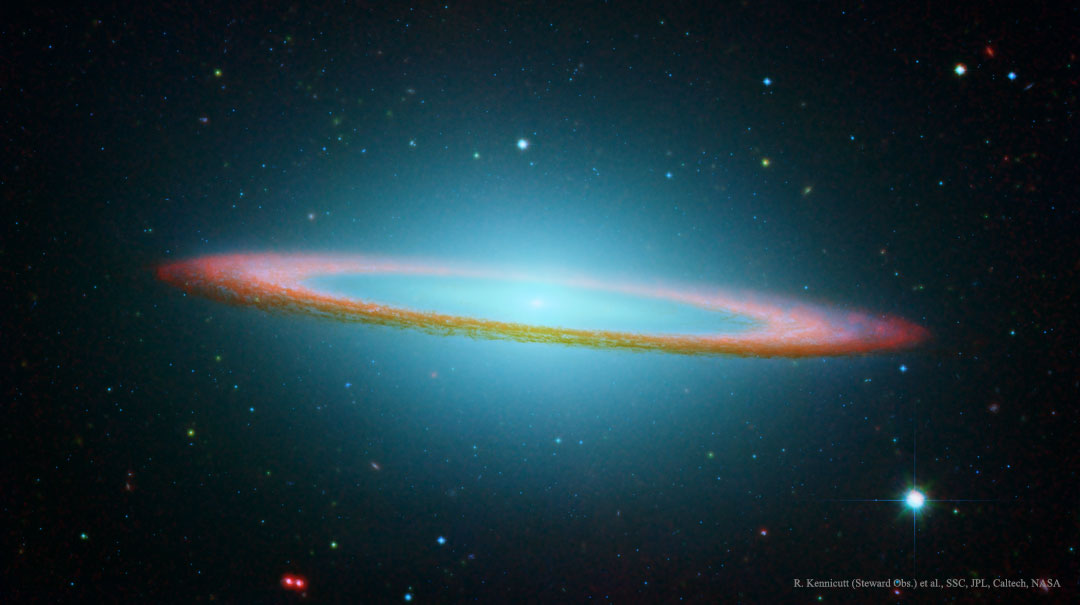
This floating ring is the size of a galaxy. In fact, it is a galaxy -- or at least part of one: the photogenic Sombrero Galaxy, one of the largest galaxies in the nearby Virgo Cluster of Galaxies. The dark band of dust that obscures the mid-section of the Sombrero Galaxy in optical light actually glows brightly in infrared light. The featured image, digitally sharpened, shows the infrared glow, recently recorded by the orbiting Spitzer Space Telescope, superposed in false-color on an existing image taken by NASA's Hubble Space Telescope in visible light. The Sombrero Galaxy, also known as M104, spans about 50,000 light years across and lies 28 million light years away. M104 can be seen with a small telescope in the direction of the constellation Virgo.

https://apod.nasa.gov/apod/ap230813.html ( August 13, 2023)

Friday, August 11, 2023

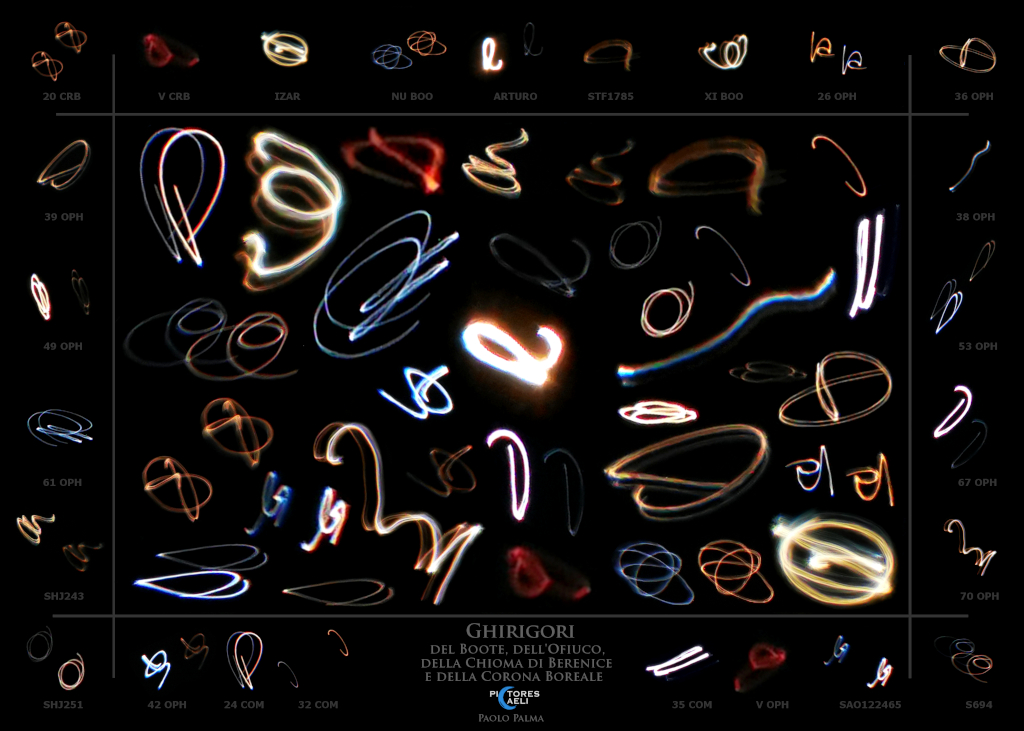
Ghirigori Star Scribbles


It's fun to scribble on the canvas of the sky. You can use a creative photographic technique to cause the light of point-like stars to dance across a digital image by tapping lightly on the telescope while making an exposure. The result will be a squiggly line traced by the star (or two squiggles traced by binary stars) that can reveal the star's color. Colorful lines, dubbed Ghirigori, made from stars found in the northern sky constellations Bootes, Corona Borealis, Ophiucus, and Coma Berenices, are captured in this artistic mosaic. The 25 stars creating the varied and colorful squiggles are identified around the border. Of course, temperature determines the color of a star. While whitish stars tend to be close to the Sun's temperature, stars with bluer hues are hotter, and yellow and red colors are cooler than the Sun.

https://apod.nasa.gov/apod/ap230812.html ( August 12, 2023)

An Artist’s Concept of the Apollo 11 Lunar Module Landing


This artist’s concept from July 11, 1969, depicts the Apollo 11 lunar module (LM) Eagle landing on the surface of the Moon.

from NASA http://www.nasa.gov/image-feature/an-artist-s-concept-of-the-apollo-11-lunar-module-landing
via IFTTT

Thursday, August 10, 2023

M51 in 255 Hours


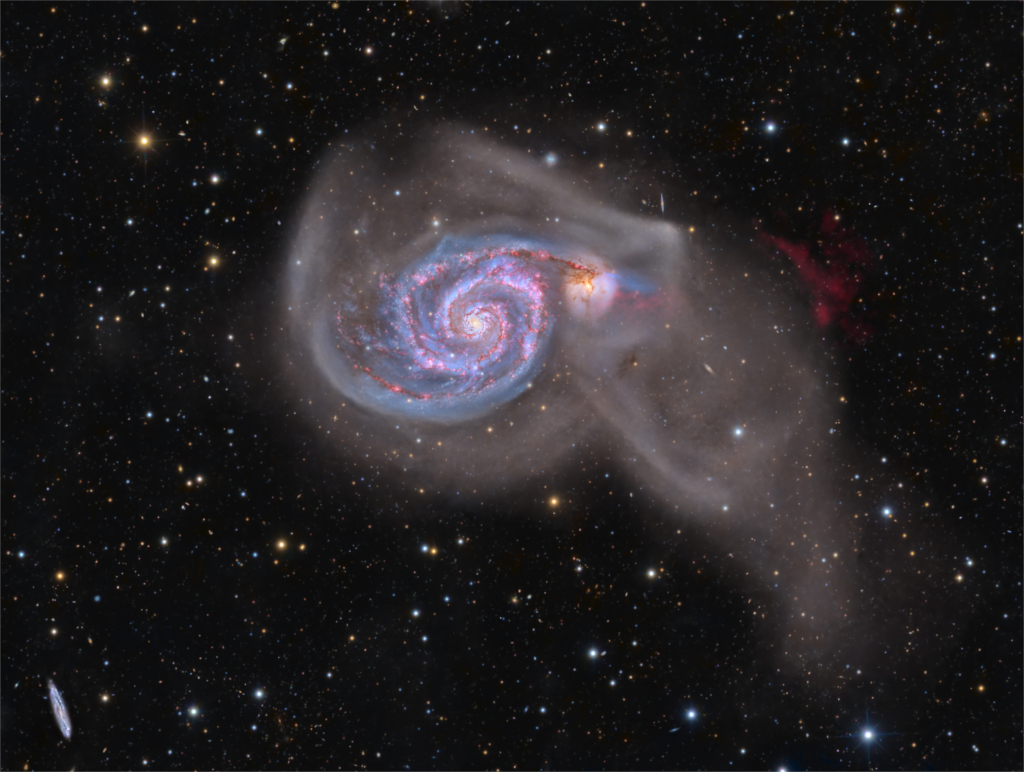
An intriguing pair of interacting galaxies, M51 is the 51st entry in Charles Messier's famous catalog. Perhaps the original spiral nebula, the large galaxy with whirlpool-like spiral structure seen nearly face-on is also cataloged as NGC 5194. Its spiral arms and dust lanes sweep in front of a companion galaxy (right), NGC 5195. Some 31 million light-years distant, within the boundaries of the well-trained constellation Canes Venatici, M51 looks faint and fuzzy to the eye in direct telescopic views. But this remarkably deep image shows off stunning details of the galaxy pair's striking colors and extensive tidal debris. A collaboration of astro-imagers using telescopes on planet Earth combined over 10 days of exposure time to create this definitive galaxy portrait of M51. The image includes 118 hours of narrowband data that also reveals a vast glowing cloud of reddish ionized hydrogen gas discovered in the M51 system.

https://apod.nasa.gov/apod/ap230811.html ( August 11, 2023)

Phoenix’s Red Planet Selfie


NASA’s Mars Phoenix Lander gathered images of itself for this selfie from June 5 through July 12, 2008, with its Surface Stereo Imager.

from NASA http://www.nasa.gov/image-feature/phoenix-s-red-planet-selfie
via IFTTT

Wednesday, August 9, 2023

Five Meters over Mars


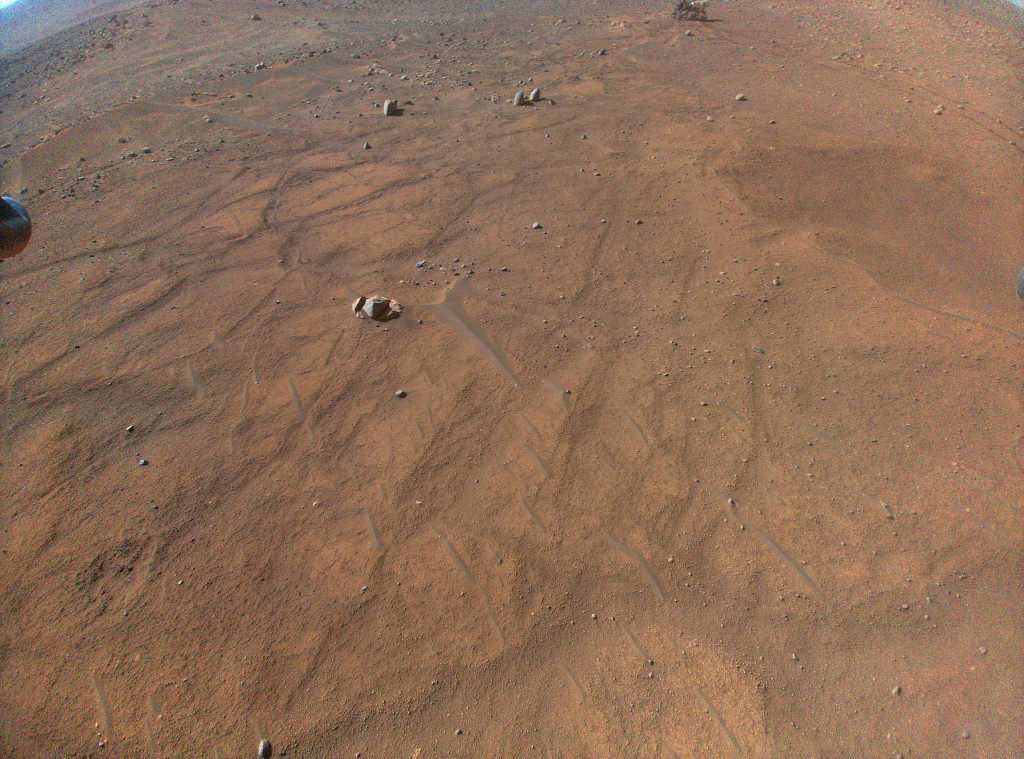
On mission sol 872 (Earth date August 3) Ingenuity snapped this sharp image on its 54th flight above the surface of the Red Planet. During the flight the Mars Helicopter hovered about 5 meters, or just over 16 feet, above the Jezero crater floor. Tips of Ingenuity's landing legs peek over the left and right edges in the camera's field of view. Tracks visible near the upper right corner lead to the Perseverance Mars Rover, seen looking on from a distance at the top right edge of the frame. Planned as a brief "pop-up" flight, Ingenuity's 54th flight lasted less than 25 seconds. It followed Ingenuity's 53rd flight made on July 22 that resulted in an unscheduled landing.

https://apod.nasa.gov/apod/ap230810.html ( August 10, 2023)

Webb Reveals Colors of Earendel, Most Distant Star Ever Detected


from NASA http://www.nasa.gov/feature/goddard/2023/webb-reveals-colors-of-earendel-most-distant-star-ever-detected
via IFTTT

ISS Daily Summary Report – 8/08/2023

iss-about-banner


Payloads: Plant Habitat-03B: The crew gained access to the Plant Habitat facility, obtained several groups of leaf samples, and prepared them for return to the ground. The Arabidopsis thaliana plants began growing in mid-July and will continue to develop throughout the 91-day growth cycle. Plants exposed to environmental stress, including spaceflight, undergo epigenetic changes that … ...

August 08, 2023 at 12:00PM
From NASA: https://blogs.nasa.gov/stationreport/2023/08/08/iss-daily-summary-report-8-08-2023/