Sunday, February 5, 2023


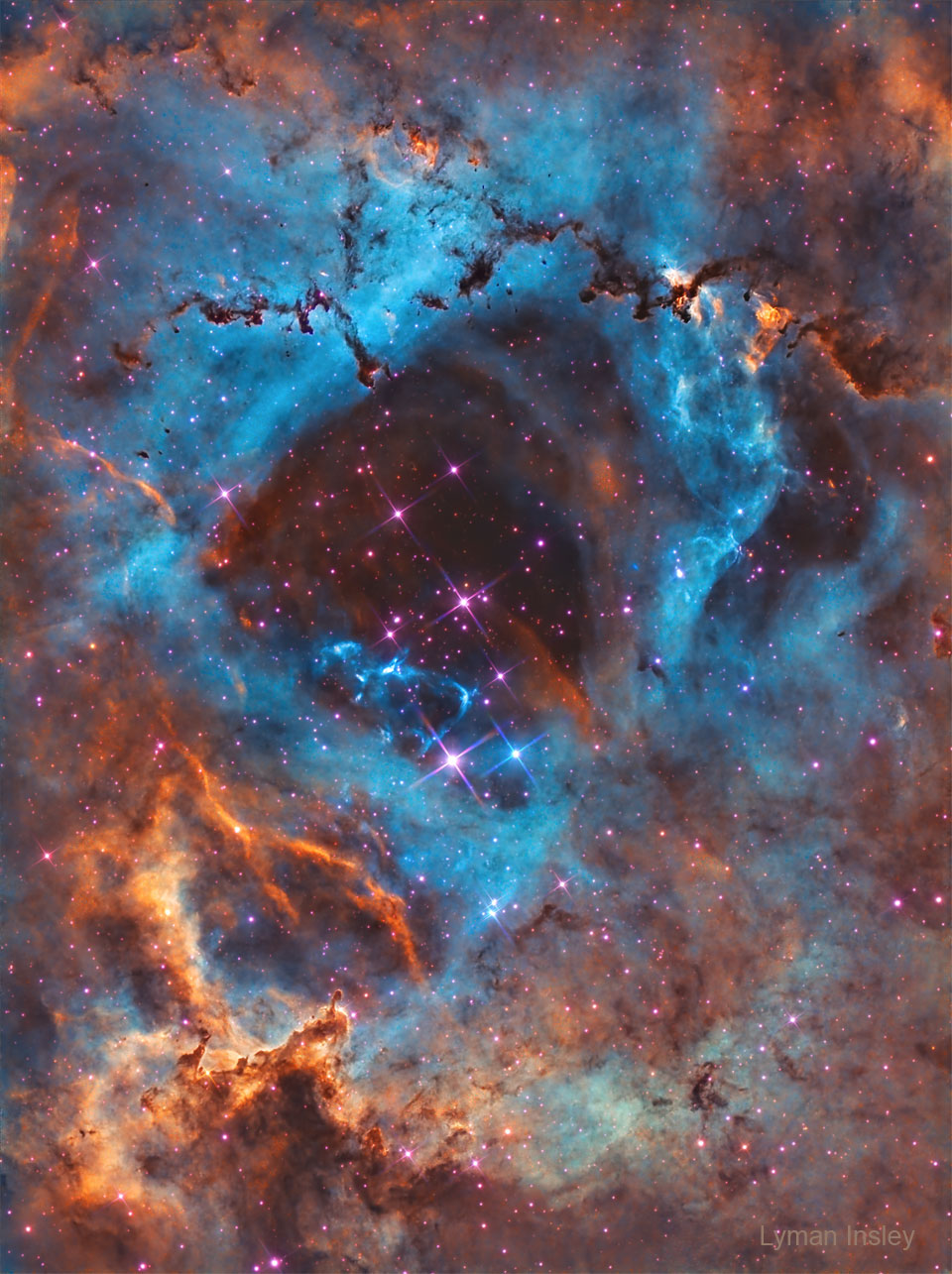
In the heart of the Rosette Nebula lies a bright cluster of stars that lights up the nebula. The stars of NGC 2244 formed from the surrounding gas only a few million years ago. The featured image taken in mid-January using multiple exposures and very specific colors of Sulfur (shaded red), Hydrogen (green), and Oxygen (blue), captures the central region in tremendous detail. A hot wind of particles streams away from the cluster stars and contributes to an already complex menagerie of gas and dust filaments while slowly evacuating the cluster center. The Rosette Nebula's center measures about 50 light-years across, lies about 5,200 light-years away, and is visible with binoculars towards the constellation of the Unicorn (Monoceros).

https://apod.nasa.gov/apod/ap230206.html ( February 06, 2023)

Saturday, February 4, 2023


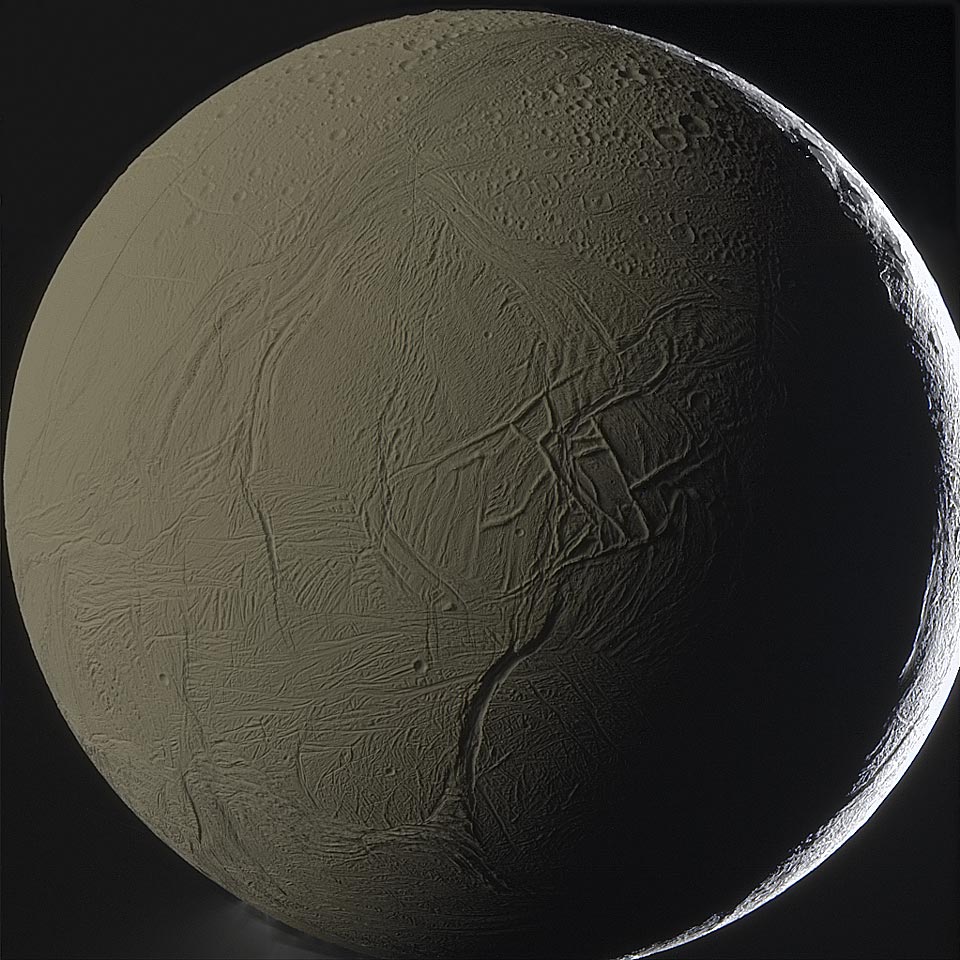
This moon is shining by the light of its planet. Specifically, a large portion of Enceladus pictured here is illuminated primarily by sunlight first reflected from the planet Saturn. The result is that the normally snow-white moon appears in the gold color of Saturn's cloud tops. As most of the illumination comes from the image left, a labyrinth of ridges throws notable shadows just to the right of the image center, while the kilometer-deep canyon Labtayt Sulci is visible just below. The bright thin crescent on the far right is the only part of Enceladus directly lit by the Sun. The featured image was taken in 2011 by the robotic Cassini spacecraft during a close pass by by the enigmatic moon. Inspection of the lower left part of this digitally sharpened image reveals plumes of ice crystals thought to originate in a below-surface sea.

https://apod.nasa.gov/apod/ap230205.html ( February 05, 2023)

Friday, February 3, 2023

NGC 2626 along the Vela Molecular Ridge


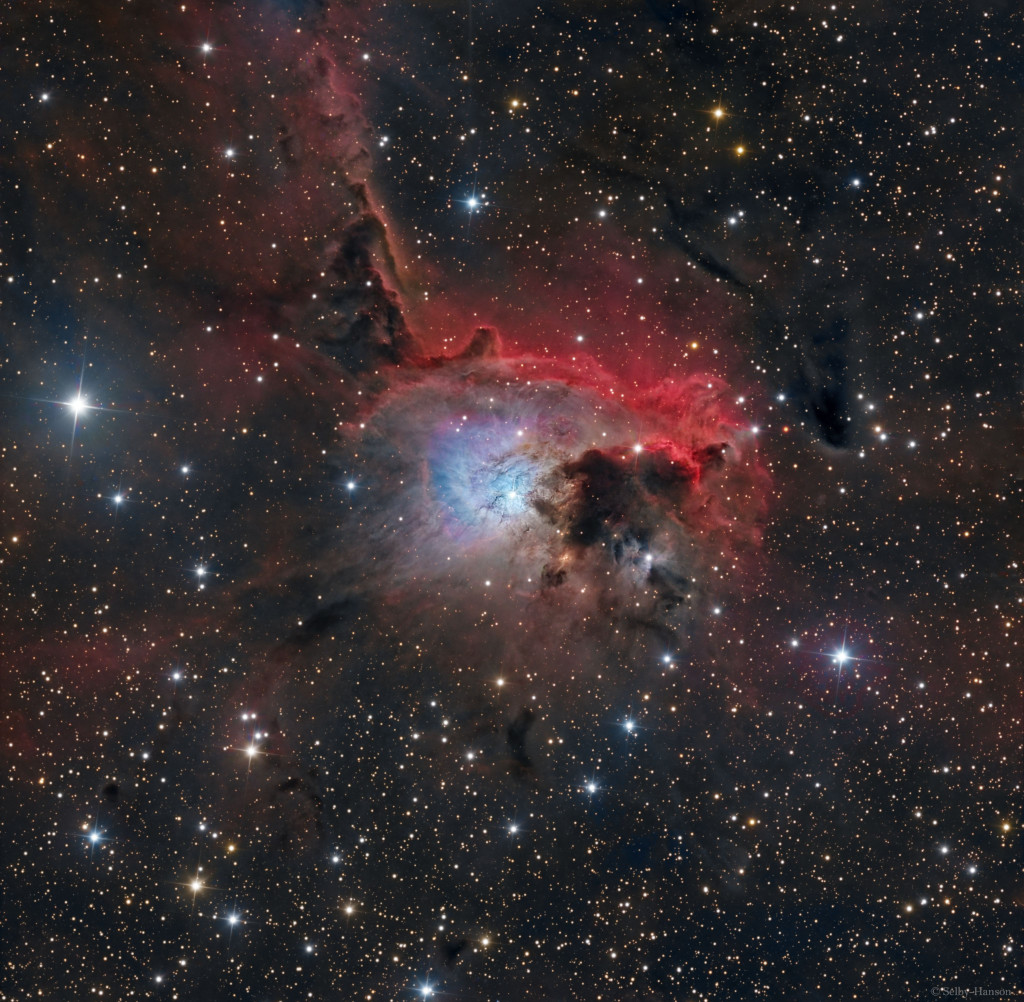
Centered in this colorful cosmic canvas, NGC 2626 is a beautiful, bright, blue reflection nebula in the southern Milky Way. Next to an obscuring dust cloud and surrounded by reddish hydrogen emission from large H II region RCW 27 it lies within a complex of dusty molecular clouds known as the Vela Molecular Ridge. NGC 2626 is itself a cloud of interstellar dust reflecting blue light from the young hot embedded star visible within the nebula. But astronomical explorations reveal many other young stars and associated nebulae in the star-forming region. NGC 2626 is about 3,200 light-years away. At that distance this telescopic field of view would span about 30 light-years along the Vela Molecular Ridge.

https://apod.nasa.gov/apod/ap230204.html ( February 04, 2023)

Spiral Galaxy Spans Space


This Jan. 10, 2013, composite image of the giant barred spiral galaxy NGC 6872 combines visible light images from the European Southern Observatory's Very Large Telescope with far-ultraviolet data from NASA's Galaxy Evolution Explorer (GALEX) and infrared data acquired by NASA's Spitzer Space Telescope.

from NASA http://www.nasa.gov/image-feature/spiral-galaxy-spans-space
via IFTTT

ISS Daily Summary Report – 2/02/2023

iss-about-banner


Payloads: None Systems: USOS EVA 85: ISS Roll Out Solar Array (IROSA) Prep 1A Troubleshooting EVA: Today, ISS crewmembers Nicole Mann and Koichi Wakata completed the 85h USOS Extravehicular Activity (EVA). The main goal of this EVA was to troubleshoot interface issues encountered during a previous EVA installation activity that was initiated but not completed. … ...

February 02, 2023 at 11:00AM
From NASA: https://blogs.nasa.gov/stationreport/2023/02/02/iss-daily-summary-report-2-02-2023/

Thursday, February 2, 2023

Polaris and the Trail of Comet ZTF


Stars trace concentric arcs around the North Celestial Pole in this three hour long night sky composite, recorded with a digital camera fixed to a tripod on January 31, near Àger, Lleida, Spain. On that date Comet C/2022 E3 (ZTF) was near its northernmost declination in planet Earth's sky. That put the comet about 10 degrees from Earth's North Celestial Pole making the comet's position circumpolar, always above the horizon, from all locations on planet Earth at more than 10 degrees northern latitude. In the startrail image, the extension of Earth's axis of rotation into space is at the left. North star Polaris traces the short, bright, concentric arc less than a degree from the North Celestial Pole. The trail of Comet ZTF is indicated at the right, its apparent motion mostly reflecting Earth's rotation like the stars. But heading for its closest approach to planet Earth on February 1, the comet is also moving significantly with respect to the background stars. The diffuse greenish trail of Comet ZTF is an almost concentric arc mingled with startrails as it sweeps through the long-necked constellation Camelopardalis.

https://apod.nasa.gov/apod/ap230203.html ( February 03, 2023)

Astronauts' View of the Moon


The waxing gibbous Moon stands out in this Jan. 2, 2023, image from the International Space Station as it orbited 269 miles above the southern Indian Ocean.

from NASA http://www.nasa.gov/image-feature/astronauts-view-of-the-moon
via IFTTT

ISS Daily Summary Report – 2/01/2023

iss-about-banner


Payloads: Fluid Dynamics in Space (FLUIDICS): The crew disconnected and stowed the Fluidics HDD and its cable from the CMAU Z-book laptop. The measurement of liquid displacement within a sphere in microgravity relates to a given kinematic representation of a spacecraft’s fuel tank. The FLUIDICS investigation evaluates the Center of Mass (CoM) position regarding a … ...

February 01, 2023 at 11:00AM
From NASA: https://blogs.nasa.gov/stationreport/2023/02/01/iss-daily-summary-report-2-01-2023/

Wednesday, February 1, 2023

Reflections on the 1970s


The 1970s are sometimes ignored by astronomers, like this beautiful grouping of reflection nebulae in Orion - NGC 1977, NGC 1975, and NGC 1973 - usually overlooked in favor of the substantial glow from the nearby stellar nursery better known as the Orion Nebula. Found along Orion's sword just north of the bright Orion Nebula complex, these reflection nebulae are also associated with Orion's giant molecular cloud about 1,500 light-years away, but are dominated by the characteristic blue color of interstellar dust reflecting light from hot young stars. In this sharp color image a portion of the Orion Nebula appears along the bottom border with the cluster of reflection nebulae at picture center. NGC 1977 stretches across the field just below center, separated from NGC 1973 (above right) and NGC 1975 (above left) by dark regions laced with faint red emission from hydrogen atoms. Taken together, the dark regions suggest the region's popular moniker, the Running Man Nebula. At the estimated distance of Orion's dusty molecular cloud this running man would be about 15 light-years across.

https://apod.nasa.gov/apod/ap230202.html ( February 02, 2023)

ISS Daily Summary Report – 1/31/2023

iss-about-banner


Payloads: ADvanced Space Experiment Processor (ADSEP): The ADSEP hardware was installed and activated. A Tissue Cassette was inserted for equipment check out. ADSEP is a thermally controlled single-middeck-locker equivalent that accommodates up to three cassette-based experiments that can be independently operated. Its companion hardware consists of a collection of several experiment cassettes, each doubly or … ...

January 31, 2023 at 11:00AM
From NASA: https://blogs.nasa.gov/stationreport/2023/01/31/iss-daily-summary-report-1-31-2023/