Sunday, December 11, 2022

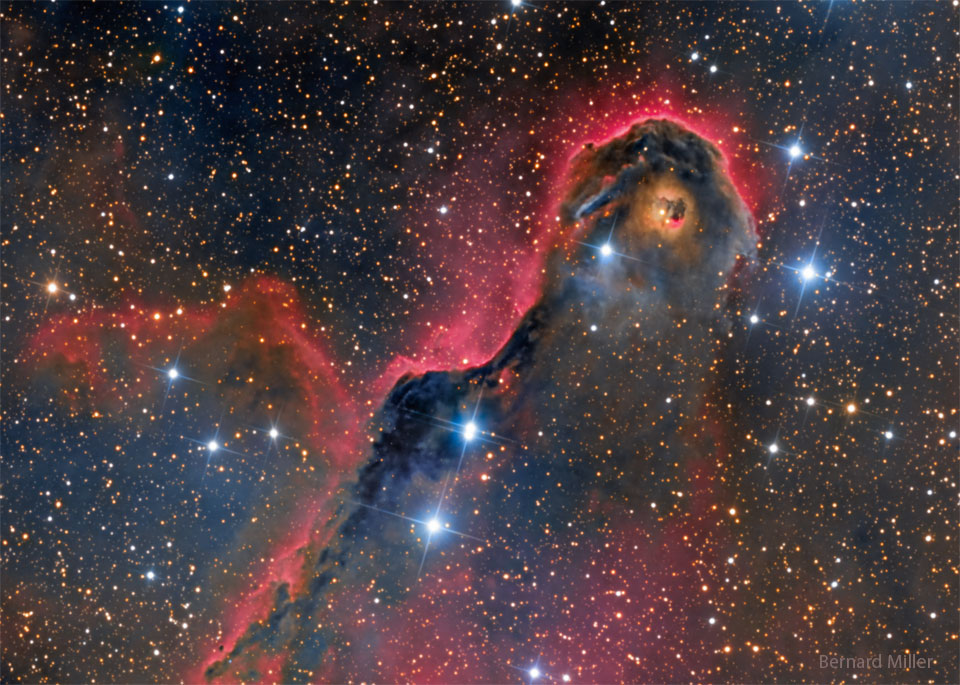
An Unusual Globule in IC 1396


Is there a monster in IC 1396? Known to some as the Elephant's Trunk Nebula, parts of gas and dust clouds of this star formation region may appear to take on foreboding forms, some nearly human. The only real monster here, however, is a bright young star too far from Earth to hurt us. Energetic light from this star is eating away the dust of the dark cometary globule near the top of the featured image. Jets and winds of particles emitted from this star are also pushing away ambient gas and dust. Nearly 3,000 light-years distant, the relatively faint IC 1396 complex covers a much larger region on the sky than shown here, with an apparent width of more than 10 full moons.

https://apod.nasa.gov/apod/ap221212.html ( December 12, 2022)

Saturday, December 10, 2022

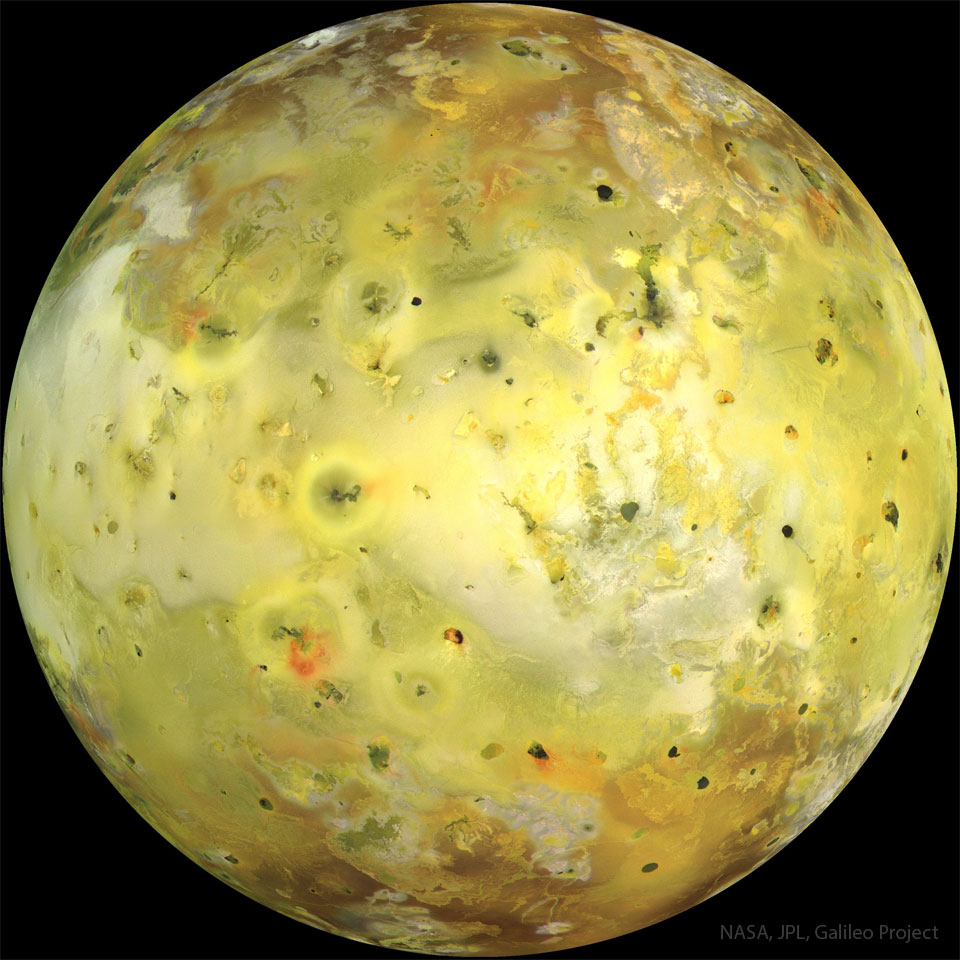
Io in True Color


The strangest moon in the Solar System is bright yellow. The featured picture, an attempt to show how Io would appear in the "true colors" perceptible to the average human eye, was taken in 1999 July by the Galileo spacecraft that orbited Jupiter from 1995 to 2003. Io's colors derive from sulfur and molten silicate rock. The unusual surface of Io is kept very young by its system of active volcanoes. The intense tidal gravity of Jupiter stretches Io and damps wobbles caused by Jupiter's other Galilean moons. The resulting friction greatly heats Io's interior, causing molten rock to explode through the surface. Io's volcanoes are so active that they are effectively turning the whole moon inside out. Some of Io's volcanic lava is so hot it glows in the dark.

https://apod.nasa.gov/apod/ap221211.html ( December 11, 2022)

Friday, December 9, 2022

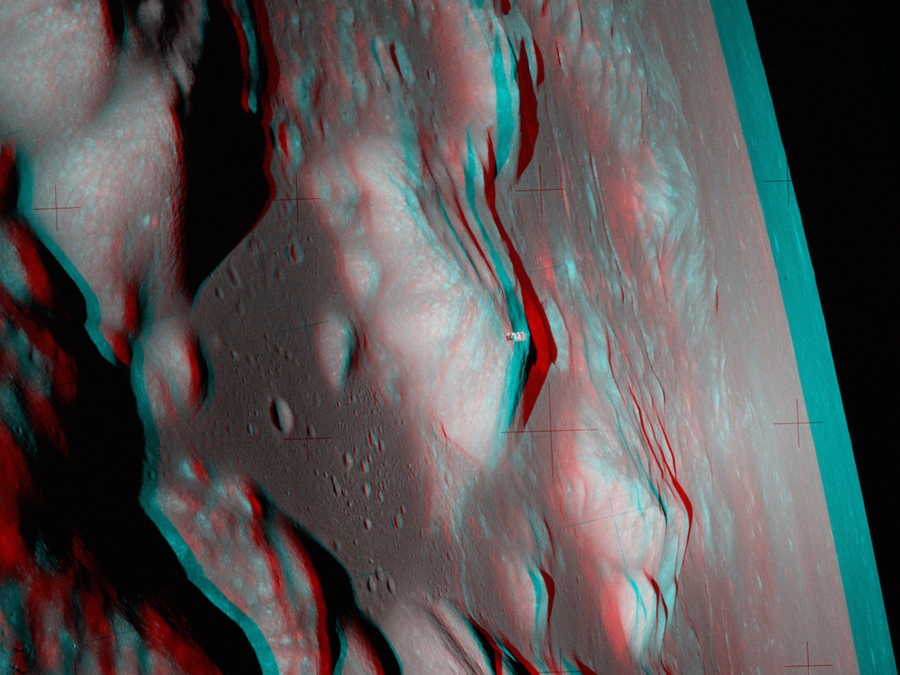
America and the Sea of Serenity


Get out your red/blue glasses and check out this stereo view of another world. Fifty years ago the scene was recorded by Apollo 17 mission commander Eugene Cernan on December 11, 1972, one orbit before descending to land on the Moon. The stereo anaglyph was assembled from two photographs (AS17-147-22465, AS17-147-22466) captured from his vantage point on board the Lunar Module Challenger as he and Dr. Harrison Schmitt flew over Apollo 17's landing site in the Taurus-Littrow Valley. The broad, sunlit face of the mountain dubbed South Massif rises near the center of the frame, above the dark floor of Taurus-Littrow to its left. Piloted by Ron Evans, the Command Module America is visible in orbit in the foreground against the South Massif's peak. Beyond the mountains, toward the lunar limb, lies the Moon's Mare Serenitatis.

https://apod.nasa.gov/apod/ap221210.html ( December 10, 2022)

ISS Daily Summary Report – 12/08/2022

iss-about-banner


Payloads: Food Physiology: A diet briefing was attended between the crew and principal investigator team in support of the Food Physiology investigation. The Integrated Impact of Diet on Human Immune Response, the Gut Microbiota, and Nutritional Status During Adaptation to Spaceflight (Food Physiology) experiment is designed to characterize the key effects of an enhanced spaceflight … ...

December 08, 2022 at 11:00AM
From NASA: https://blogs.nasa.gov/stationreport/2022/12/08/iss-daily-summary-report-12-08-2022/

Orion Gazes at Moon Before Return to Earth


On flight day 20 of the Artemis I mission, Dec. 5, 2022, Orion captured the Moon on the day of return powered flyby, the final major engine maneuver of the flight test.

from NASA http://www.nasa.gov/image-feature/orion-gazes-at-moon-before-return-to-earth
via IFTTT

Thursday, December 8, 2022

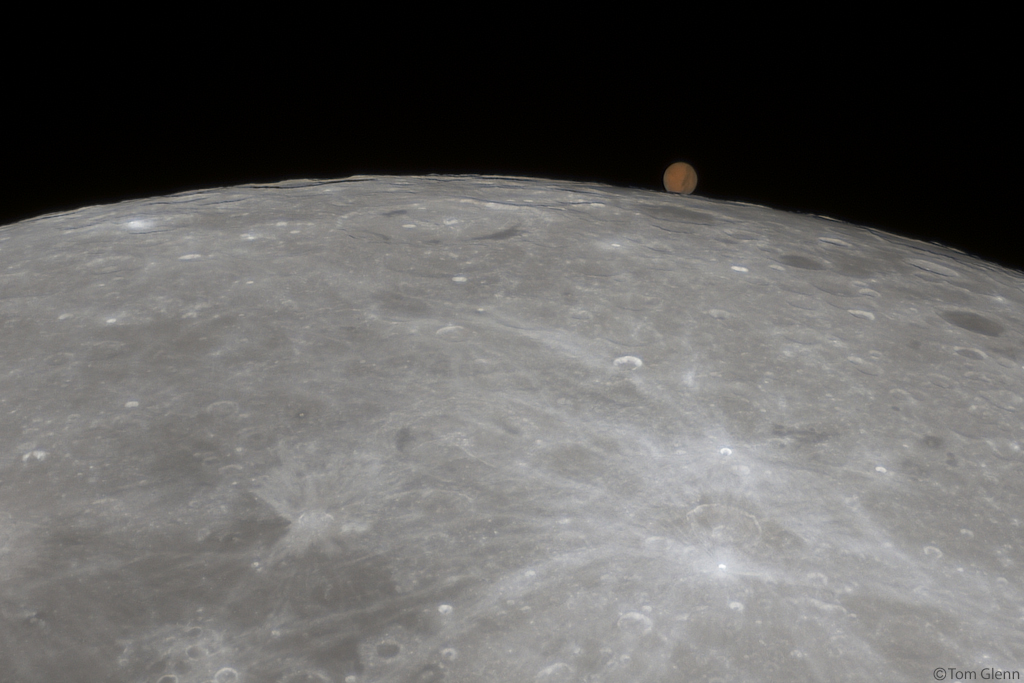
Mars Rises above the Lunar Limb


On the night of December 7 Mars wandered near the Full Moon. In fact the Red Planet was occulted, passing behind the Moon, when viewed from locations across Europe and North America. About an hour after disappearing behind the lunar disk Mars reappears in this stack of sharp video frames captured from San Diego, planet Earth. With the Moon in the foreground Mars was a mere 82 million kilometers distant, near its own opposition. Full Moon and full Mars were bright enough provide the spectacular image with no exposure adjustments necessary. In the image Mars appears to rise just over ancient, dark-floored, lunar crater Abel very close to the southeastern edge of the Moon's near side. Humboldt is the large impact crater to its north (left).

https://apod.nasa.gov/apod/ap221209.html ( December 09, 2022)

Pioneer 10 Flies by Jupiter


In this illustration by Rick Giudice from August 1973, the Pioneer 10 spacecraft passes by the gas giant planet Jupiter.

from NASA http://www.nasa.gov/image-feature/pioneer-10-flies-by-jupiter
via IFTTT

ISS Daily Summary Report – 12/07/2022

iss-about-banner


Payloads: Behavioral Core Measures (BCM): A BCM research session consisting of a set of 12 runs/tests was performed. The Standardized Behavioral Measures for Detecting Behavioral Health Risks during Exploration Missions (BCM) experiment initially examined a suite of measurements to reliably assess the risk of adverse cognitive or behavioral conditions and psychiatric disorders during long-duration spaceflight, … ...

December 07, 2022 at 11:00AM
From NASA: https://blogs.nasa.gov/stationreport/2022/12/07/iss-daily-summary-report-12-07-2022/

Wednesday, December 7, 2022

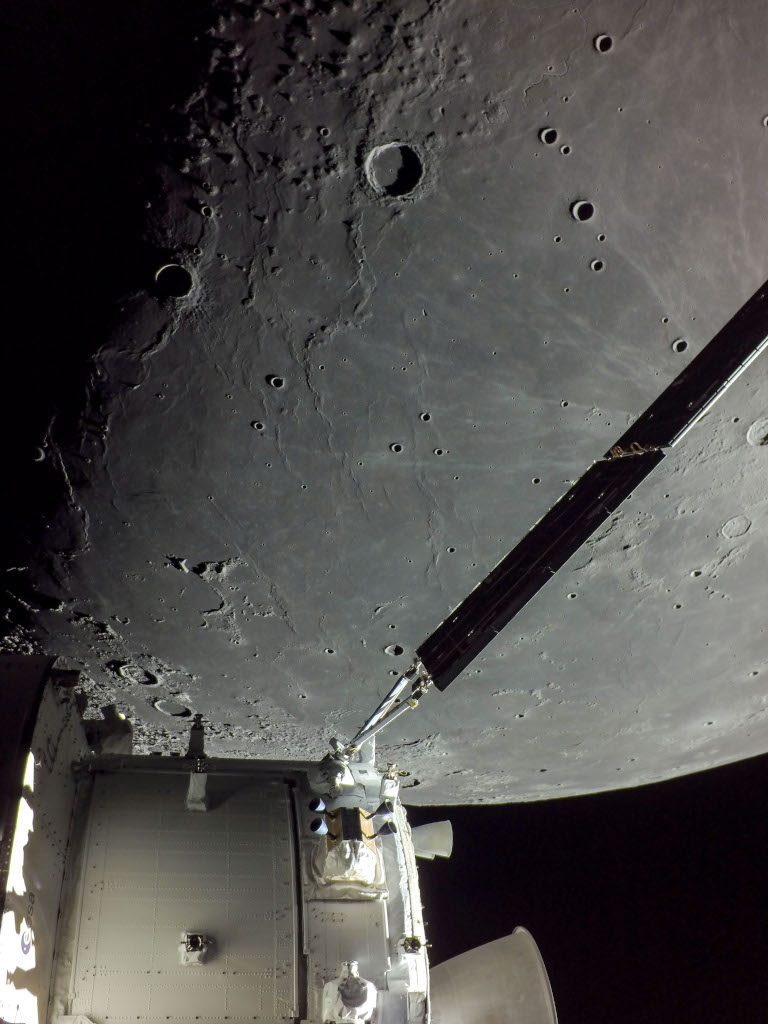
Orion and the Ocean of Storms


A camera on board the uncrewed Orion spacecraft captured this view on December 5 as Orion approached its return powered flyby of the Moon. Below one of Orion's extended solar arrays lies dark, smooth, terrain along the western edge of the Oceanus Procellarum. Prominent on the lunar nearside Oceanus Procellarum, the Ocean of Storms, is the largest of the Moon's lava-flooded maria. The lunar terminator, shadow line between lunar night and day, runs along the left of the frame. The 41 kilometer diameter crater Marius is top center, with ray crater Kepler peeking in at the edge, just right of the solar array wing. Kepler's bright rays extend to the north and west, reaching the dark-floored Marius. Of course the Orion spacecraft is now headed toward a December 11 splashdown in planet Earth's water-flooded Pacific Ocean.

https://apod.nasa.gov/apod/ap221208.html ( December 08, 2022)

Apollo 17 Astronauts Capture Iconic Blue Marble 50 Years Ago


This classic photograph of the Earth was taken on Dec. 7, 1972, by the crew of the final Apollo mission, Apollo 17, as they traveled toward the moon on their lunar landing mission.

from NASA http://www.nasa.gov/image-feature/apollo-17-astronauts-capture-iconic-blue-marble-50-years-ago
via IFTTT