Friday, August 5, 2022

Curiosity's Dusty Selfie


Since August 2012, Curiosity has been exploring 3-mile-high Mt. Sharp in Gale Crater. The rover has climbed more than 2,000 feet (612 meters), reaching progressively younger rocks that serve as a record on how Mars has evolved from a wet, habitable planet to a cold desert environment.

from NASA http://www.nasa.gov/image-feature/curiositys-dusty-selfie
via IFTTT

ISS Daily Summary Report – 8/04/2022

iss-about-banner


Payloads: Cerebral Augmentation: The crew set up the appropriate hardware and participated in a Cerebral Autoregulation science session. As the body’s most important organ, the brain needs a strong and reliable blood supply, so the brain is capable of self-regulating blood flow even when the heart and blood vessels cannot maintain an ideal blood pressure. … ...

August 04, 2022 at 12:00PM
From NASA: https://blogs.nasa.gov/stationreport/2022/08/04/iss-daily-summary-report-8-04-2022/

Thursday, August 4, 2022

ISS Daily Summary Report – 8/03/2022

iss-about-banner


Payloads: Astrobee-Zero Robotics: The crew assisted with the performance of the competition finals. In this experiment session, student teams compete by using the Astrobee robots to spell out 3-6 letter passwords for the crew. The password is needed for a fictional situation in which two astronauts need to enter a password to restart power systems. … ...

August 03, 2022 at 12:00PM
From NASA: https://blogs.nasa.gov/stationreport/2022/08/03/iss-daily-summary-report-8-03-2022/

Ice Stars


Like distant galaxies amid clouds of interstellar dust, chunks of sea ice drift through graceful swirls of grease ice in the frigid waters of Foxe Basin near Baffin Island in the Canadian Arctic.

from NASA http://www.nasa.gov/image-feature/ice-stars
via IFTTT

Wednesday, August 3, 2022

Wildflowers in Bloom at Kennedy Space Center


With wildflowers surrounding the view, NASA’s Space Launch System Moon rocket – carried atop the crawler-transporter 2 – arrives at Launch Pad 39B at the agency’s Kennedy Space Center in Florida on June 6, 2022.

from NASA http://www.nasa.gov/image-feature/wildflowers-in-bloom-at-kennedy-space-center
via IFTTT

Tuesday, August 2, 2022

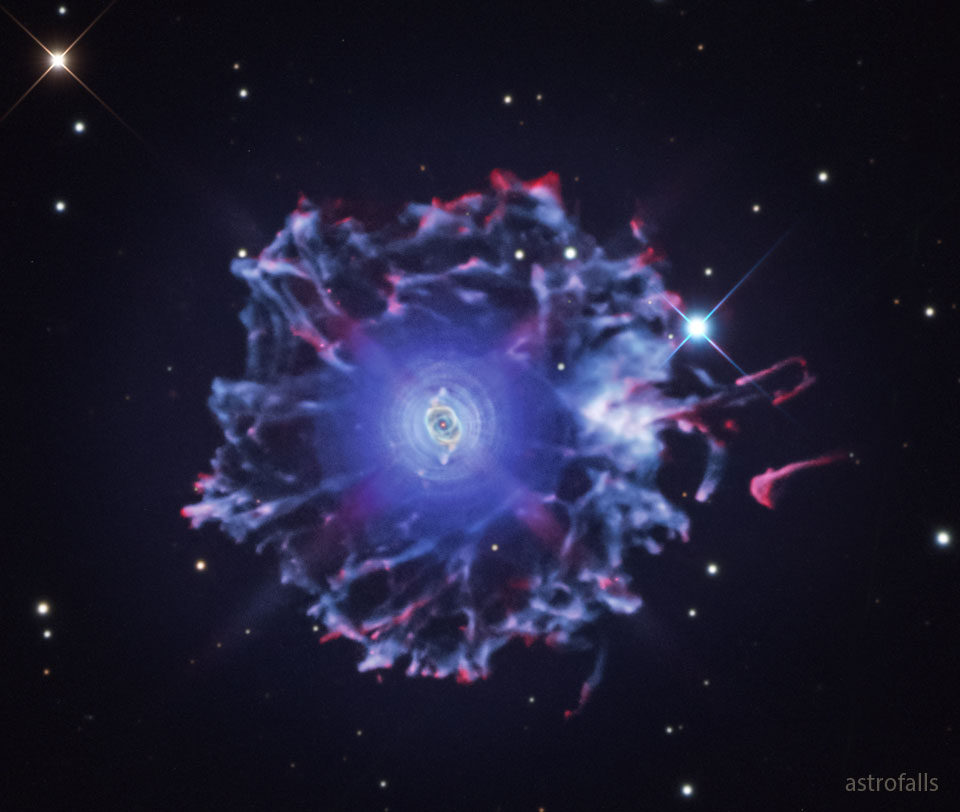
Halo of the Cats Eye


What created the unusual halo around the Cat's Eye nebula? No one is sure. What is sure is that the Cat's Eye Nebula (NGC 6543) is one of the best known planetary nebulae on the sky. Although haunting symmetries are seen in the bright central region, this image was taken to feature its intricately structured outer halo, which spans over three light-years across. Planetary nebulae have long been appreciated as a final phase in the life of a Sun-like star. Only recently however, have some planetaries been found to have expansive halos, likely formed from material shrugged off during earlier puzzling episodes in the star's evolution. While the planetary nebula phase is thought to last for around 10,000 years, astronomers estimate the age of the outer filamentary portions of the Cat's Eye Nebula's halo to be 50,000 to 90,000 years.

https://apod.nasa.gov/apod/ap220803.html ( August 03, 2022)

Webb Captures Stellar Gymnastics in The Cartwheel Galaxy


from NASA http://www.nasa.gov/feature/goddard/2022/webb-captures-stellar-gymnastics-in-the-cartwheel-galaxy
via IFTTT

ISS Daily Summary Report – 8/01/2022

iss-about-banner


Payloads: Airborne Particulate Monitor (APM): Experiment data was transferred from the APM for subsequent downlink to the ground. Following this, the APM hardware was relocated from Node 3 to the US Lab. Air quality in crewed spacecraft is important for keeping astronauts healthy and comfortable. Although requirements exist for maximum allowable concentrations of particulate matter, … ...

August 01, 2022 at 12:00PM
From NASA: https://blogs.nasa.gov/stationreport/2022/08/01/iss-daily-summary-report-8-01-2022/

Monday, August 1, 2022

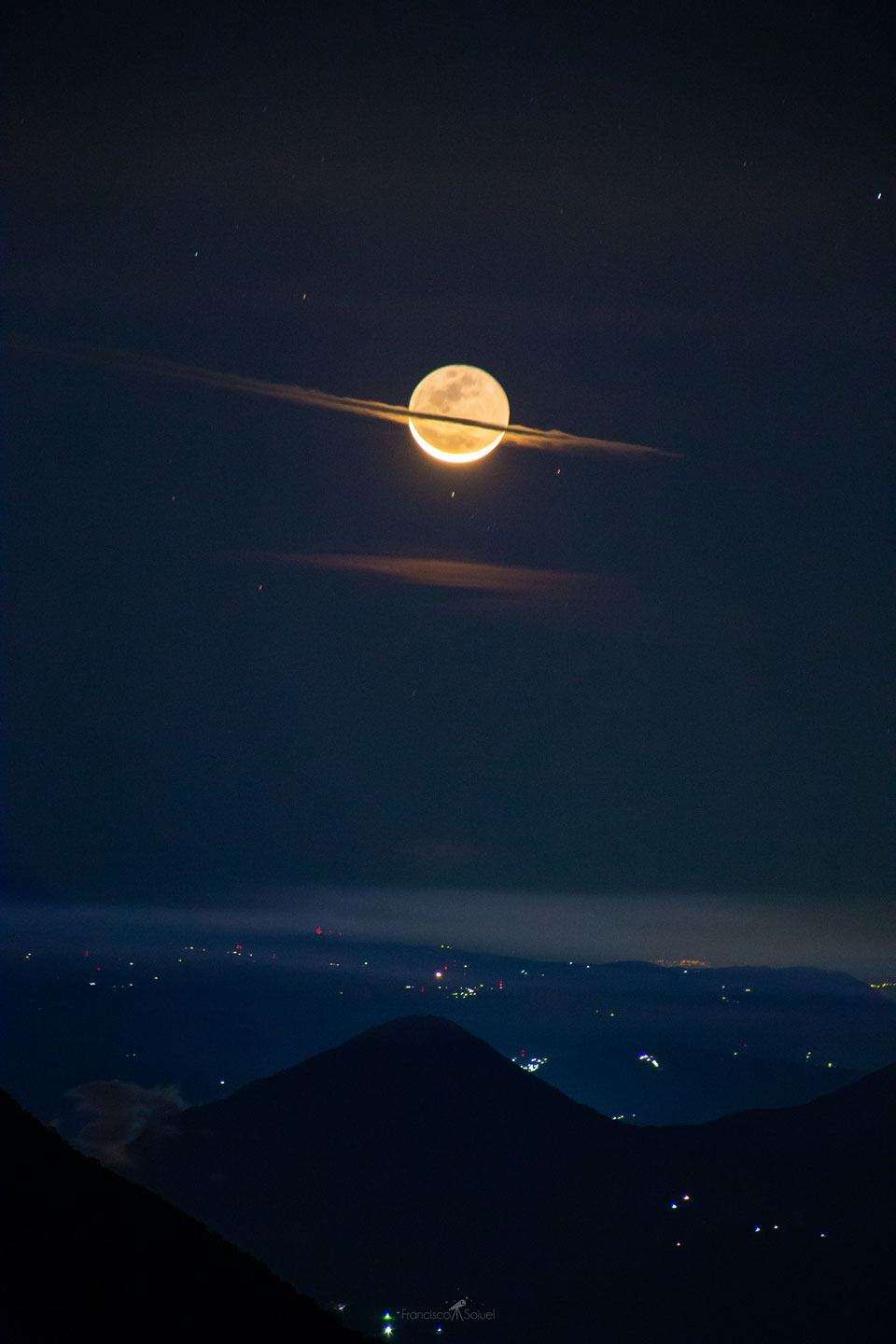
A Moon Dressed Like Saturn


Why does Saturn appear so big? It doesn't -- what is pictured are foreground clouds on Earth crossing in front of the Moon. The Moon shows a slight crescent phase with most of its surface visible by reflected Earthlight known as ashen glow. The Sun directly illuminates the brightly lit lunar crescent from the bottom, which means that the Sun must be below the horizon and so the image was taken before sunrise. This double take-inducing picture was captured on 2019 December 24, two days before the Moon slid in front of the Sun to create a solar eclipse. In the foreground, lights from small Guatemalan towns are visible behind the huge volcano Pacaya.

https://apod.nasa.gov/apod/ap220802.html ( August 02, 2022)

NASA Pays Tribute to Nichelle Nichols


NASA celebrates the life of Nichelle Nichols, Star Trek actor, trailblazer, and role model, who symbolized to so many what was possible. She partnered with us to recruit some of the first women and minority astronauts, and inspired generations to reach for the stars.

from NASA http://www.nasa.gov/image-feature/nasa-pays-tribute-to-nichelle-nichols
via IFTTT