Friday, June 10, 2022

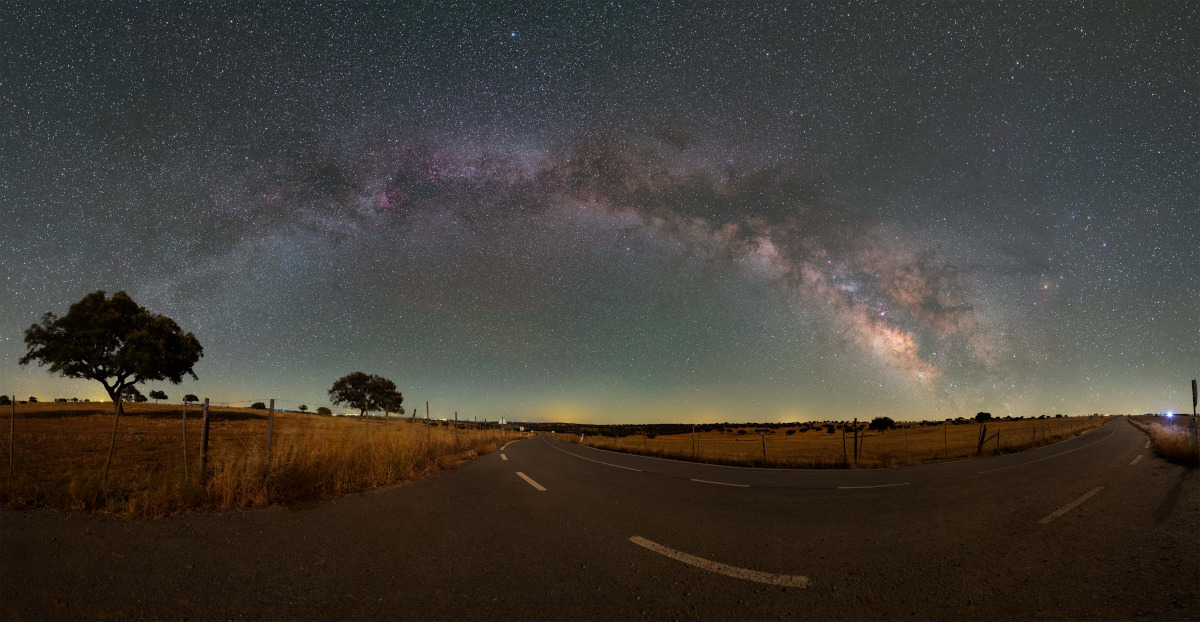
The Road and the Milky Way


At night you can follow this road as it passes through the Dark Sky Alqueva reserve not too far from Alentejo, Portugal. Or you could stop, look up, and follow the Milky Way through the sky. Both stretch from horizon to horizon in this 180 degree panorama recorded on June 3. Our galaxy's name, the Milky Way, does refer to its appearance as a milky path in the sky. The word galaxy itself derives from the Greek for milk. From our fair planet the arc of the Milky Way is most easily visible on moonless nights from dark sky areas, though not quite so bright or colorful as in this image. The glowing celestial band is due to the collective light of myriad stars along the galactic plane too faint to be distinguished individually. The diffuse starlight is cut by dark swaths of the galaxy's obscuring interstellar dust clouds. Standing above the Milky Way arc near the top of this panoramic nightscape is bright star Vega, with the galaxy's central bulge near the horizon at the right.

https://apod.nasa.gov/apod/ap220611.html ( June 11, 2022)

Hubble Investigates an Enigmatic Star Cluster


Unlike most globular clusters, Ruprecht 106 may be what astronomers call a single population globular cluster.

from NASA http://www.nasa.gov/image-feature/goddard/2022/hubble-investigates-an-enigmatic-star-cluster
via IFTTT

ISS Daily Summary Report – 6/09/2022

iss-about-banner


Payloads: Astrorad Vest: The AstroRad Vest was worn overnight, doffed, and a questionnaire filled out to give feedback on the session. Comfort and Human Factors AstroRad Radiation Garment Evaluation (CHARGE) tests a special vest designed to protect astronauts from radiation caused by unpredictable Solar Particle Events (SPEs). Astronauts provide input on the garment as they … ...

June 09, 2022 at 12:00PM
From NASA: https://blogs.nasa.gov/stationreport/2022/06/09/iss-daily-summary-report-6-09-2022/

Thursday, June 9, 2022

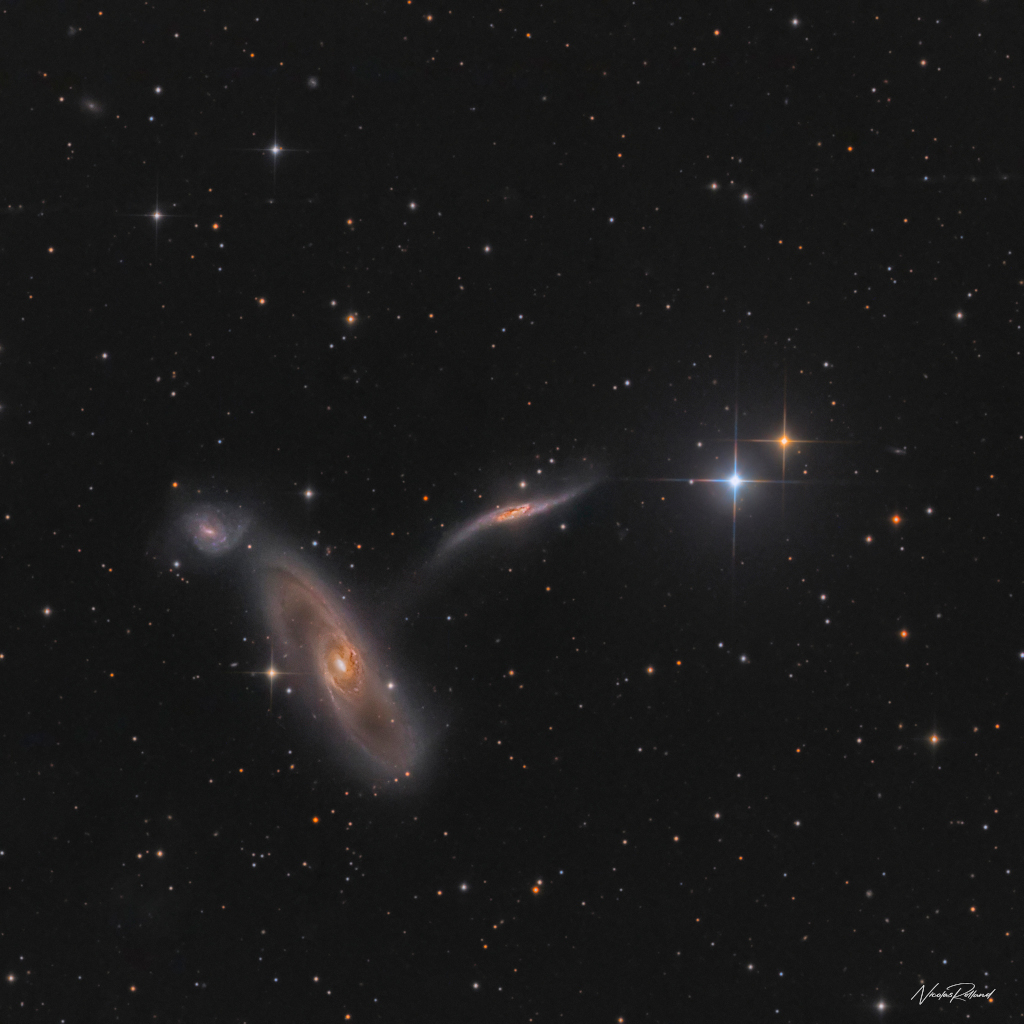
Arp 286: Trio in Virgo


This colorful telescopic field of view features a trio of interacting galaxies almost 90 million light-years away, toward the constellation Virgo. On the right two spiky, foreground Milky Way stars echo the extragalactic hues, a reminder that stars in our own galaxy are like those in distant island universes. With sweeping spiral arms and obscuring dust lanes, the dominant member of the trio, NGC 5566, is enormous, about 150,000 light-years across. Just above it lies smaller, bluish NGC 5569. Near center a third galaxy, NGC 5560, is apparently stretched and distorted by its interaction with massive NGC 5566. The trio is also included in Halton Arp's 1966 Atlas of Peculiar Galaxies as Arp 286. Of course, such cosmic interactions are now appreciated as part of the evolution of galaxies.

https://apod.nasa.gov/apod/ap220610.html ( June 10, 2022)

ISS Daily Summary Report – 6/08/2022

iss-about-banner


Payloads: Astrobee: The JEM was prepared for the Integrated System for Autonomous and Adaptive Caretaking (ISAAC 9) crew-minimal activity later in the week. In this activity, JPM lighting was adjusted as appropriate, the Astrobee dock was power-cycled, Astrobee free-fliers were powered on, and software was updated. Astrobee is made up of three free-flying, cube-shaped robots … ...

June 08, 2022 at 12:00PM
From NASA: https://blogs.nasa.gov/stationreport/2022/06/08/iss-daily-summary-report-6-08-2022/

When Galaxy Clusters Collide


Galaxy clusters contain hundreds of galaxies and huge amounts of hot gas and dark matter.

from NASA http://www.nasa.gov/image-feature/when-galaxy-clusters-collide
via IFTTT

Wednesday, June 8, 2022

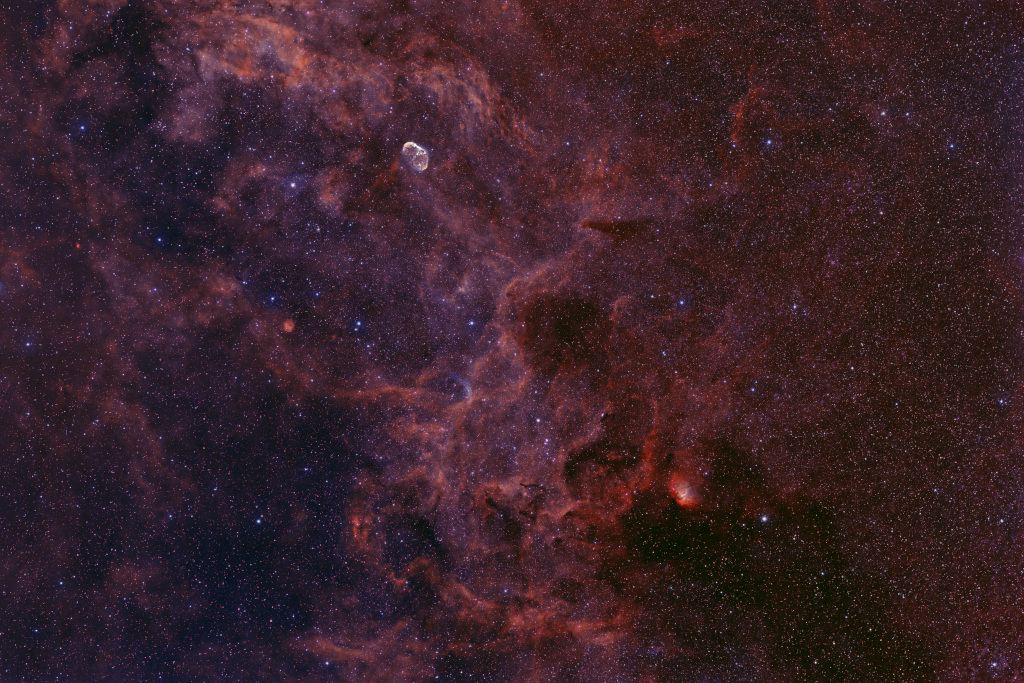
Cosmic Clouds in Cygnus


These cosmic clouds of gas and dust drift through rich star fields along the plane of our Milky Way Galaxy toward the high flying constellation Cygnus. They're too faint to be seen with the unaided eye though, even on a clear, dark night. Image data from a camera and telephoto lens using narrowband filters was used to construct this 10 degree wide field of view. The deep mosaic reveals a region that includes star forming dust clouds seen in silhouette against the characteristic glow of atomic hydrogen and oxygen gas. NGC 6888 is the standout emission nebula near the top. Blown by winds from an massive Wolf-Rayet star it's about 25 light-years across and known as the Crescent Nebula. A faint bluish curl just below center in the frame is also the signature of a Wolf-Rayet star. Burning fuel at a prodigious rate and near the end of their stellar lives, both stars will ultimately go out with a bang in a spectacular supernova explosion. Toward the right, a massive, young O type star powers the glow of Sh2-101, the Tulip Nebula.

https://apod.nasa.gov/apod/ap220609.html ( June 09, 2022)

ISS Daily Summary Report – 6/07/2022

iss-about-banner


Payloads: AstroPi: Following the completion of the European AstroPi Challenge ‘Mission Zero’, the AstroPi Vis unit was returned to its default configuration and position. Two augmented Raspberry Pi computers (called AstroPis) were flown to the ISS and are both equipped with the mighty Sense Hardware Attached on Top (HAT) that measures the environment inside the … ...

June 07, 2022 at 12:00PM
From NASA: https://blogs.nasa.gov/stationreport/2022/06/07/iss-daily-summary-report-6-07-2022/

Pacific Ocean From the Space Station


The International Space Station orbits into a dawn 261 miles above a cloudy Pacific Ocean in this image from April 2022.

from NASA http://www.nasa.gov/image-feature/pacific-ocean-from-the-space-station
via IFTTT

Tuesday, June 7, 2022

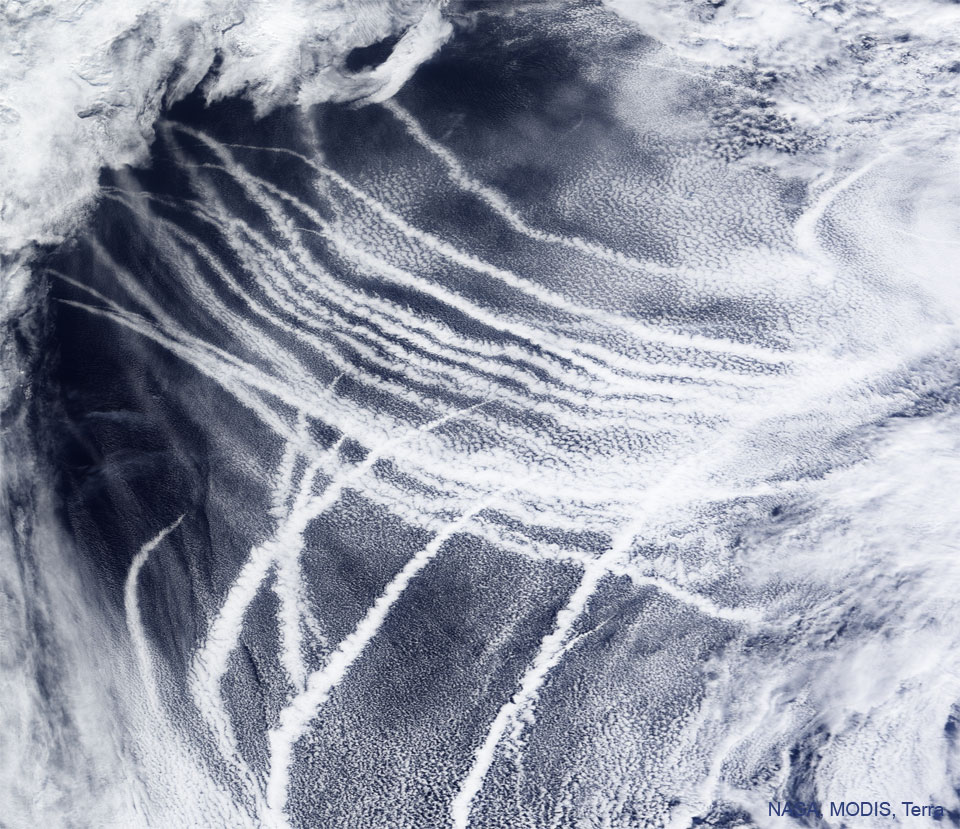
Ship Tracks over the Pacific Ocean


What are those unusual streaks? Some images of planet Earth show clear bright streaks that follow the paths of ships. Known as ship tracks, these low and narrow bands are caused by the ship's engine exhaust. Water vapor condenses around small bits of exhaust known as aerosols, which soon grow into floating water drops that efficiently reflect sunlight. Ship tracks were first discovered in 1965 in Earth images taken by NASA's TIROS satellites. Multiple ship tracks are visible across the featured image that was captured in 2009 over the Pacific Ocean by the MODIS instrument on NASA's Terra satellite. Inspired by ship-tracks, some scientists have suggested deploying a network of floating buoys in the worlds' oceans that spray salt-aerosol containing sea-water into the air so that, with the help of the wind, streams of sunlight-reflecting clouds would also form. Why do this? These human-made clouds could reflect so much sunlight they might help fight global warming.

https://apod.nasa.gov/apod/ap220608.html ( June 08, 2022)