Sunday, June 5, 2022

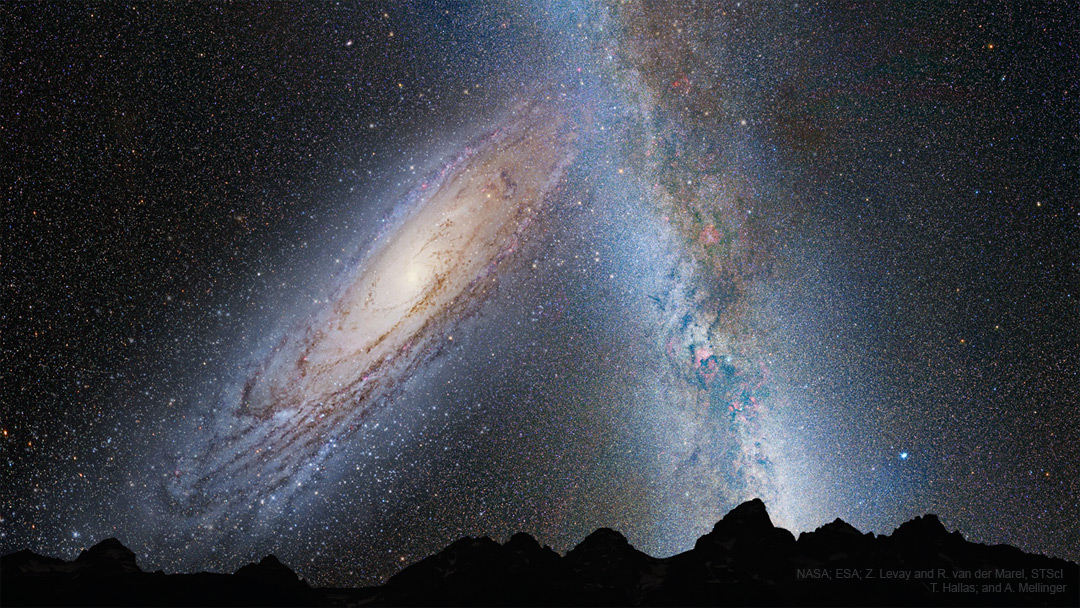
Milky Way Galaxy Doomed: Collision with Andromeda Pending


Will our Milky Way Galaxy collide one day with its larger neighbor, the Andromeda Galaxy? Most likely, yes. Careful plotting of slight displacements of M31's stars relative to background galaxies on recent Hubble Space Telescope images indicate that the center of M31 could be on a direct collision course with the center of our home galaxy. Still, the errors in sideways velocity appear sufficiently large to admit a good chance that the central parts of the two galaxies will miss, slightly, but will become close enough for their outer halos to become gravitationally entangled. Once that happens, the two galaxies will become bound, dance around, and eventually merge to become one large elliptical galaxy -- over the next few billion years. Pictured here is a combination of images depicting the sky of a world (Earth?) in the distant future when the outer parts of each galaxy begin to collide. The exact future of our Milky Way and the entire surrounding Local Group of Galaxies is likely to remain an active topic of research for years to come.

https://apod.nasa.gov/apod/ap220606.html ( June 06, 2022)

Saturday, June 4, 2022

Two Black Holes Dancing in 3C 75


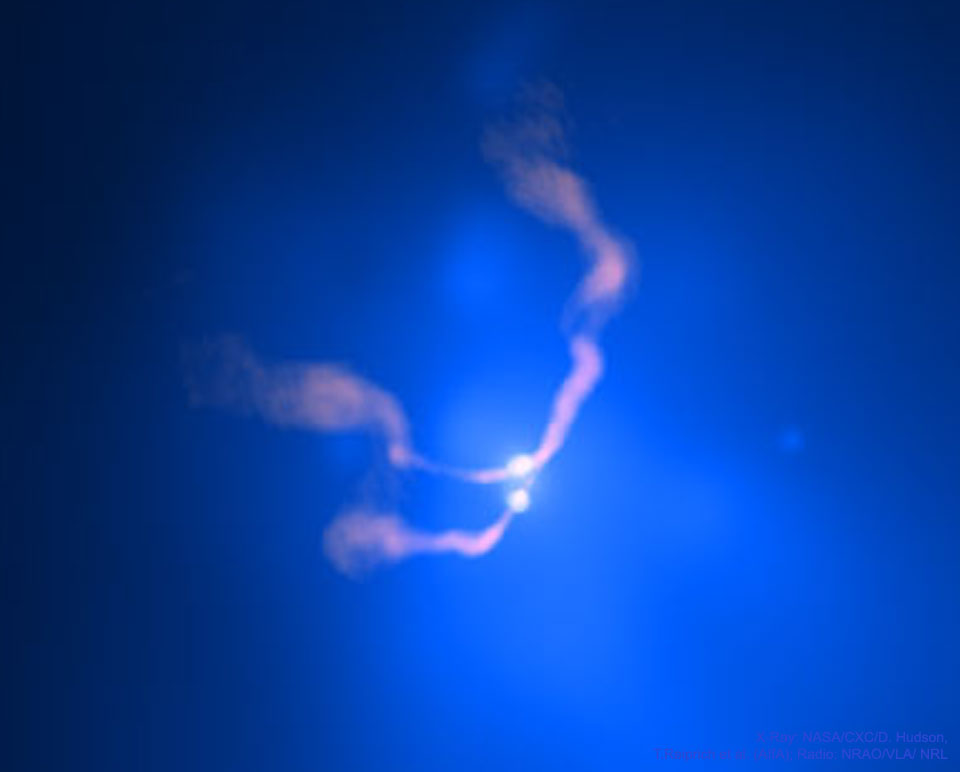
What's happening at the center of active galaxy 3C 75? The two bright sources at the center of this composite x-ray (blue)/ radio (pink) image are co-orbiting supermassive black holes powering the giant radio source 3C 75. Surrounded by multimillion degree x-ray emitting gas, and blasting out jets of relativistic particles the supermassive black holes are separated by 25,000 light-years. At the cores of two merging galaxies in the Abell 400 galaxy cluster they are some 300 million light-years away. Astronomers conclude that these two supermassive black holes are bound together by gravity in a binary system in part because the jets' consistent swept back appearance is most likely due to their common motion as they speed through the hot cluster gas at about 1200 kilometers per second. Such spectacular cosmic mergers are thought to be common in crowded galaxy cluster environments in the distant universe. In their final stages, the mergers are expected to be intense sources of gravitational waves.

https://apod.nasa.gov/apod/ap220605.html ( June 05, 2022)

Friday, June 3, 2022

Tau Herculids from Space


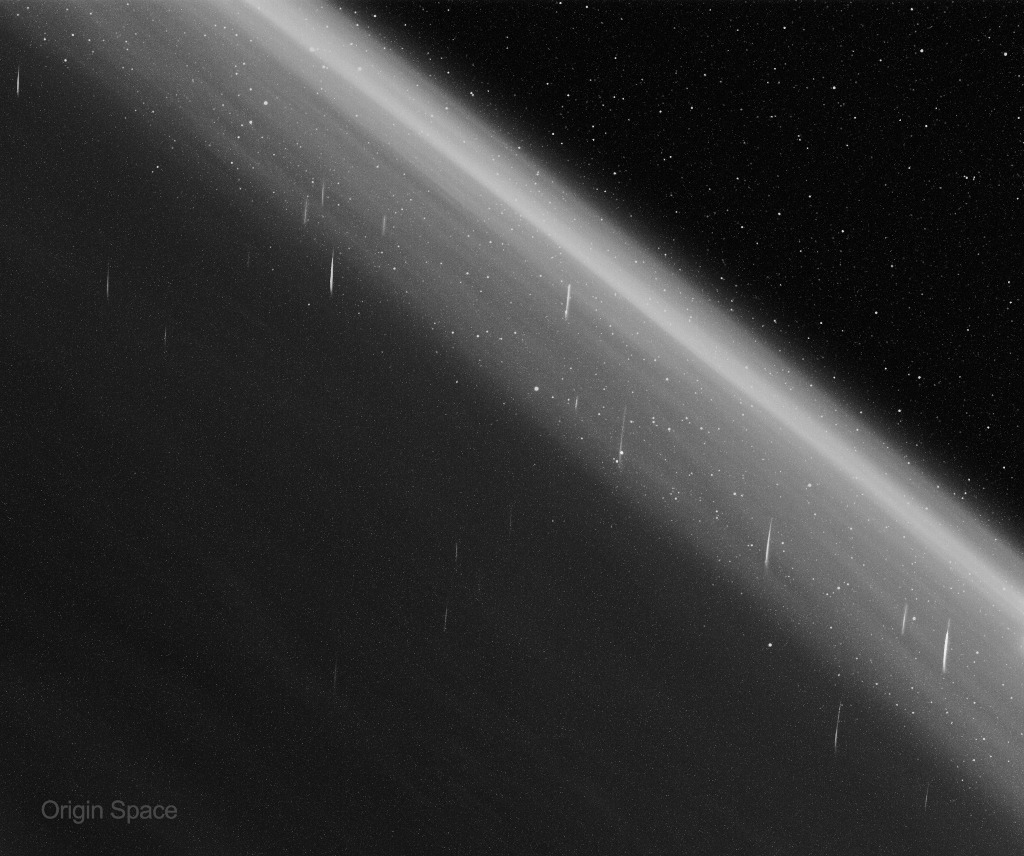
On May 31 tens of parallel meteor streaks were recorded in this 8 degree wide field of view of planet Earth's limb from space. The image is one of a series of 5 minute long observations by the orbiting Yangwang-1 space telescope. It was captured at 03:43 UT, near the peak of the Tau Herculid meteor shower. As predicted, the meteor shower was an active one this year, caused as Earth swept through a relatively dense stream of debris from disintegrating Comet 73P/Schwassmann-Wachmann 3, but was lacking bright meteors. Nearly all of the Tau Herculid meteors in the Yangwang-1 image are too faint to be detected by groundbased instruments. But on that date patient earthbound skywatchers under clear skies still enjoyed a memorable showing of the Tau Herculids.

https://apod.nasa.gov/apod/ap220604.html ( June 04, 2022)

Apollo 1 Monument Dedication


The Apollo 1 monument at Arlington National Cemetery was dedicated on Thursday, June 2, 2022, in Arlington, Va.

from NASA http://www.nasa.gov/image-feature/apollo-1-monument-dedication
via IFTTT

Thursday, June 2, 2022

A 10 000 Kilometer Galactic Bridge


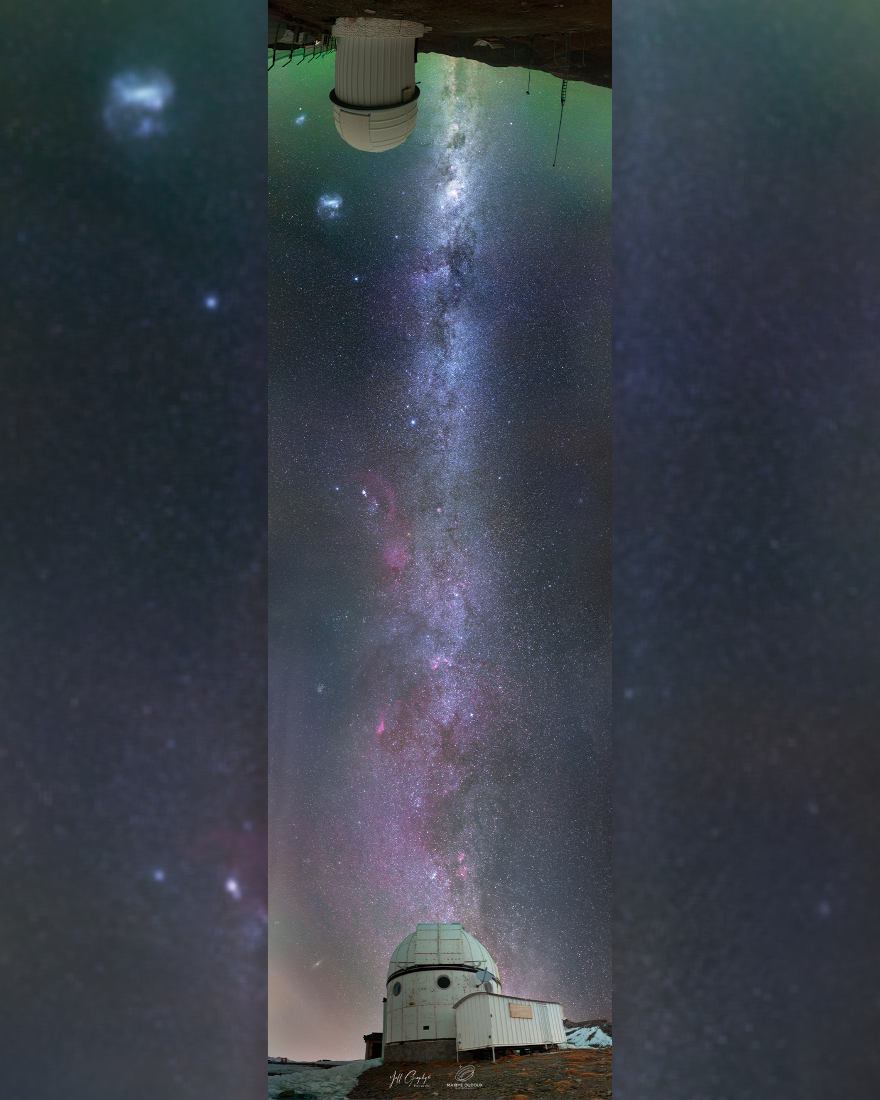
With this creative astro-collaboration you can follow the plane of our Milky Way Galaxy as it bridges northern and southern hemisphere skies. To construct the expansive composite nightscape, skies over Observatorio El Sauce in Chile (top) were imaged on the same date but 6 hours later than the skies over the Saint-Veran observatory in the French Alps. The 6 hour time-lag allowed Earth's rotation to align the Milky Way above domes at the two sites. All exposures were made with similar cameras and lenses mounted on simple tripods. A faint greenish airglow is visible in the dark Chilean sky that also features the Large and Small Magellanic Clouds near the observatory dome. In the French Alps light pollution is apparent, but the distant Andromeda Galaxy can still be spotted near the horizon in the northern night. On planet Earth the two observatories are separated by about 10,000 kilometers.

https://apod.nasa.gov/apod/ap220603.html ( June 03, 2022)

Huge Rings Around a Black Hole


This image features a spectacular set of rings around a black hole.

from NASA http://www.nasa.gov/image-feature/huge-rings-around-a-black-hole
via IFTTT

ISS Daily Summary Report – 6/01/2022

iss-about-banner


Progress 79P Undocking: Today, the Russian Cargo Vehicle Progress 79P, which provided cargo and propellent to the ISS, undocked from the Service Module Aft port at 3:08 AM CT. Following departure from the ISS the vehicle’s thrusters fired to maneuver 79P into a deorbit trajectory to send it into the Earth’s atmosphere where it burned … ...

June 01, 2022 at 12:00PM
From NASA: https://blogs.nasa.gov/stationreport/2022/06/01/iss-daily-summary-report-6-01-2022/

Wednesday, June 1, 2022

Lunar Occultation of Venus


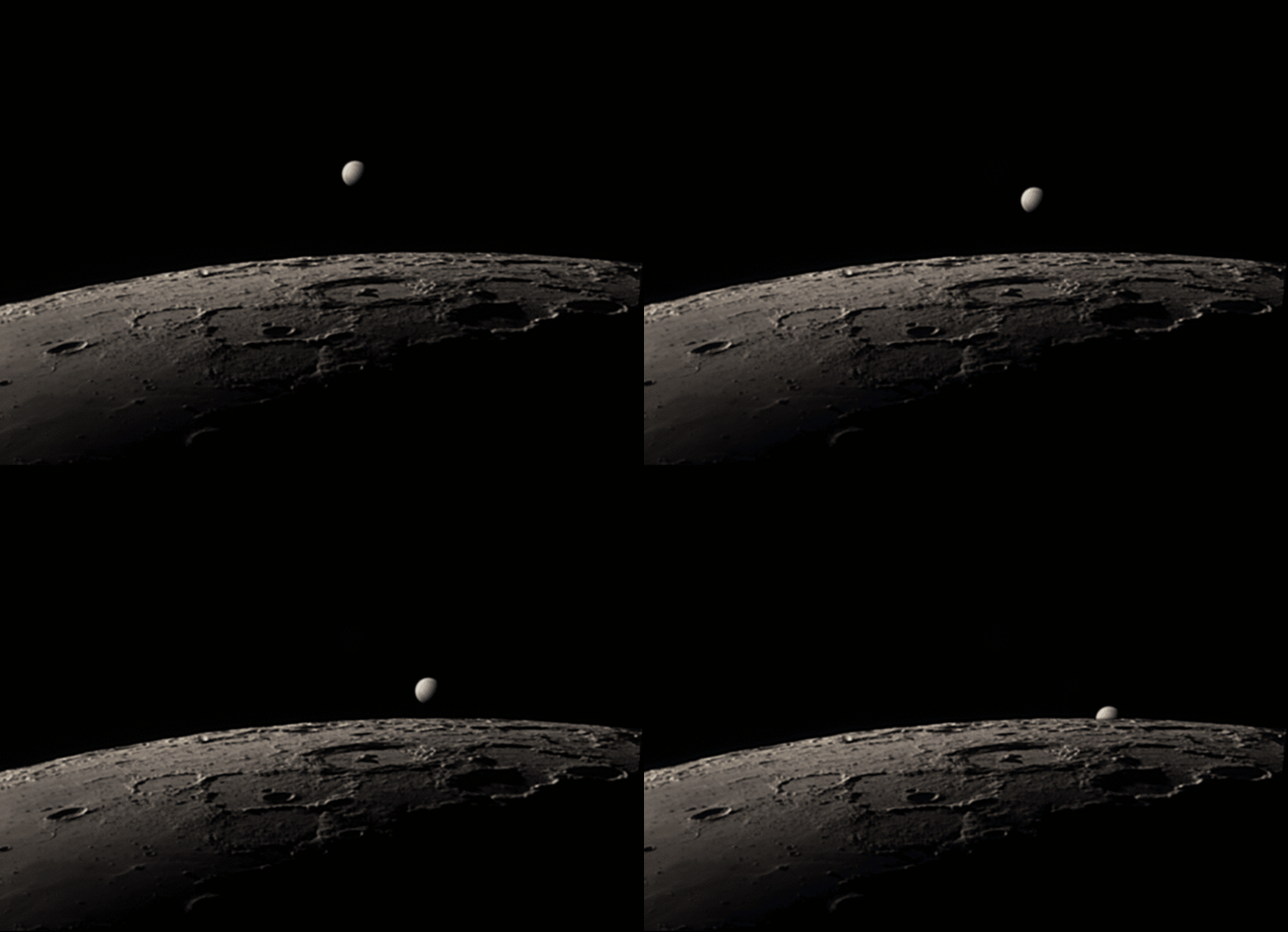
On May 27 Venus rose as the morning star, near the waning crescent Moon in a predawn sky already full of planets. It was close on the sky to the Moon's crescent and a conjunction of the second an third brightest celestial beacons were enjoyed by skygazers around the world. But seen from locations along a track through southeast Asia and the Indian Ocean the Moon actually passed in front of Venus in a lunar occultation. In this animated gif the 75 percent illuminated disk of Venus approaches and just begins to disappear behind the sunlit southwestern lunar limb. The telescopic frames used to construct it were captured from Reunion Island in the Indian Ocean around 4:50am local time, with the Moon and Venus very close to the eastern horizon. At the time Venus was over 180 million kilometers from Reunion Island, compared to a lunar distance of a mere 400 thousand kilometers or so. About 50 minutes later Venus emerged from behind the Moon.

https://apod.nasa.gov/apod/ap220602.html ( June 02, 2022)

ISS Daily Summary Report – 5/31/2022

iss-about-banner


Payloads: Behavioral Core Measures (BCM): The crew performed two BCM research sessions consisting of a set of 12 runs/tests each. The Standardized Behavioral Measures for Detecting Behavioral Health Risks during Exploration Missions (BCM) experiment initially examined a suite of measurements to reliably assess the risk of adverse cognitive effects, behavioral conditions, or psychiatric disorders during … ...

May 31, 2022 at 12:00PM
From NASA: https://blogs.nasa.gov/stationreport/2022/05/31/iss-daily-summary-report-5-31-2022/

Hurricane Season 2022 Begins


Hurricanes are the most powerful weather event on Earth. The 2022 Atlantic hurricane season extends from June 1 to November 30.

from NASA http://www.nasa.gov/image-feature/hurricane-season-2022-begins
via IFTTT