Wednesday, April 6, 2022

Testing the Aircraft of the Future


NASA and industry partners are working towards a future that sees aviation meet cleaner sustainability standards.

from NASA http://www.nasa.gov/image-feature/testing-the-aircraft-of-the-future
via IFTTT
Tuesday, April 5, 2022

Earendel: A Star in the Early Universe


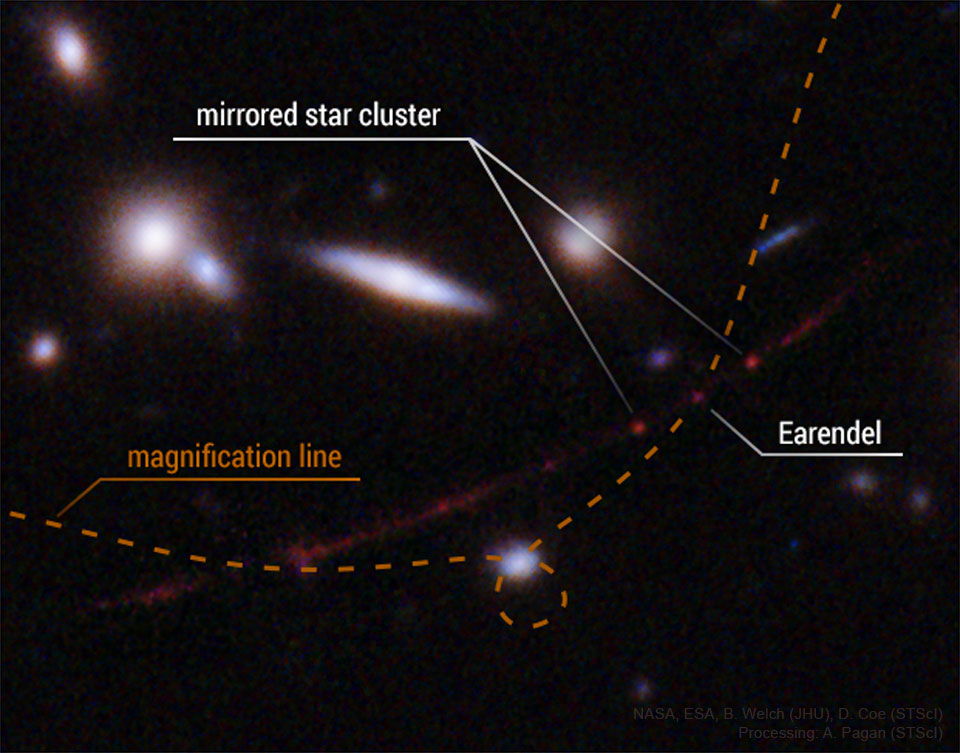
Is Earendel the farthest star yet discovered? This scientific possibility started when the Hubble Space Telescope observed a huge cluster of galaxies. The gravitational lens effect of this cluster was seen to magnify and distort a galaxy far in the background. This distorted background galaxy -- so far away it has a redshift of 6.2 -- appears in the featured image as a long red string, while beads on that string are likely to be star clusters.   The galaxy cluster lens creates a line of maximum magnification line where superposed background objects may appear magnified many thousands of times. On the intersection between the galaxy line and the maximum magnification line is one "bead" which shows evidence of originating from a single bright star in the early universe -- now named Earendel. Future investigations may include more imaging by Hubble to see how Earendel's brightness varies, and, quite possibly, by the new James Webb Space Telescope when it becomes operational later this year.  Earendel's great distance exceeds that of any known stable star -- although the star that exploded creating GRB 090423 had a redshift of 8.2.

https://apod.nasa.gov/apod/ap220406.html ( April 06, 2022)

Cold as (Dry) Ice


Every winter, a layer of carbon dioxide frost (dry ice) forms on the surface of Mars.

from NASA http://www.nasa.gov/image-feature/cold-as-dry-ice
via IFTTT

Monday, April 4, 2022

Seven Sisters versus California


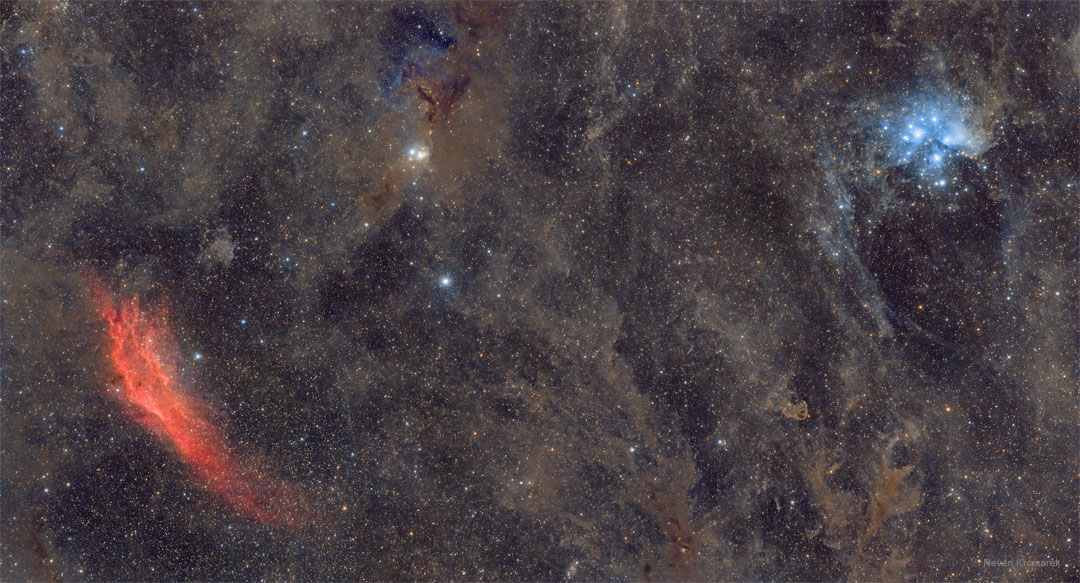
On the upper right, dressed in blue, is the Pleiades. Also known as the Seven Sisters and M45, the Pleiades is one of the brightest and most easily visible open clusters on the sky. The Pleiades contains over 3,000 stars, is about 400 light years away, and only 13 light years across. Surrounding the stars is a spectacular blue reflection nebula made of fine dust. A common legend is that one of the brighter stars faded since the cluster was named. On the lower left, shining in red, is the California Nebula. Named for its shape, the California Nebula is much dimmer and hence harder to see than the Pleiades. Also known as NGC 1499, this mass of red glowing hydrogen gas is about 1,500 light years away. Although about 25 full moons could fit between them, the featured wide angle, deep field image composite has captured them both. A careful inspection of the deep image will also reveal the star forming region IC 348 and the molecular cloud LBN 777 (the Baby Eagle Nebula).

https://apod.nasa.gov/apod/ap220405.html ( April 05, 2022)

Space Launch System Rocket at Dawn


NASA’s Space Launch System (SLS) rocket with the Orion spacecraft aboard is seen at sunrise atop a mobile launcher at Launch Complex 39B, Monday, April 4, 2022.

from NASA http://www.nasa.gov/image-feature/space-launch-system-rocket-at-dawn
via IFTTT

Sunday, April 3, 2022

A Vortex Aurora over Iceland


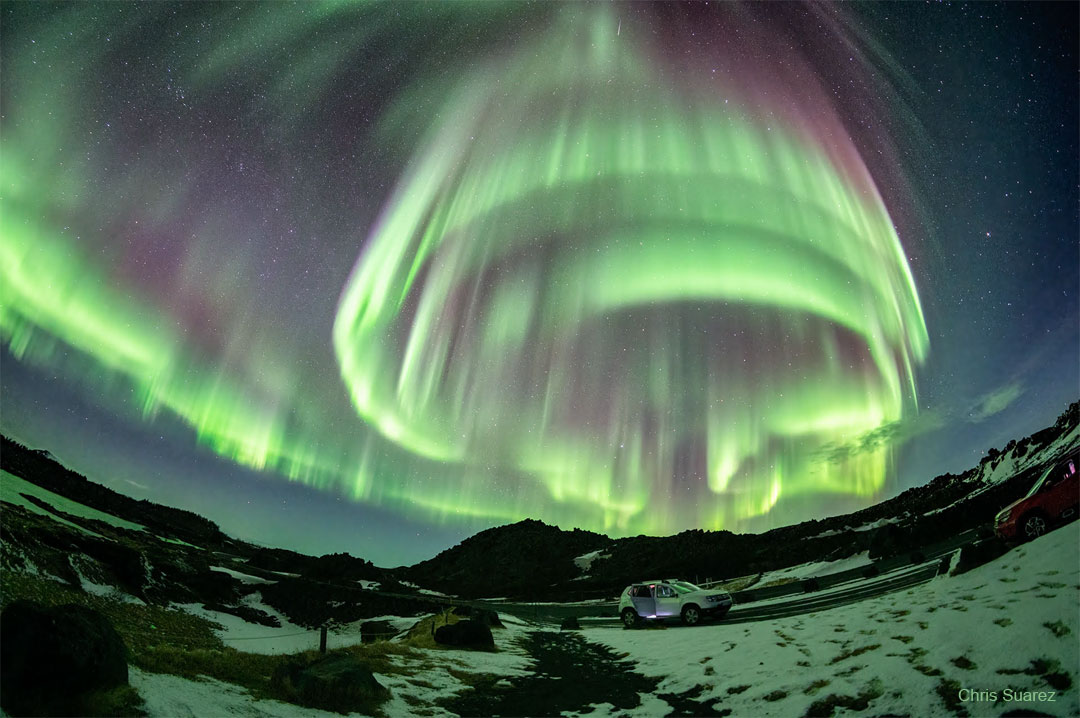
No, the car was not in danger of being vacuumed into space by the big sky vortex. For one reason, the vortex was really an aurora, and since auroras are created by particles striking the Earth from space, they do not create a vacuum. This rapidly developing auroral display was caused by a Coronal Mass Ejection from the Sun that passed by the Earth closely enough to cause a ripple in Earth's magnetosphere. The upper red parts of the aurora occur over 250 kilometers high with its red glow created by atmospheric atomic oxygen directly energized by incoming particles. The lower green parts of the aurora occur over 100 kilometers high with its green glow created by atmospheric atomic oxygen energized indirectly by collisions with first-energized molecular nitrogen. Below 100 kilometers, there is little atomic oxygen, which is why auroras end abruptly. The concentric cylinders depict a dramatic auroral corona as seen from the side. The featured image was created from a single 3-second exposure taken in mid-March over Lake Myvatn in Iceland.

https://apod.nasa.gov/apod/ap220404.html ( April 04, 2022)

Saturday, April 2, 2022

CMB Dipole: Speeding Through the Universe


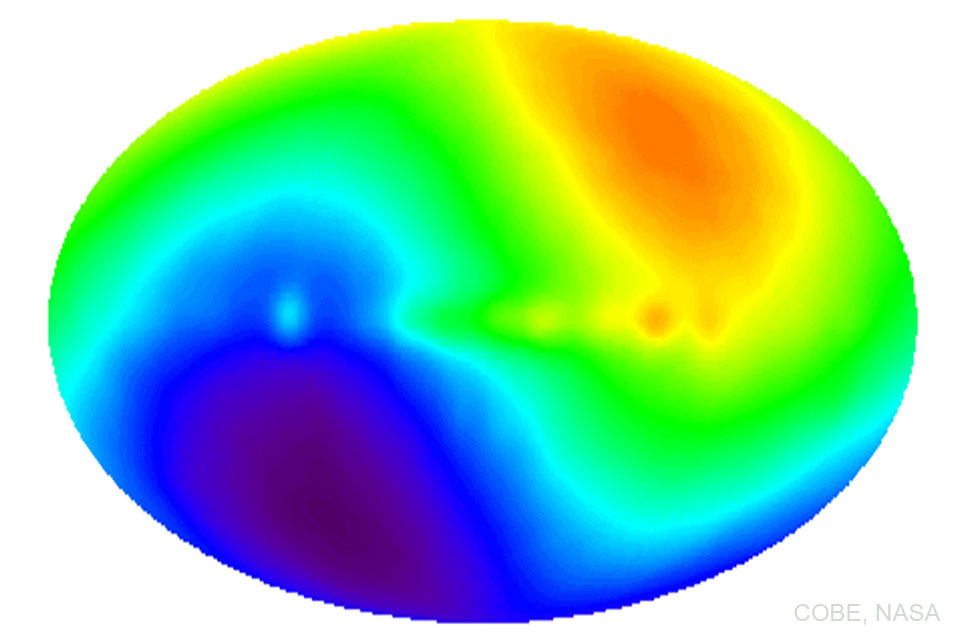
Our Earth is not at rest. The Earth moves around the Sun. The Sun orbits the center of the Milky Way Galaxy. The Milky Way Galaxy orbits in the Local Group of Galaxies. The Local Group falls toward the Virgo Cluster of Galaxies. But these speeds are less than the speed that all of these objects together move relative to the cosmic microwave background radiation (CMBR). In the featured all-sky map from the COBE satellite in 1993, microwave light in the Earth's direction of motion appears blueshifted and hence hotter, while microwave light on the opposite side of the sky is redshifted and colder. The map indicates that the Local Group moves at about 600 kilometers per second relative to this primordial radiation. This high speed was initially unexpected and its magnitude is still unexplained. Why are we moving so fast? What is out there?

https://apod.nasa.gov/apod/ap220403.html ( April 03, 2022)

Friday, April 1, 2022

Nova Scotia Northern Lights


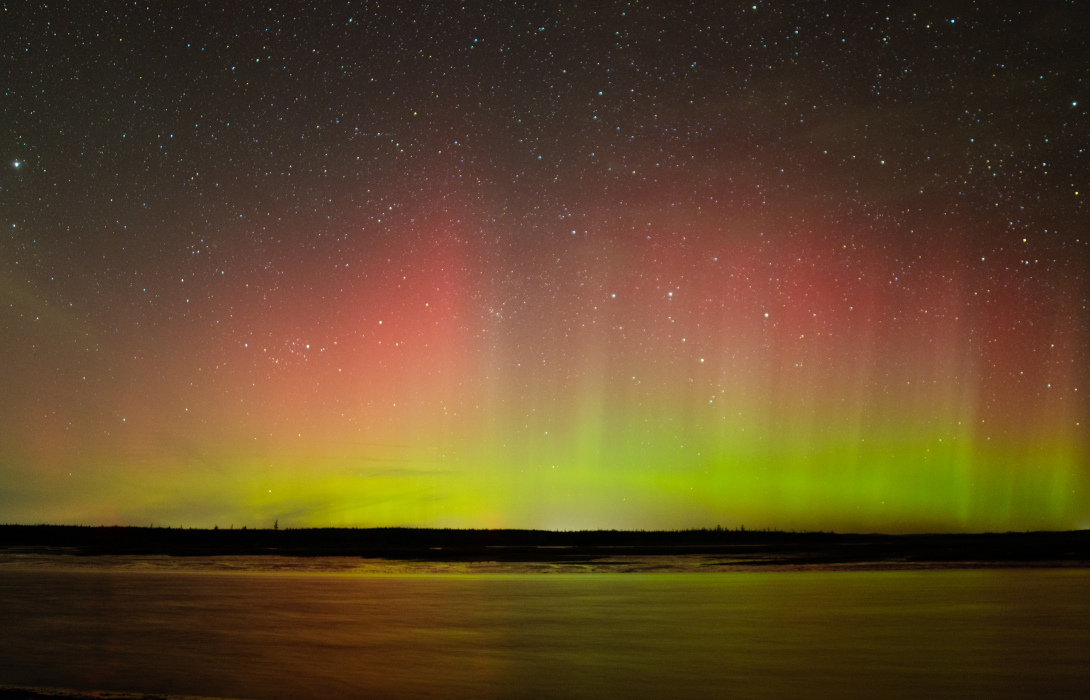
This almost otherworldly display of northern lights was captured in clear skies during the early hours of March 31 from 44 degrees north latitude, planet Earth. In a five second exposure the scene looks north from Martinique Beach Provincial Park in Nova Scotia, Canada. Stars of the W-shaped constellation Cassiopeia shine well above the horizon, through the red tint of the higher altitude auroral glow. Auroral activity was anticipated by skywatchers alerted to the possibility of stormy space weather by Sun-staring spacecraft. The predicted geomagnetic storm was sparked as a coronal mass ejection, launched from prolific solar active region 2975, impacted our fair planet's magnetosphere.

https://apod.nasa.gov/apod/ap220402.html ( April 02, 2022)

Prepping for Wet Dress Rehearsal


Engineers and technicians are continuing to prepare for the Artemis I wet dress rehearsal test which is slated to begin on April 1 and conclude on April 3.  

from NASA http://www.nasa.gov/image-feature/prepping-for-wet-dress-rehearsal
via IFTTT

ISS Daily Summary Report – 3/31/2022

iss-about-banner


Payloads: Gravitational References for Sensimotor Performance: Reaching and Grasping (GRASP): Crewmembers performed GRASP quasi-free-floating science sessions. The purpose of the GRASP investigation is to better understand how the central nervous system (CNS) integrates information from different sensations (e.g. sight or hearing), encoded in different reference frames, in order to coordinate the hand with the visual … ...


March 31, 2022 at 12:00PM
From NASA: https://blogs.nasa.gov/stationreport/2022/03/31/iss-daily-summary-report-3-31-2022/