Sunday, December 5, 2021

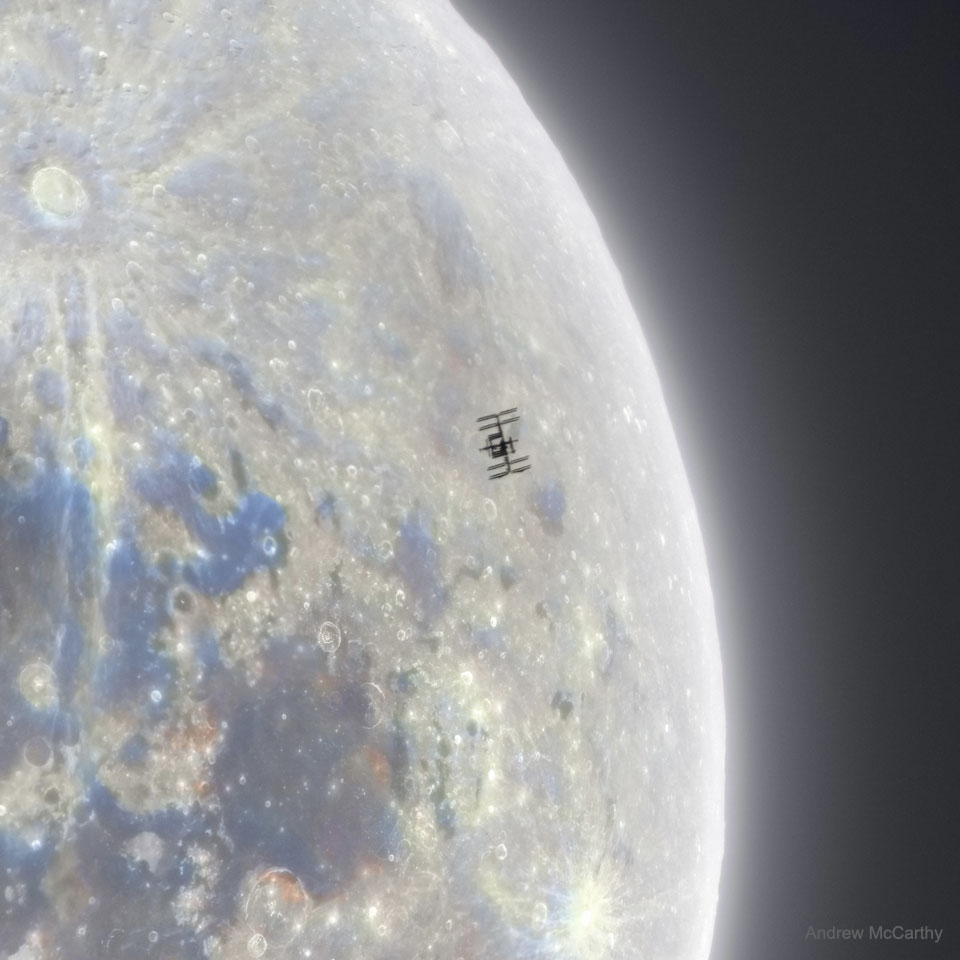
Space Station Silhouette on the Moon


What's that unusual spot on the Moon? It's the International Space Station. Using precise timing, the Earth-orbiting space platform was photographed in front of a partially lit gibbous Moon last month. The featured composite, taken from Payson, Arizona, USA last month, was intricately composed by combining, in part, many 1/2000-second images from a video of the ISS crossing the Moon. A close inspection of this unusually crisp ISS silhouette will reveal the outlines of numerous solar panels and trusses. The bright crater Tycho is visible on the upper left, as well as comparatively rough, light colored terrain known as highlands, and relatively smooth, dark colored areas known as maria. On-line tools can tell you when the International Space Station will be visible from your area.

https://apod.nasa.gov/apod/ap211206.html ( December 06, 2021)

Saturday, December 4, 2021

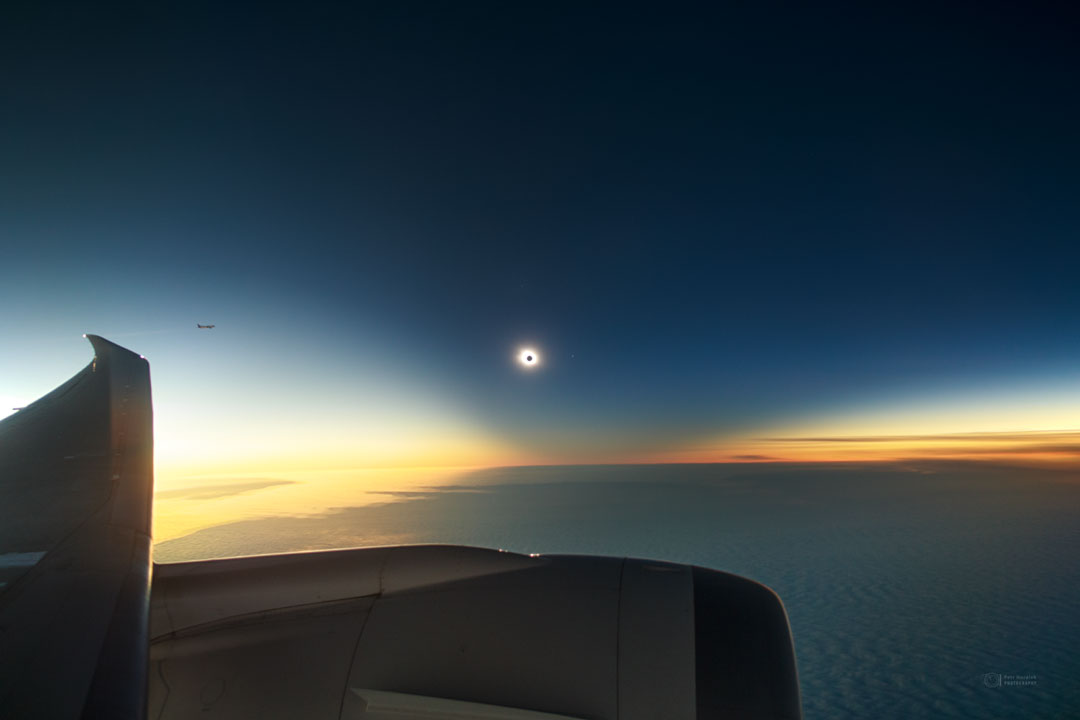
Total Solar Eclipse Below the Bottom of the World


Yesterday there was a total solar eclipse visible only at the end of the Earth. To capture the unusual phenomenon, airplanes took flight below the clouded seascape of Southern Ocean. The featured image shows one relatively spectacular capture where the bright spot is the outer corona of the Sun and the eclipsing Moon is seen as the dark spot in the center. A wing and engine of the airplane are visible across the left and bottom of the image, while another airplane observing the eclipse is visible on the far left. The dark area of the sky surrounding the eclipsed Sun is called a shadow cone. It is dark because you are looking down a long corridor of air shadowed by the Moon. A careful inspection of the eclipsed Sun will reveal the planet Mercury just to the right. The next total solar eclipse shadow will cross parts of Australia and Indonesia in April of 2023, while the one after that will cross North America in April of 2024.

https://apod.nasa.gov/apod/ap211205.html ( December 05, 2021)

Friday, December 3, 2021

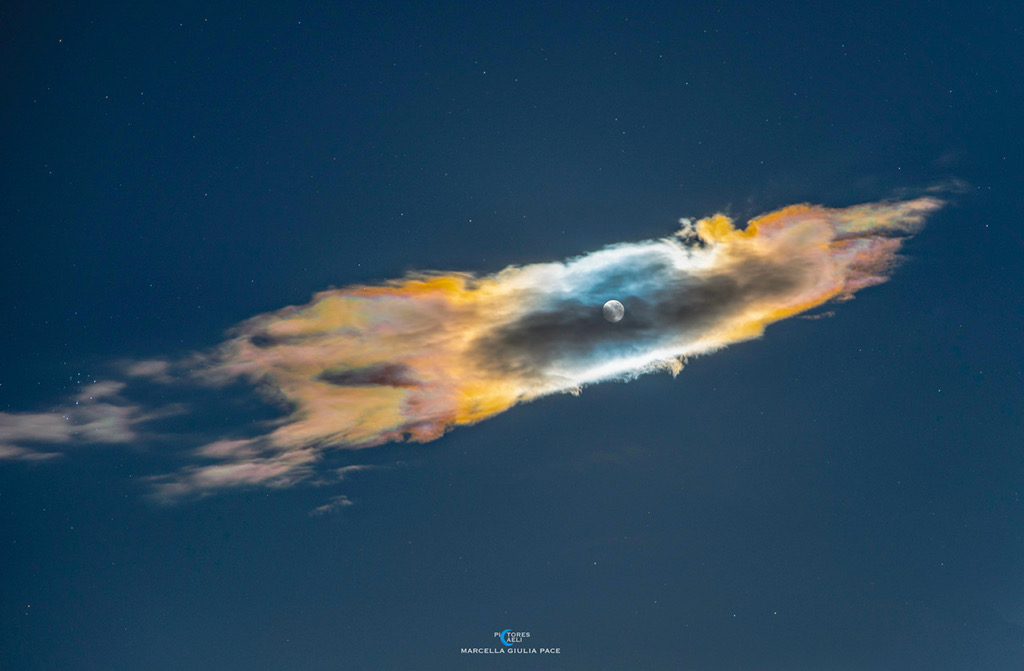
Iridescent by Moonlight


In this snapshot from November 18, the Full Moon was not far from Earth's shadow. In skies over Sicily the brightest lunar phase was eclipsed by passing clouds though. The full moonlight was dimmed and momentarily diffracted by small but similar sized water droplets near the edges of the high thin clouds. The resulting iridescence shines with colors like a lunar corona. On that night, the Full Moon was also seen close to the Pleiades star cluster appearing at the lower left of the iridescent cloud bank. The stars of the Seven Sisters were soon to share the sky with a darker, reddened lunar disk.

https://apod.nasa.gov/apod/ap211204.html ( December 04, 2021)

Become a Flight Director ... And Perhaps a Legend


Christopher Kraft, flight director during Project Mercury, works at his console inside the Flight Control area at Mercury Mission Control.

from NASA http://www.nasa.gov/image-feature/become-a-flight-director-and-perhaps-a-legend
via IFTTT

Thursday, December 2, 2021

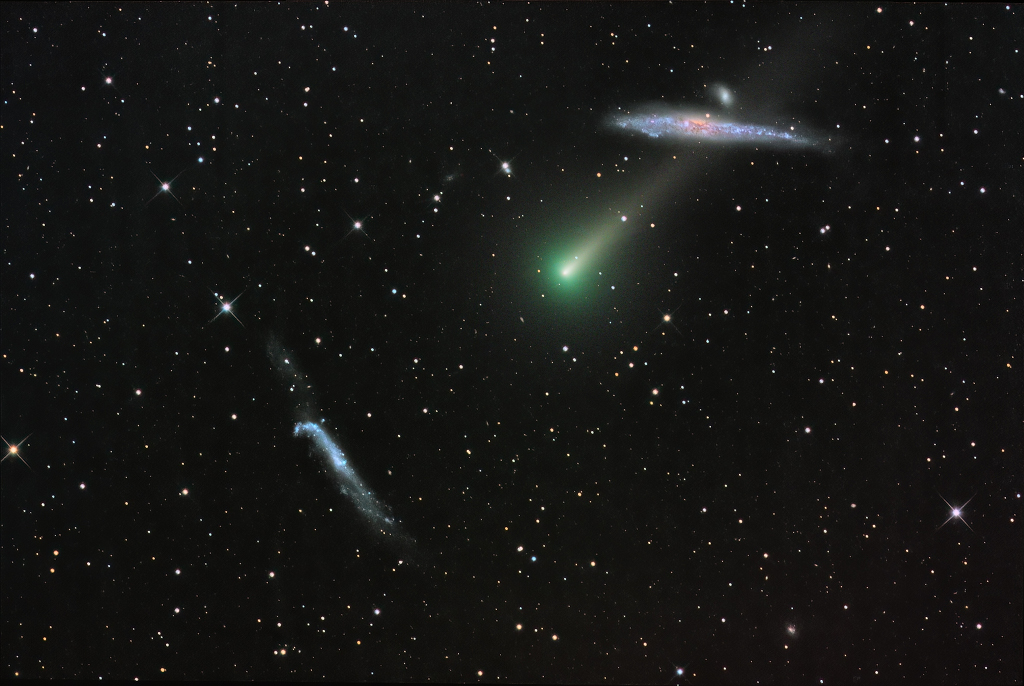
Comet Leonard and the Whale Galaxy


Sweeping through northern predawn skies, on November 24 Comet Leonard (C/2021 A1) was caught between two galaxies in this composite telescopic image. Sporting a greenish coma the comet's dusty tail seems to harpoon the heart of NGC 4631 (top) also known as the Whale Galaxy. Of course NGC 4631 and NGC 4656 (bottom, aka the Hockey Stick) are background galaxies some 25 million light-years away. On that date the comet was about 6 light-minutes from our fair planet. Its closest approach to Earth (and even closer approach to Venus) still to come, Comet Leonard will grow brighter in December. Already a good object for binoculars and small telescopes, this comet will likely not return to the inner Solar System. Its perihelion, or closest approach to the Sun, will be on January 3, 2022.

https://apod.nasa.gov/apod/ap211203.html ( December 03, 2021)

Photographing Mars


NASA’s Curiosity Mars rover used its black-and-white navigation cameras to capture panoramas of this scene at two times of day on Nov. 16, 2021.

from NASA http://www.nasa.gov/image-feature/photographing-mars
via IFTTT

ISS Daily Summary Report – 12/01/2021

iss-about-banner


Payloads: Actiwatch Plus:  Actiwatch Plus devices were connected to the HRF-1 rack using a USB Hub in preparation for ground commanding and battery charging.  The Actiwatch is a waterproof, nonintrusive, sleep-wake activity monitor worn on the wrist of a crewmember. The device contains a miniature uniaxial accelerometer that produces a signal as the subject moves. … ...

December 01, 2021 at 11:00AM
From NASA: https://blogs.nasa.gov/stationreport/2021/12/01/iss-daily-summary-report-12-01-2021/

Wednesday, December 1, 2021

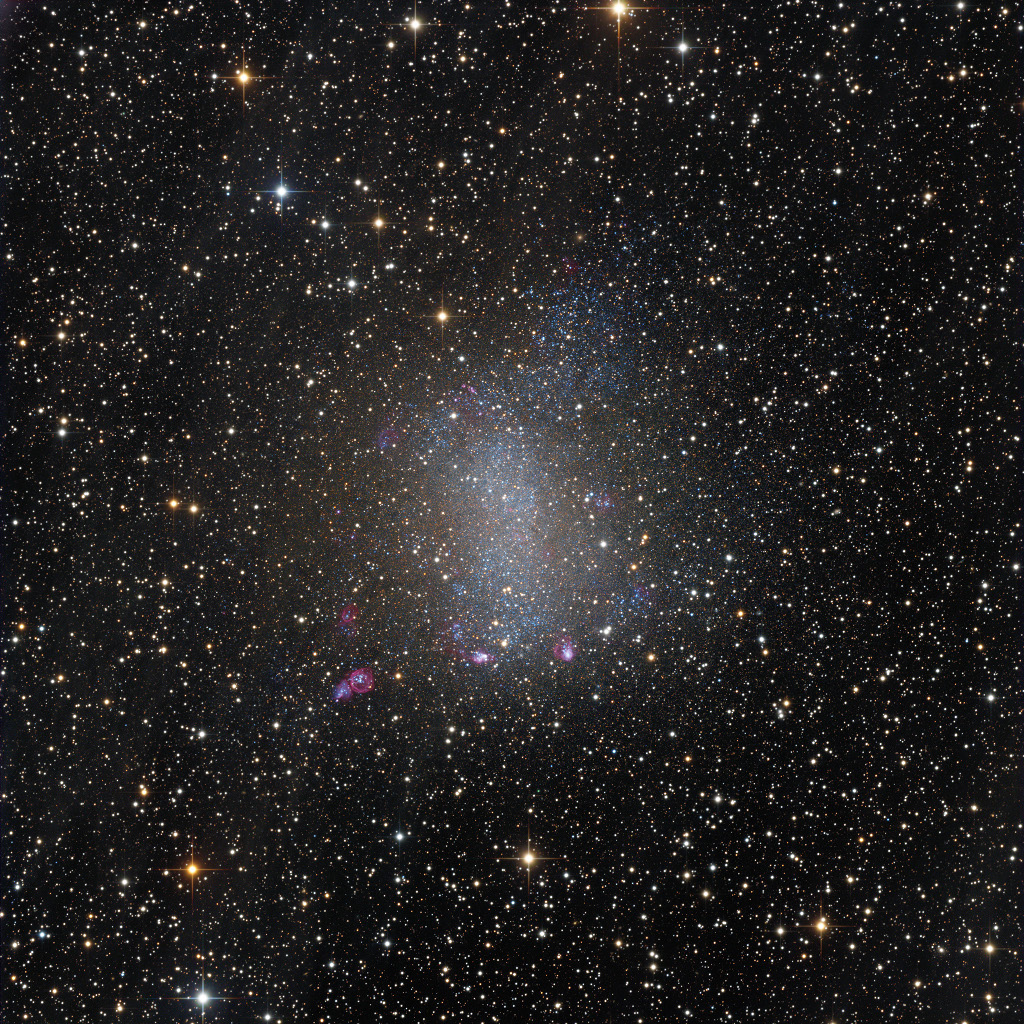
NGC 6822: Barnard s Galaxy


Grand spiral galaxies often seem to get all the glory, flaunting their young, bright, blue star clusters in beautiful, symmetric spiral arms. But small galaxies form stars too, like nearby NGC 6822, also known as Barnard's Galaxy. Beyond the rich starfields in the constellation Sagittarius, NGC 6822 is a mere 1.5 million light-years away, a member of our Local Group of galaxies. A dwarf irregular galaxy similar to the Small Magellanic Cloud, NGC 6822 is about 7,000 light-years across. Brighter foreground stars in our Milky Way have a spiky appearance. Behind them, Barnard's Galaxy is seen to be filled with young blue stars and mottled with the telltale pinkish hydrogen glow of star forming regions in this deep color composite image.

https://apod.nasa.gov/apod/ap211202.html ( December 02, 2021)

ISS Daily Summary Report – 11/30/2021

iss-about-banner


ExtraVehicular (EVA) Status: Due to a late debris notification Monday night, the P1 SASA R&R EVA was deferred today. The USOS crew was provided an uplinked list of activities to work from in lieu of the scheduled timeline. These activities were accelerated from later in the week to accommodate the open time on today’s plan.  … ...

November 30, 2021 at 11:00AM
From NASA: https://blogs.nasa.gov/stationreport/2021/11/30/iss-daily-summary-report-11-30-2021/

Eagle, Omega Nebula, Trifid, and Lagoon: Four Famous Nebulae


These four nebulae are known for their breathtaking beauty: the Eagle Nebula (which contains the Pillars of Creation), the Omega Nebula, the Trifid Nebula, and the Lagoon Nebula.

from NASA http://www.nasa.gov/image-feature/eagle-omega-nebula-trifid-and-lagoon-four-famous-nebulae
via IFTTT