Thursday, August 12, 2021

A Perfect Spiral


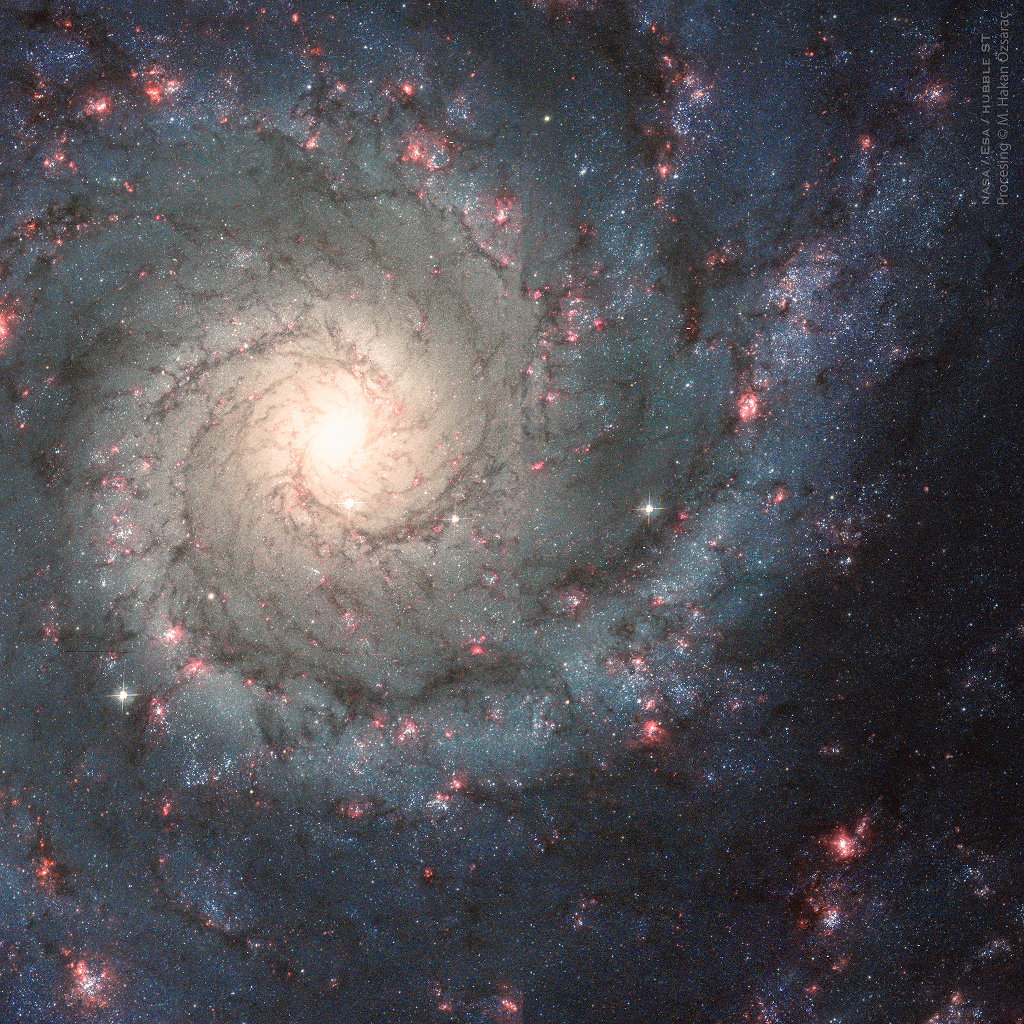
If not perfect then this spiral galaxy is at least one of the most photogenic. An island universe of about 100 billion stars, 32 million light-years away toward the constellation Pisces, M74 presents a gorgeous face-on view. Classified as an Sc galaxy, the grand design of M74's graceful spiral arms are traced by bright blue star clusters and dark cosmic dust lanes. This sharp composite was constructed from image data recorded by the Hubble Space Telescope's Advanced Camera for Surveys. Spanning about 30,000 light-years across the face of M74, it includes exposures recording emission from hydrogen atoms, highlighting the reddish glow of the galaxy's large star-forming regions. With a lower surface brightness than most galaxies in the Messier catalog, M74 is sometimes known as the Phantom Galaxy.

https://apod.nasa.gov/apod/ap210813.html ( August 13, 2021)

The Lagoon Nebula Gives Birth to Stars


Known as NGC 6523 or the Lagoon Nebula, Messier 8 is a giant cloud of gas and dust where stars are born.

from NASA http://www.nasa.gov/image-feature/the-lagoon-nebula-gives-birth-to-stars
via IFTTT

ISS Daily Summary Report – 8/11/2021

iss-about-banner


Payloads Investigating the Structure of Paramagnetic Aggregates from Colloidal Ellipsoids (InSPACE-4):  The crew disconnected the InSPACE-4 SSD cards and USB Cables from MSG HD Video Drawer and packed the items for return.  InSPACE-4 studies the assembly of tiny structures from colloids using magnetic fields.  These structures change the properties of the assembled material, such as … ...

August 11, 2021 at 12:00PM
From NASA: https://blogs.nasa.gov/stationreport/2021/08/11/iss-daily-summary-report-8-11-2021/

Wednesday, August 11, 2021

A Beautiful Trifid


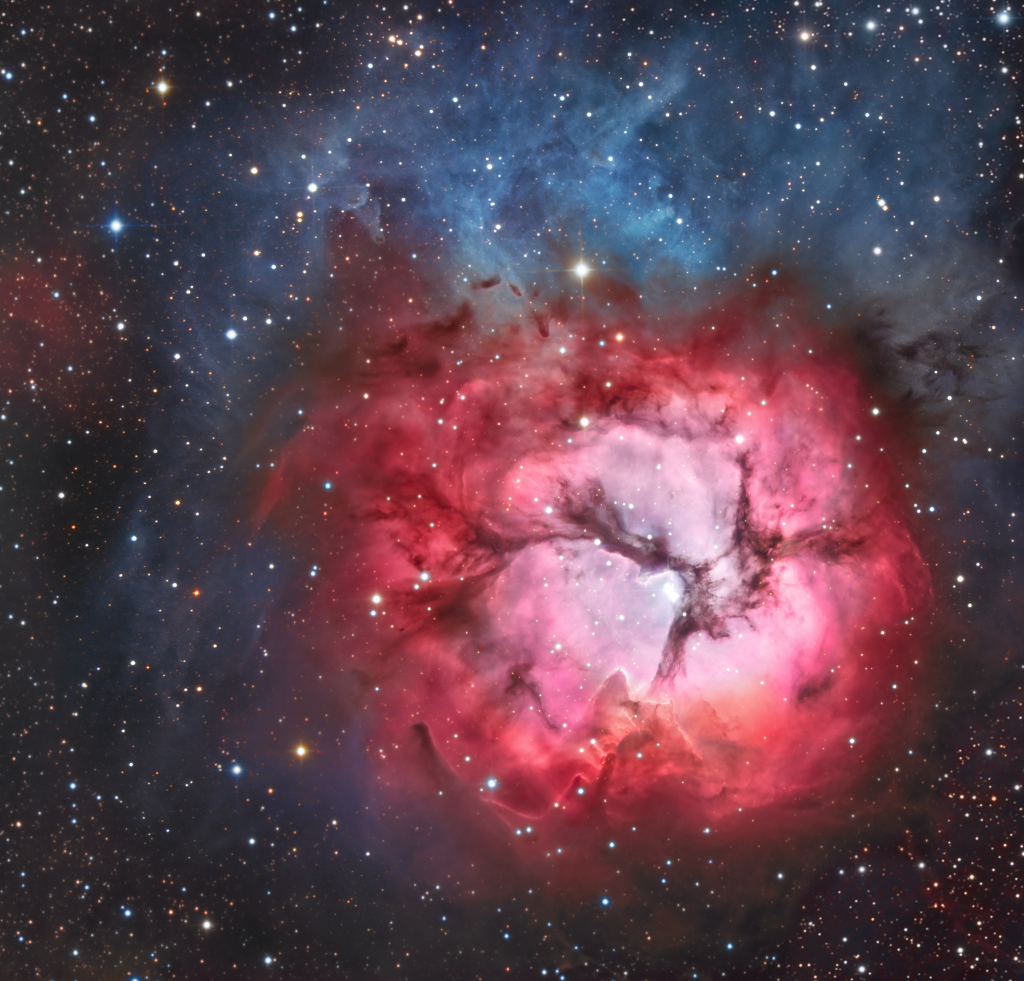
The beautiful Trifid Nebula is a cosmic study in contrasts. Also known as M20, it lies about 5,000 light-years away toward the nebula rich constellation Sagittarius. A star forming region in the plane of our galaxy, the Trifid does illustrate three different types of astronomical nebulae; red emission nebulae dominated by light from hydrogen atoms, blue reflection nebulae produced by dust reflecting starlight, and dark nebulae where dense dust clouds appear in silhouette. But the red emission region roughly separated into three parts by obscuring dust lanes is what lends the Trifid its popular name. Pillars and jets sculpted by newborn stars, below and left of the emission nebula's center, appear in famous Hubble Space Telescope close-up images of the region. The Trifid Nebula is about 40 light-years across. Just too faint to be seen by the unaided eye, it almost covers the area of a full moon in planet Earth's sky.

https://apod.nasa.gov/apod/ap210812.html ( August 12, 2021)

ISS Daily Summary Report – 8/10/2021

iss-about-banner


Payloads: Astrobee: The crew relocated stowage items from JPM Rack Fronts in preparation for the ground to perform remote Astrobee free flyer Ops. Astrobee is made up of three free-flying, cube-shaped robots, which are designed to help scientists, and engineers develop and test technologies for use in microgravity to assist astronauts with routine chores, and … ...

August 10, 2021 at 12:00PM
From NASA: https://blogs.nasa.gov/stationreport/2021/08/10/iss-daily-summary-report-8-10-2021/

Behold! The Perseid Meteor Shower


In this 30 second exposure, a meteor streaks across the sky during the annual Perseid meteor shower, Wednesday, Aug. 11, 2021, in Spruce Knob, West Virginia.

from NASA http://www.nasa.gov/image-feature/behold-the-perseid-meteor-shower
via IFTTT

Tuesday, August 10, 2021

Mammatus Clouds over Saskatchewan


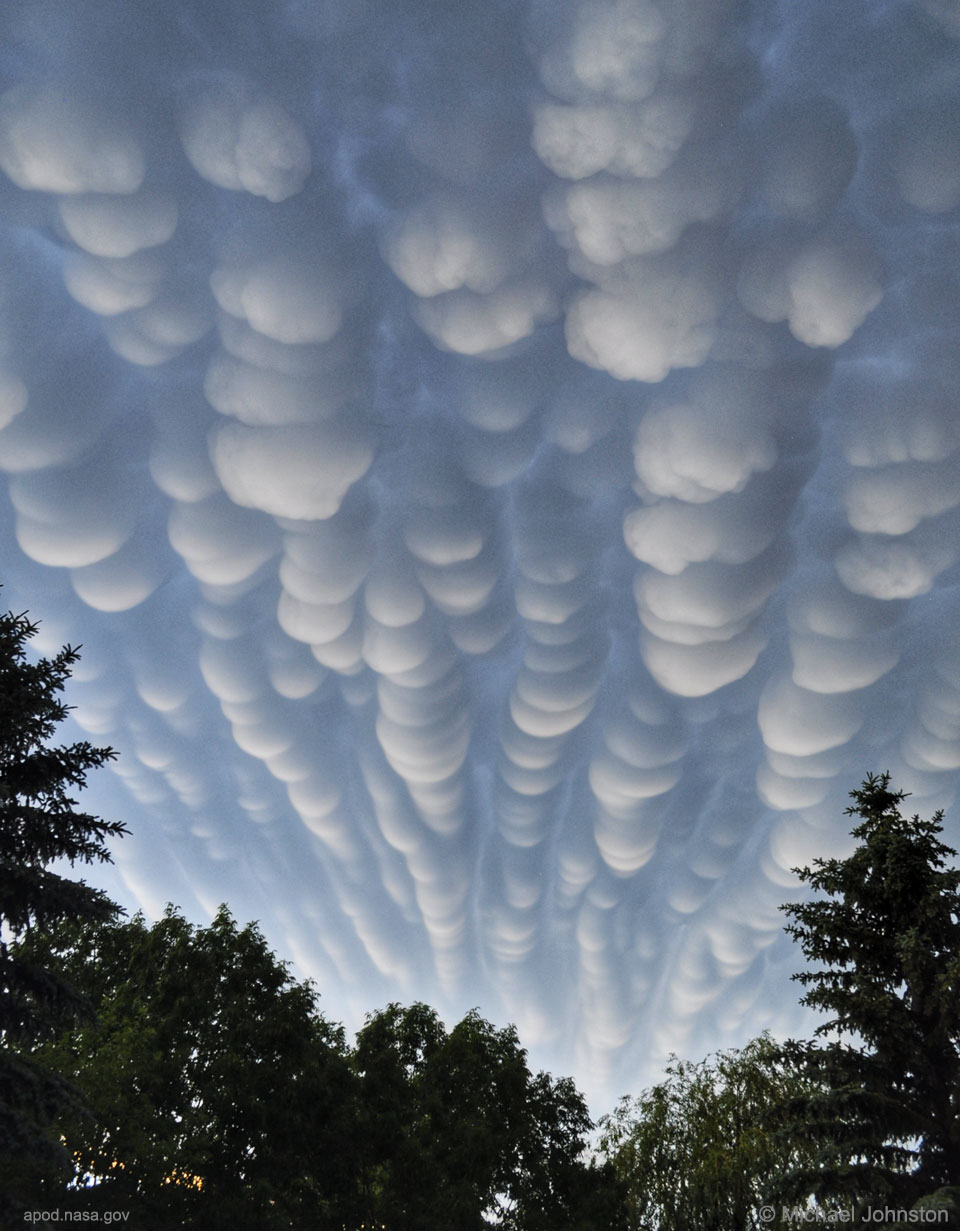
When do cloud bottoms appear like bubbles? Normally, cloud bottoms are flat. This is because moist warm air that rises and cools will condense into water droplets at a specific temperature, which usually corresponds to a very specific height. As water droplets grow, an opaque cloud forms. Under some conditions, however, cloud pockets can develop that contain large droplets of water or ice that fall into clear air as they evaporate. Such pockets may occur in turbulent air near a thunderstorm. Resulting mammatus clouds can appear especially dramatic if sunlit from the side. The mammatus clouds pictured here, lasting only a few minutes, were photographed over Regina, Saskatchewan, Canada, just after a storm in 2012.

https://apod.nasa.gov/apod/ap210811.html ( August 11, 2021)

Cygnus Cargo Craft Slated to Launch to Station


Northrop Grumman’s 16th cargo resupply mission to the International Space Station is slated to launch Aug. 10, 2021.

from NASA http://www.nasa.gov/image-feature/cygnus-cargo-craft-slated-to-launch-to-station
via IFTTT

Monday, August 9, 2021

Fire in Space


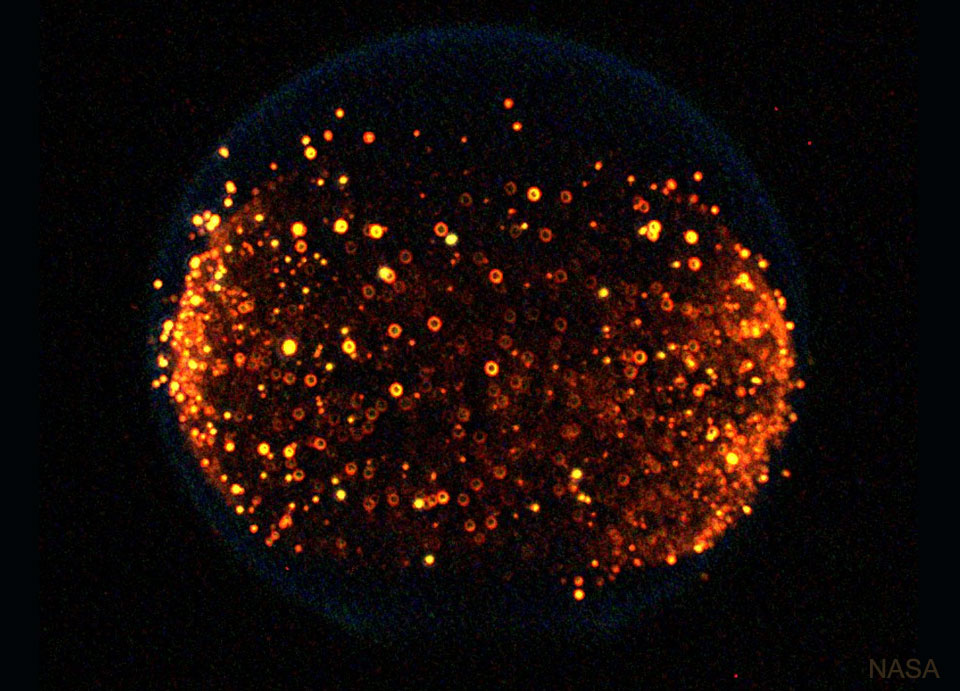
What does fire look like in space? In the gravity on Earth, heated air rises and expands, causing flames to be teardrop shaped. In the microgravity of the air-filled International Space Station (ISS), however, flames are spheres. Fire is the rapid acquisition of oxygen, and space flames meet new oxygen molecules when they float by randomly from all directions -- creating the enveloping sphere. In the featured image taken in the ISS's Combustion Integration Rack, a spherical flame envelopes clusters of hot glowing soot. Without oxygen, say in the vacuum of empty space, a fire would go out immediately. The many chemical reactions involved with fire are complex, and testing them in microgravity is helping humanity not only to better understand fire -- but how to put out fire, too.

https://apod.nasa.gov/apod/ap210810.html ( August 10, 2021)

Download NASA E-Books on National Book Lovers Day


Happy #NationalBookLoversDay!

from NASA http://www.nasa.gov/image-feature/download-nasa-e-books-on-national-book-lovers-day
via IFTTT