Wednesday, August 11, 2021

Behold! The Perseid Meteor Shower


In this 30 second exposure, a meteor streaks across the sky during the annual Perseid meteor shower, Wednesday, Aug. 11, 2021, in Spruce Knob, West Virginia.

from NASA http://www.nasa.gov/image-feature/behold-the-perseid-meteor-shower
via IFTTT
Tuesday, August 10, 2021

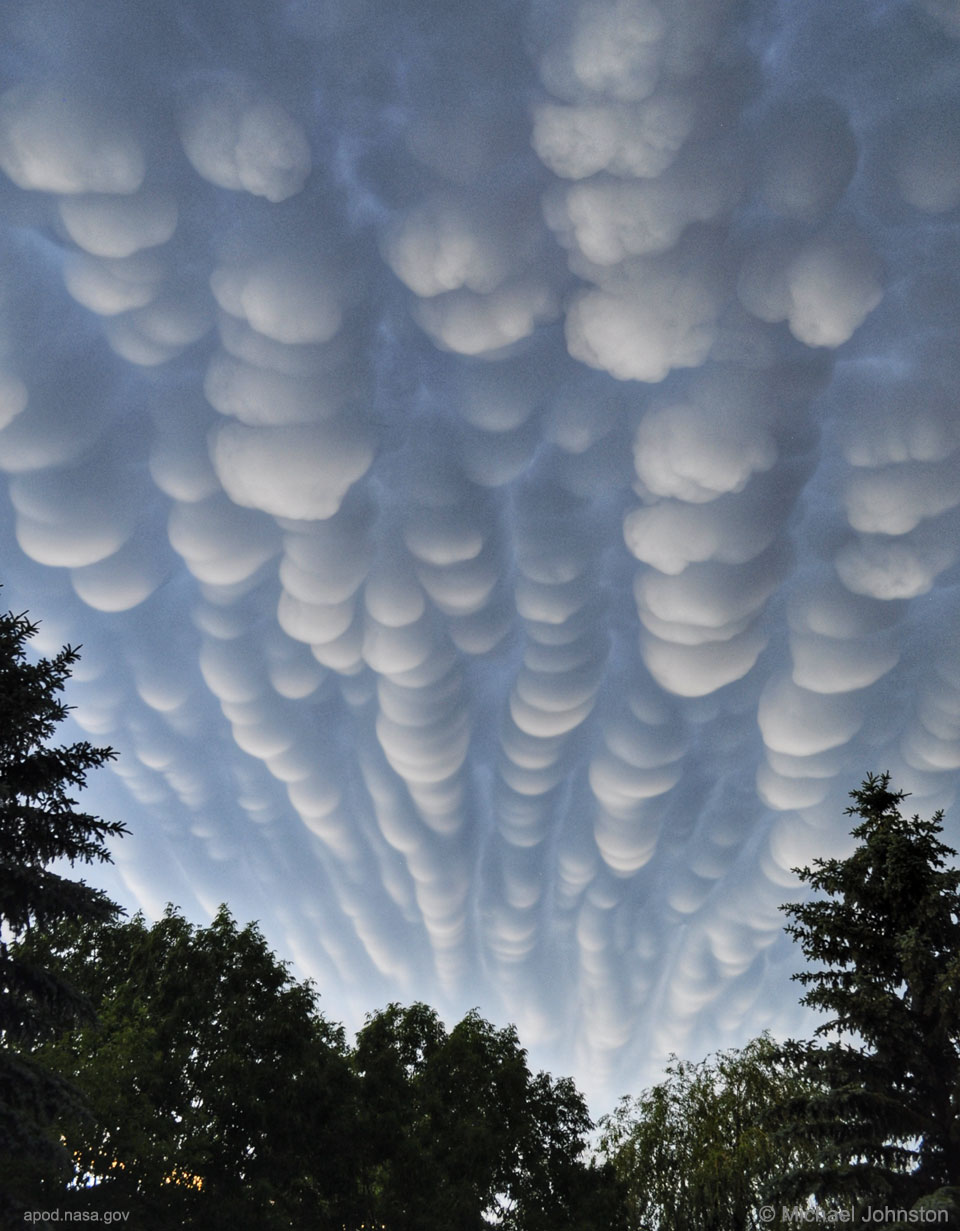
Mammatus Clouds over Saskatchewan


When do cloud bottoms appear like bubbles? Normally, cloud bottoms are flat. This is because moist warm air that rises and cools will condense into water droplets at a specific temperature, which usually corresponds to a very specific height. As water droplets grow, an opaque cloud forms. Under some conditions, however, cloud pockets can develop that contain large droplets of water or ice that fall into clear air as they evaporate. Such pockets may occur in turbulent air near a thunderstorm. Resulting mammatus clouds can appear especially dramatic if sunlit from the side. The mammatus clouds pictured here, lasting only a few minutes, were photographed over Regina, Saskatchewan, Canada, just after a storm in 2012.

https://apod.nasa.gov/apod/ap210811.html ( August 11, 2021)

Cygnus Cargo Craft Slated to Launch to Station


Northrop Grumman’s 16th cargo resupply mission to the International Space Station is slated to launch Aug. 10, 2021.

from NASA http://www.nasa.gov/image-feature/cygnus-cargo-craft-slated-to-launch-to-station
via IFTTT

Monday, August 9, 2021

Fire in Space


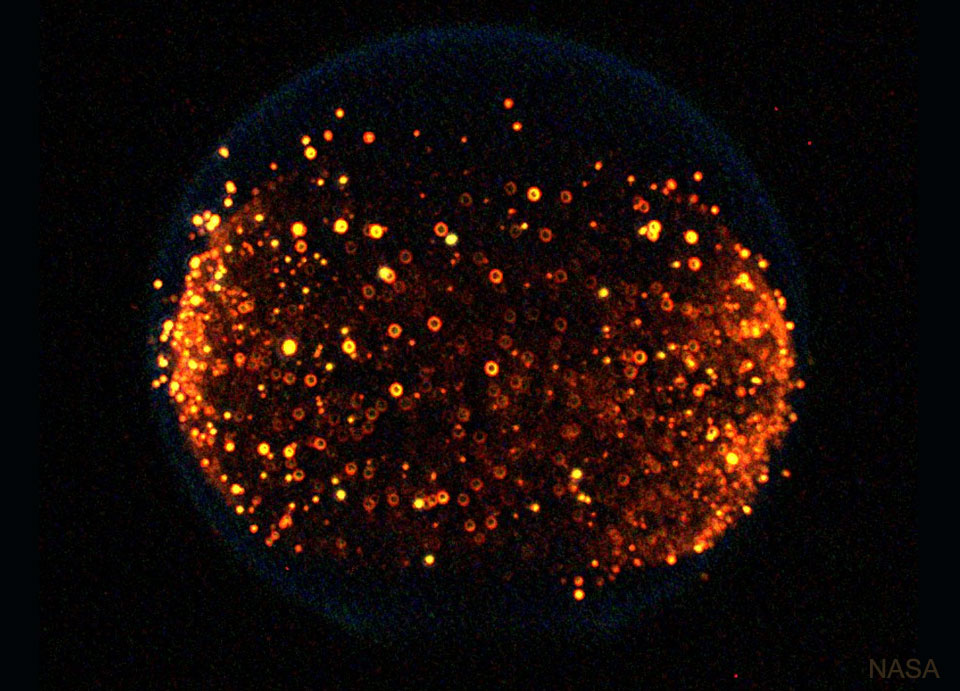
What does fire look like in space? In the gravity on Earth, heated air rises and expands, causing flames to be teardrop shaped. In the microgravity of the air-filled International Space Station (ISS), however, flames are spheres. Fire is the rapid acquisition of oxygen, and space flames meet new oxygen molecules when they float by randomly from all directions -- creating the enveloping sphere. In the featured image taken in the ISS's Combustion Integration Rack, a spherical flame envelopes clusters of hot glowing soot. Without oxygen, say in the vacuum of empty space, a fire would go out immediately. The many chemical reactions involved with fire are complex, and testing them in microgravity is helping humanity not only to better understand fire -- but how to put out fire, too.

https://apod.nasa.gov/apod/ap210810.html ( August 10, 2021)

Download NASA E-Books on National Book Lovers Day


Happy #NationalBookLoversDay!

from NASA http://www.nasa.gov/image-feature/download-nasa-e-books-on-national-book-lovers-day
via IFTTT

Sunday, August 8, 2021

Perseus and the Lost Meteors


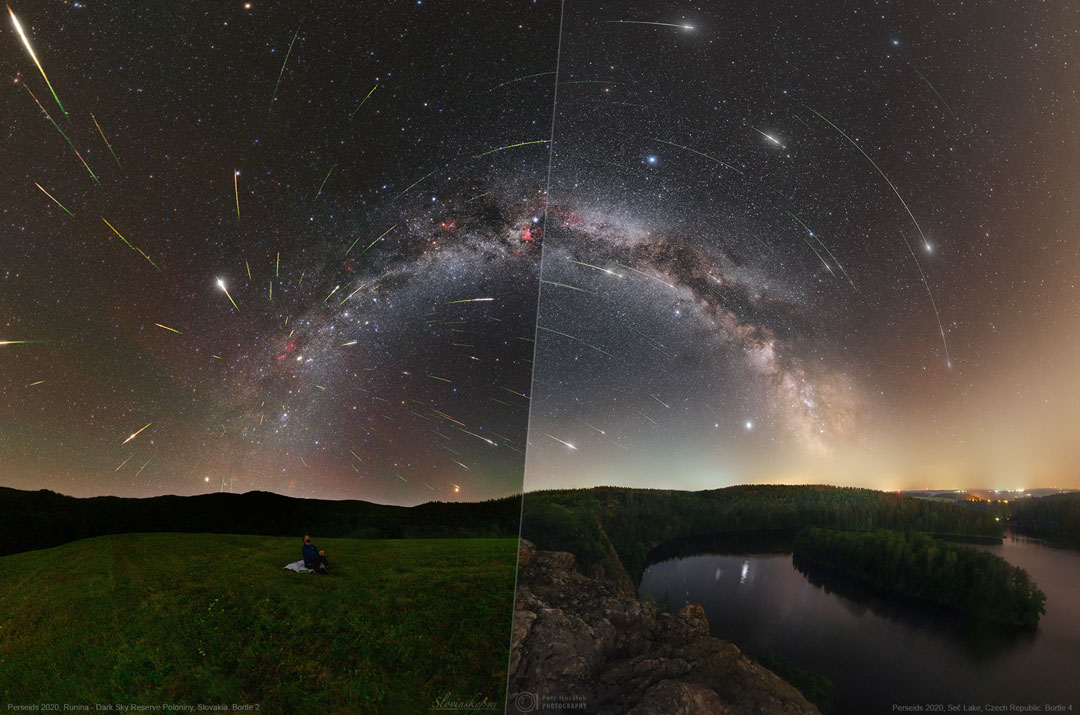
What's the best way to watch a meteor shower? This question might come up later this week when the annual Perseid Meteor Shower peaks. One thing that is helpful is a dark sky, as demonstrated in the featured composite image of last year's Perseids. Many more faint meteors are visible on the left image, taken through a very dark sky in Slovakia, than on the right image, taken through a moderately dark sky in the Czech Republic. The band of the Milky Way Galaxy bridges the two coordinated images, while the meteor shower radiant in the constellation of Perseus is clearly visible on the left. In sum, many faint meteors are lost through a bright sky. Light pollution is shrinking areas across our Earth with dark skies, although inexpensive ways to combat this might be implemented.

https://apod.nasa.gov/apod/ap210809.html ( August 09, 2021)

Saturday, August 7, 2021

A Perseid Below


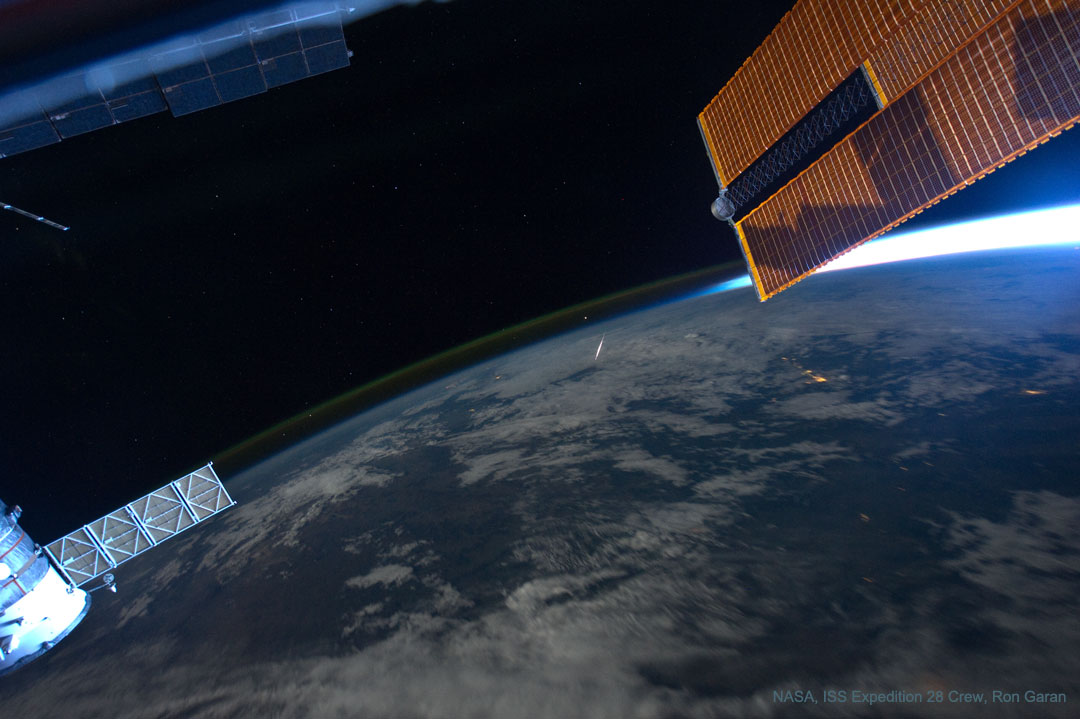
Earthlings typically watch meteor showers by looking up. But this remarkable view, captured on August 13, 2011 by astronaut Ron Garan, caught a Perseid meteor by looking down. From Garan's perspective onboard the International Space Station orbiting at an altitude of about 380 kilometers, the Perseid meteors streak below, swept up dust left from comet Swift-Tuttle heated to incandescence. The glowing comet dust grains are traveling at about 60 kilometers per second through the denser atmosphere around 100 kilometers above Earth's surface. In this case, the foreshortened meteor flash is right of frame center, below the curving limb of the Earth and a layer of greenish airglow, just below bright star Arcturus. Want to look up at a meteor shower? You're in luck, as the 2021 Perseids meteor shower peaks this week. This year, even relatively faint meteors should be visible through clear skies from a dark location as the bright Moon will mostly absent.

https://apod.nasa.gov/apod/ap210808.html ( August 08, 2021)

Friday, August 6, 2021

Jezero Crater: Raised Ridges in 3D


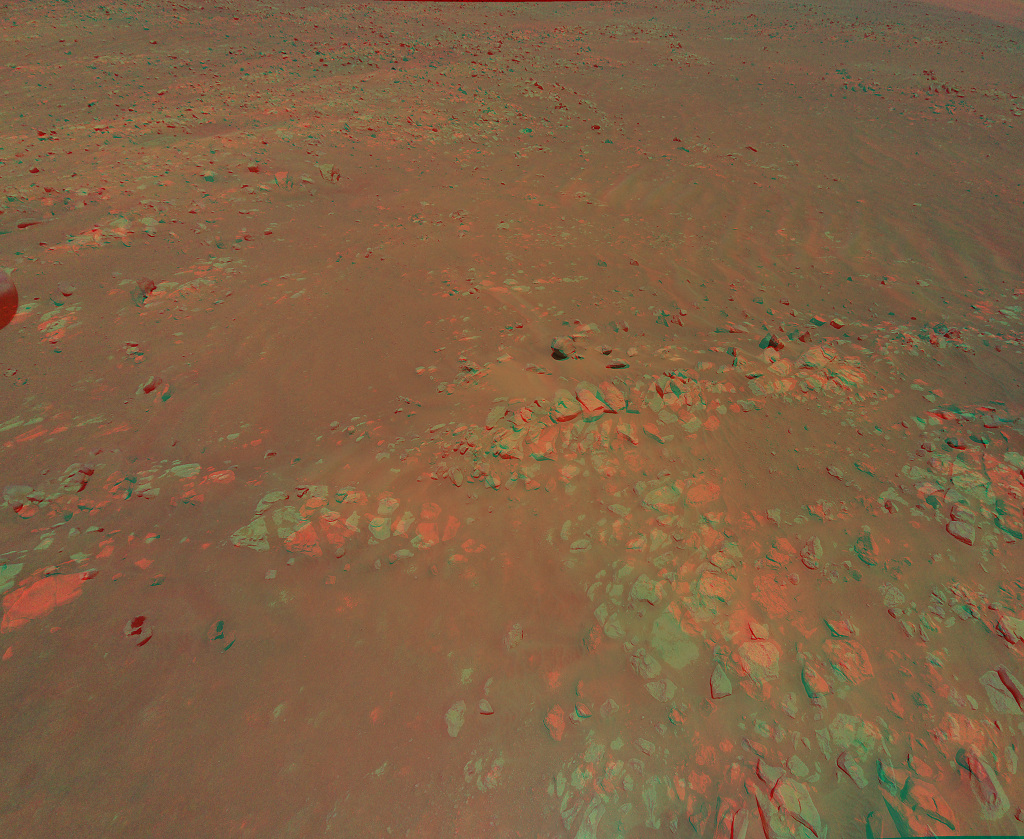
Get out your red-blue glasses and hover over the surface of Mars. Taken on July 24, the 3D color view is from the Mars Ingenuity Helicopter's 10th flight above the Red Planet. Two images from Ingenuity's color camera, both captured at an altitude of 12 meters (40 feet), but a few meters apart to provide a stereo perspective, were used to construct the color anaglyph. Ingenuity's stereo images were made at the request of the Mars Perseverance rover science team. The team is considering a visit to these raised ridges on the floor of Jezero Crater during Perseverance's first science campaign.

https://apod.nasa.gov/apod/ap210807.html ( August 07, 2021)

ISS Daily Summary Report – 8/05/2021

iss-about-banner


Payloads Cell Biology Experiment Facility (CBEF) humidifier installation:  The crew installed the CBEF Incubator Unit (IU) humidifier on the micro-gravity CBEF IU.  The Cell Biology Experiment Facility (CBEF) is a Japan Aerospace Exploration Agency (JAXA) subrack facility; it is an incubator with an artificial gravity generator. CBEF is housed in the Saibo (living cell) Experiment … ...

August 05, 2021 at 12:00PM
From NASA: https://blogs.nasa.gov/stationreport/2021/08/05/iss-daily-summary-report-8-05-2021/

Juno Celebrates 10 Years With a New View of Jovian Moon Ganymede


This infrared view of Jupiter’s icy moon Ganymede was obtained by the Jovian Infrared Auroral Mapper (JIRAM) instrument aboard NASA’s Juno spacecraft during its July 20, 2021, flyby.

from NASA http://www.nasa.gov/image-feature/juno-celebrates-10-years-with-a-new-view-of-jovian-moon-ganymede
via IFTTT