Thursday, August 5, 2021

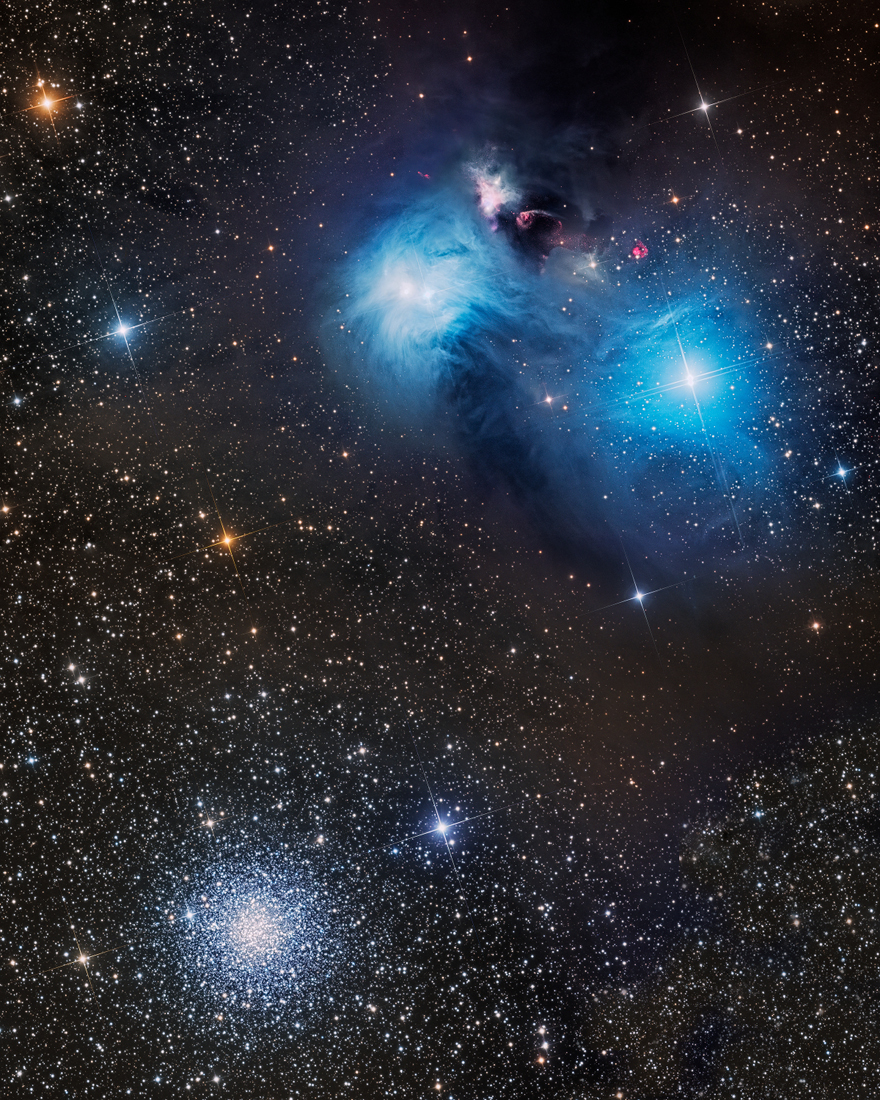
Stars and Dust Across Corona Australis


Cosmic dust clouds cross a rich field of stars in this telescopic vista near the northern boundary of Corona Australis, the Southern Crown. Less than 500 light-years away the dust clouds effectively block light from more distant background stars in the Milky Way. Top to bottom the frame spans about 2 degrees or over 15 light-years at the clouds' estimated distance. At top right is a group of lovely reflection nebulae cataloged as NGC 6726, 6727, 6729, and IC 4812. A characteristic blue color is produced as light from hot stars is reflected by the cosmic dust. The dust also obscures from view stars in the region still in the process of formation. Just above the bluish reflection nebulae a smaller NGC 6729 surrounds young variable star R Coronae Australis. To its right are telltale reddish arcs and loops identified as Herbig Haro objects associated with energetic newborn stars. Magnificent globular star cluster NGC 6723 is at bottom left in the frame. Though NGC 6723 appears to be part of the group, its ancient stars actually lie nearly 30,000 light-years away, far beyond the young stars of the Corona Australis dust clouds.

https://apod.nasa.gov/apod/ap210806.html ( August 06, 2021)

Curiosity Celebrates Another Year on Mars


In this self-portrait from 2018, NASA's Curiosity Mars rover sits atop Vera Rubin Ridge, which the rover had been investigating.

from NASA http://www.nasa.gov/image-feature/curiosity-celebrates-another-year-on-mars
via IFTTT

Wednesday, August 4, 2021

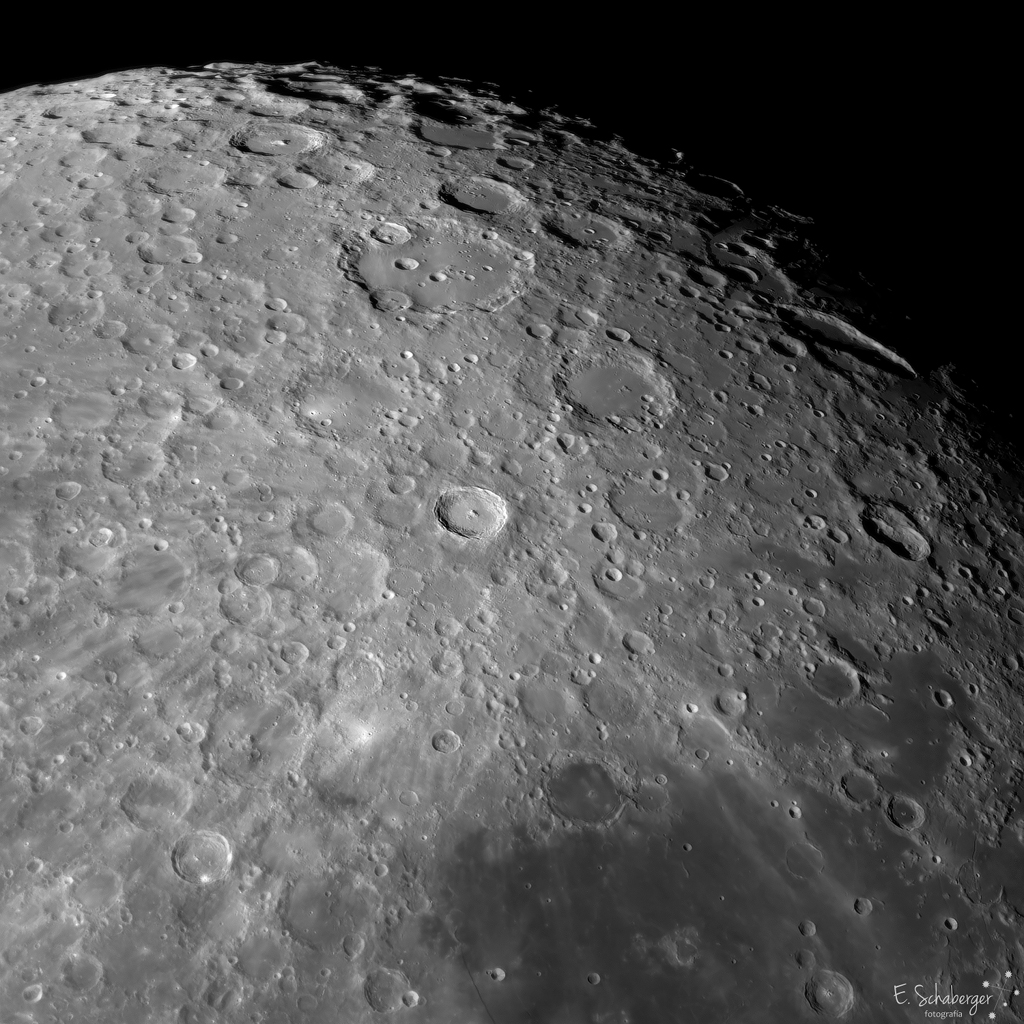
Tycho and Clavius


South is up in this detailed telescopic view across the Moon's rugged southern highlands. Captured on July 20, the lunar landscape features the Moon's young and old, the large craters Tycho and Clavius. About 100 million years young, Tycho is the sharp-walled 85 kilometer diameter crater near center, its 2 kilometer tall central peak in bright sunlight and dark shadow. Debris ejected during the impact that created Tycho still make it the stand out lunar crater when the Moon is near full, producing a highly visible radiating system of light streaks, bright rays that extend across much of the lunar near side. In fact, some of the material collected at the Apollo 17 landing site, about 2,000 kilometers away, likely originated from the Tycho impact. One of the oldest and largest craters on the Moon's near side, 225 kilometer diameter Clavius is due south (above) of Tycho. Clavius crater's own ray system resulting from its original impact event would have faded long ago. The old crater's worn walls and smooth floor are now overlayed by smaller craters from impacts that occurred after Clavius was formed. Observations by the Stratospheric Observatory for Infrared Astronomy (SOFIA) published in 2020 found water at Clavius. Of course both young Tycho and old Clavius craters are lunar locations in the science fiction epic 2001: A Space Odyssey.

https://apod.nasa.gov/apod/ap210805.html ( August 05, 2021)

ISS Daily Summary Report – 8/03/2021

iss-about-banner


Payloads Investigating the Structure of Paramagnetic Aggregates from Colloidal Ellipsoids (InSPACE-4):  The crew performed the steps necessary to initiate experiment runs, with a goal of working through runs 61-64. InSPACE-4 studies the assembly of tiny structures from colloids using magnetic fields. These structures change the properties of the assembled material, such as its mechanical response … ...

August 03, 2021 at 12:00PM
From NASA: https://blogs.nasa.gov/stationreport/2021/08/03/iss-daily-summary-report-8-03-2021/

The Menu Matters


An army marches on its stomach, the saying goes, and astronauts fly on theirs.

from NASA http://www.nasa.gov/image-feature/the-menu-matters
via IFTTT

Tuesday, August 3, 2021

EHT Resolves Central Jet from Black Hole in Cen A


How do supermassive black holes create powerful jets? To help find out, the Event Horizon Telescope (EHT) imaged the center of the nearby active galaxy Centaurus A. The cascade of featured inset images shows Cen A from it largest, taking up more sky than many moons, to its now finest, taking up only as much sky as an golf ball on the moon. The new image shows what may look like two jets -- but is actually two sides of a single jet. This newly discovered jet-edge brightening does not solve the jet-creation mystery, but does imply that the particle outflow is confined by a strong pressure -- possibly involving a magnetic field. The EHT is a coordination of radio telescopes from around the Earth -- from the Caltech Submillimeter Observatory in Hawaii USA, to ALMA in Chile, to NOEMA in France, and more. The EHT will continue to observe massive, nearby black holes and their energetic surroundings.

https://apod.nasa.gov/apod/ap210804.html ( August 04, 2021)

ISS Daily Summary Report – 8/02/2021

iss-about-banner


Payloads Combustion Integrated Rack/Advanced Combustion via Microgravity Experiments (CIR/ACME): The crew exchanged a used 85% O2/ 15% N2 bottle with a new one of the same composition; however, during the installation, a loose pressure relief valve body was found.  The ground is discussing steps to re-tighten the valve body and proceed with operations.  This will … ...

August 02, 2021 at 12:00PM
From NASA: https://blogs.nasa.gov/stationreport/2021/08/02/iss-daily-summary-report-8-02-2021/

Illuminating the Next Launch


A United Launch Alliance Atlas V rocket with NASA’s Starliner spacecraft aboard is illuminated by spotlights on Monday, Aug. 2, 2021, as it sits on the launch pad.

from NASA http://www.nasa.gov/image-feature/illuminating-the-next-launch
via IFTTT

Monday, August 2, 2021

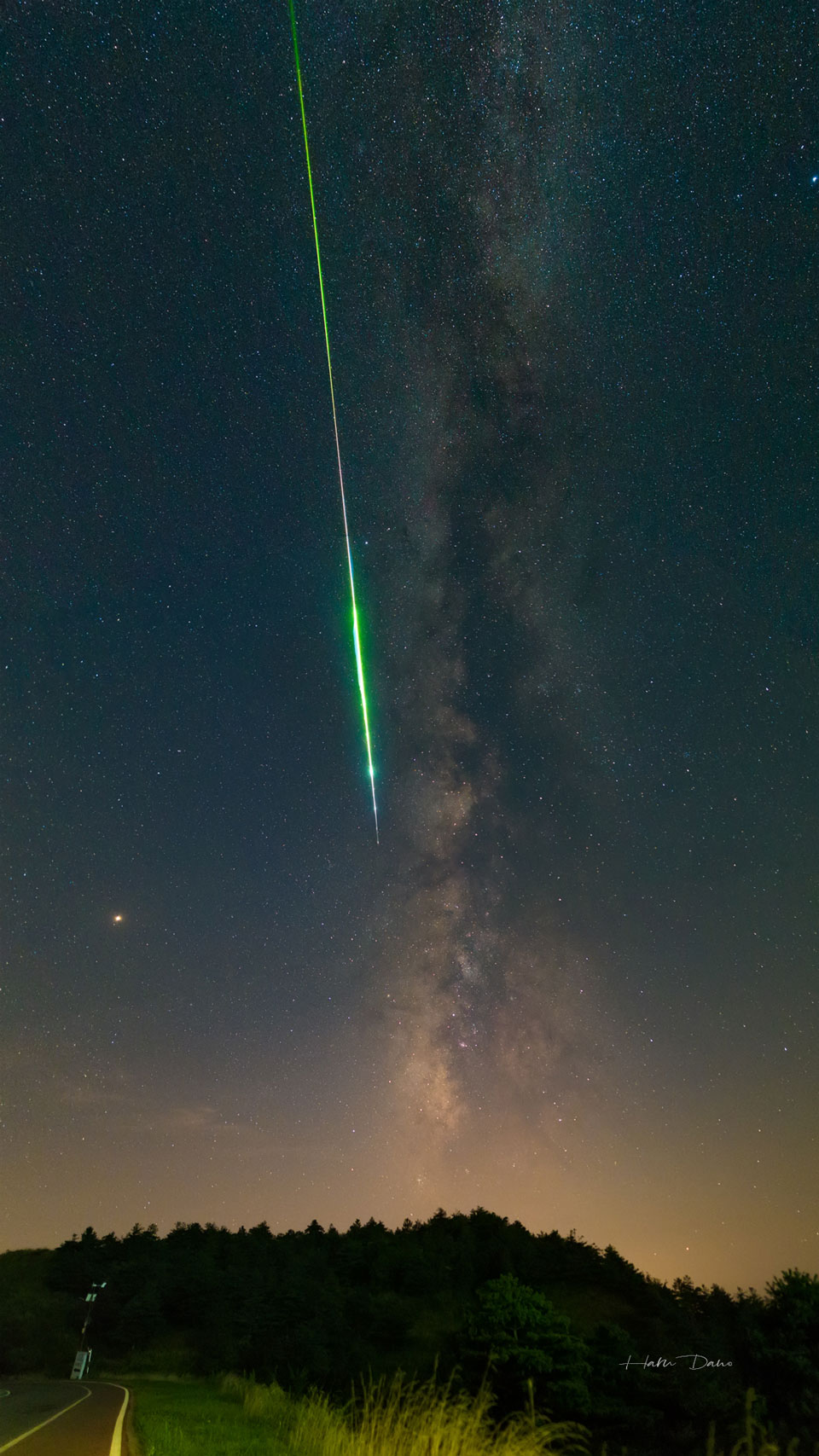
A Perseid Meteor and the Milky Way


It was bright and green and flashed as it moved quickly along the Milky Way. It left a trail that took 30 minutes to dissipate. Given the day, August 12, and the direction, away from Perseus, it was likely a small bit from the nucleus of Comet Swift-Tuttle plowing through the Earth's atmosphere -- and therefore part of the annual Perseids meteor shower. The astrophotographer captured the fireball as it shot across the sky in 2018 above a valley in Yichang, Hubei, China. The meteor's streak, also caught on video, ended near the direction of Mars on the lower left. Next week, the 2021 Perseids meteor shower will peak again. This year the Moon will set shortly after the Sun, leaving a night sky ideal for seeing lots of Perseids from dark and clear locations across planet Earth.

https://apod.nasa.gov/apod/ap210803.html ( August 03, 2021)

Rolling to the Launch Pad


A United Launch Alliance Atlas V rocket with Boeing’s CST-100 Starliner spacecraft aboard is seen as it is rolled out of the Vertical Integration Facility on Monday, Aug. 2, 2021.

from NASA http://www.nasa.gov/image-feature/rolling-to-the-launch-pad
via IFTTT