Saturday, July 10, 2021

Find the Moon


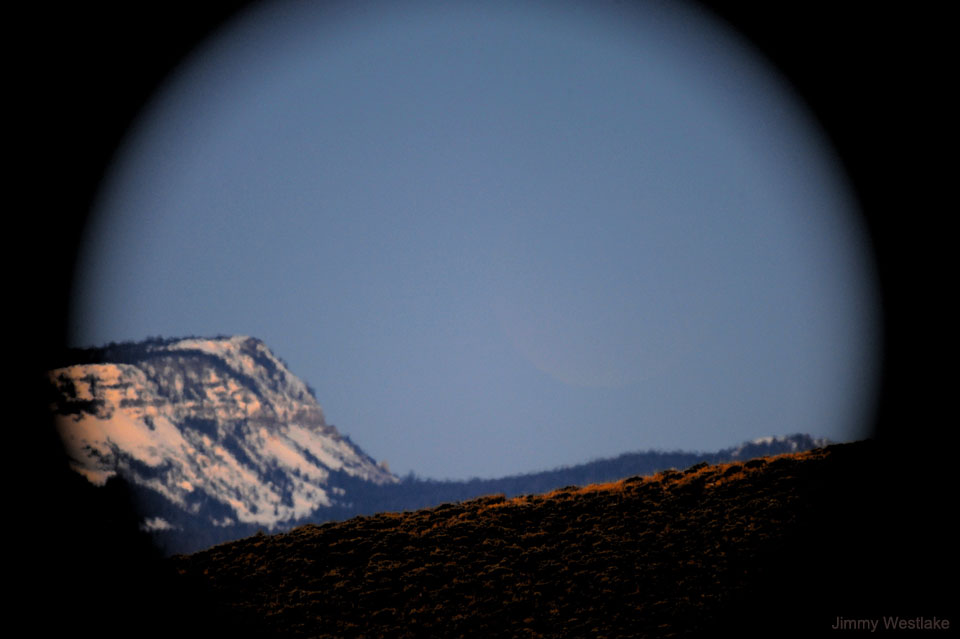
Where's the Moon? Somewhere in this image, the Earth's Moon is hiding. The entire Moon is visible, in its completely full phase, in plain sight. Even the photographer's keen eye couldn't find it even though he knew exactly where to look -- only the long exposure of his camera picked it up -- barely. Although by now you might be congratulating yourself on finding it, why was it so difficult to see? For one reason, this photograph was taken during a total lunar eclipse, when the Earth's shadow made the Moon much dimmer than a normal full Moon. For another, the image, taken in Colorado, USA, was captured just before sunrise. With the Moon on the exact opposite side of the sky from the Sun, this meant that the Sun was just below the horizon, but still slightly illuminating the sky. Last, as the Moon was only about two degrees above the horizon, the large volume of air between the camera and the horizon scattered a lot of light away from the background Moon. Twelve minutes after this image was acquired in 2012, the Sun peeked over the horizon and the Moon set.

https://apod.nasa.gov/apod/ap210711.html ( July 11, 2021)

Friday, July 9, 2021

Mercury and the Da Vinci Glow


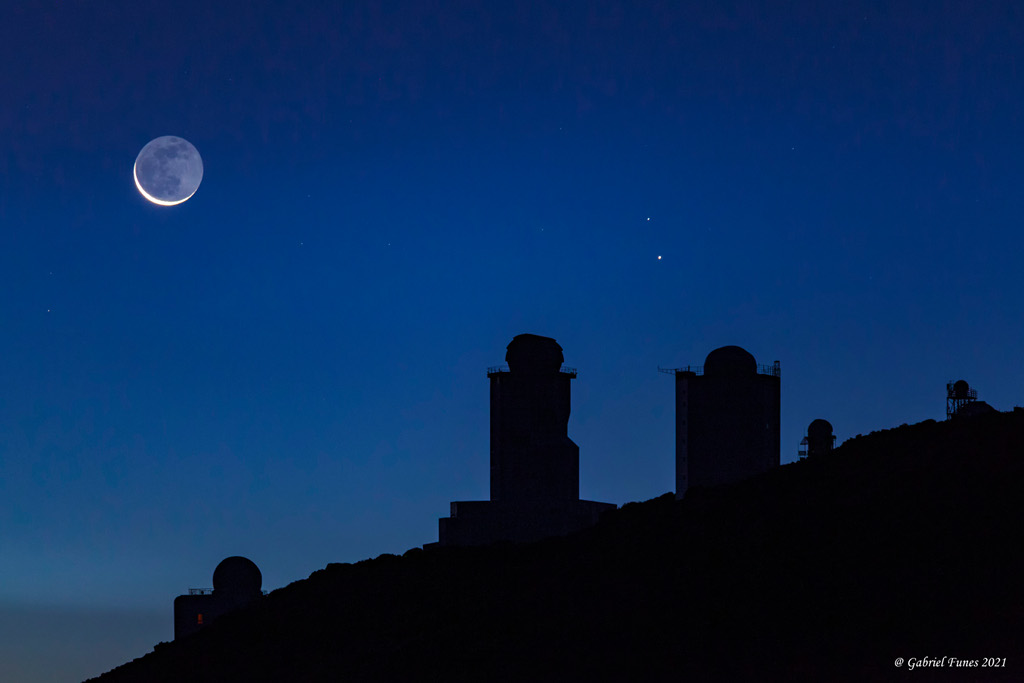
On July 8th early morning risers saw Mercury near an old Moon low on the eastern horizon. On that date bright planet, faint glow of lunar night side, and sunlit crescent were captured in this predawn skyscape from Tenerife's Teide National Park in the Canary Islands. Never far from the Sun in planet Earth's sky, the fleeting inner planet shines near its brightest in the morning twilight scene. Mercury lies just below the zeta star of the constellation Taurus, Zeta Tauri, near the tip of the celestial bull's horn. Of course the Moon's ashen glow is earthshine, earthlight reflected from the Moon's night side. A description of earthshine, in terms of sunlight reflected by Earth's oceans illuminating the Moon's dark surface, was written over 500 years ago by Leonardo da Vinci. Waiting for the coming dawn in the foreground are the Teide Observatory's sentinels of the Sun, also known as (large domes left to right) the THEMIS, VTT, and GREGOR solar telescopes.

https://apod.nasa.gov/apod/ap210710.html ( July 10, 2021)

ISS Daily Summary Report – 7/08/2021

iss-about-banner


SpaceX-22 Undock and Return: Cargo Dragon SpaceX-22 (SpX-22) undocked from the ISS today at 9:45 AM CT to return cargo and payloads to the ground concluding the 33-day mission aboard the ISS. SpX-22 will complete departure phasing through Friday evening, jettison the Trunk carrying the empty ISS Power Augmentation (IPA) for destructive re-entry, deorbit, and … ...

July 08, 2021 at 09:33AM
From NASA: https://blogs.nasa.gov/stationreport/2021/07/08/iss-daily-summary-report-7-08-2021/

Hubble Glimpses a Galactic Duo


Two enormous galaxies capture your attention in this spectacular image taken with the NASA/ESA Hubble Space Telescope using the Wide Field Camera 3 (WFC3).

from NASA http://www.nasa.gov/image-feature/goddard/2021/hubble-glimpses-a-galactic-duo
via IFTTT

Thursday, July 8, 2021

M82: Starburst Galaxy with a Superwind


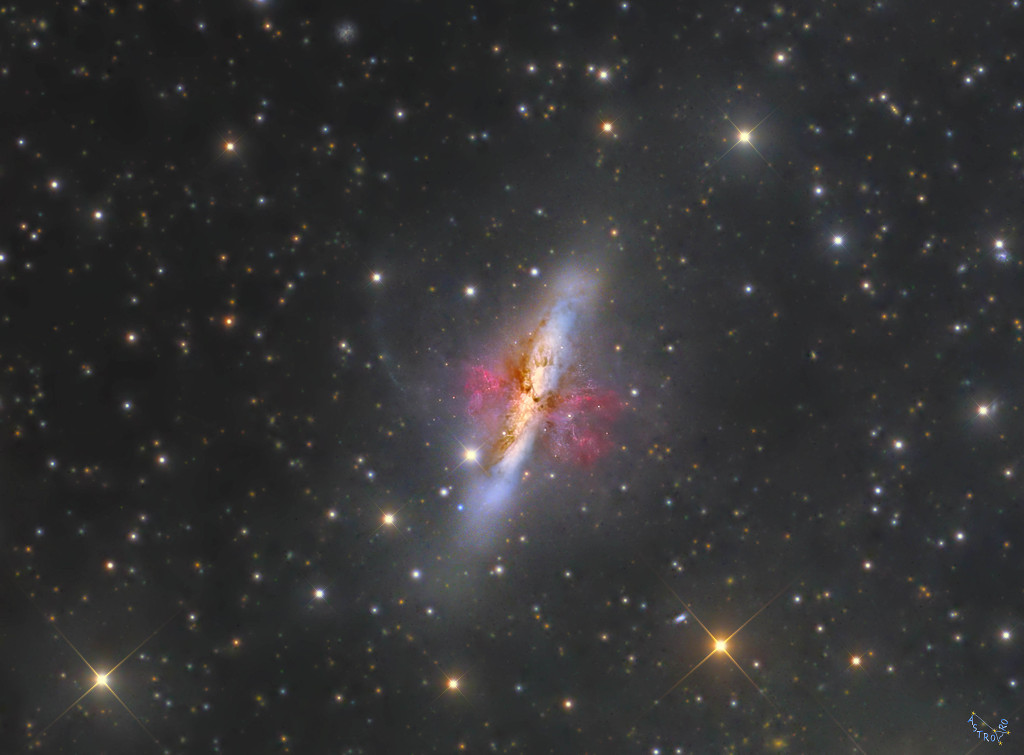
M82 is a starburst galaxy with a superwind. In fact, through ensuing supernova explosions and powerful winds from massive stars, the burst of star formation in M82 is driving a prodigious outflow. Evidence for the superwind from the galaxy's central regions is clear in sharp telescopic snapshot. The composite image highlights emission from long outflow filaments of atomic hydrogen gas in reddish hues. Some of the gas in the superwind, enriched in heavy elements forged in the massive stars, will eventually escape into intergalactic space. Triggered by a close encounter with nearby large galaxy M81, the furious burst of star formation in M82 should last about 100 million years or so. Also known as the Cigar Galaxy for its elongated visual appearance, M82 is about 30,000 light-years across. It lies 12 million light-years away near the northern boundary of Ursa Major.

https://apod.nasa.gov/apod/ap210709.html ( July 09, 2021)

ISS Daily Summary Report – 7/07/2021

iss-about-banner


Payloads Astrobee/SoundSee: The crew participated in a crew conference, set up the appropriate hardware, and initiated the SoundSee science session. Investigation of Deep Audio Analytics on the ISS (SoundSee Mission) tests monitoring of the acoustic environment using an audio sensor on Astrobee, a mobile robotic platform aboard the space station. Microphones collect acoustic information, and … ...

July 07, 2021 at 12:00PM
From NASA: https://blogs.nasa.gov/stationreport/2021/07/07/iss-daily-summary-report-7-07-2021/

This Week in NASA History: Final Launch of Shuttle Program – July 8, 2011


This week in 2011, space shuttle Atlantis, mission STS-135, launched from NASA’s Kennedy Space Center to the International Space Station.

from NASA http://www.nasa.gov/centers/marshall/history/images/this-week-in-nasa-history-final-launch-of-shuttle-program-july-8-2011.html
via IFTTT

Wednesday, July 7, 2021

Perihelion to Aphelion


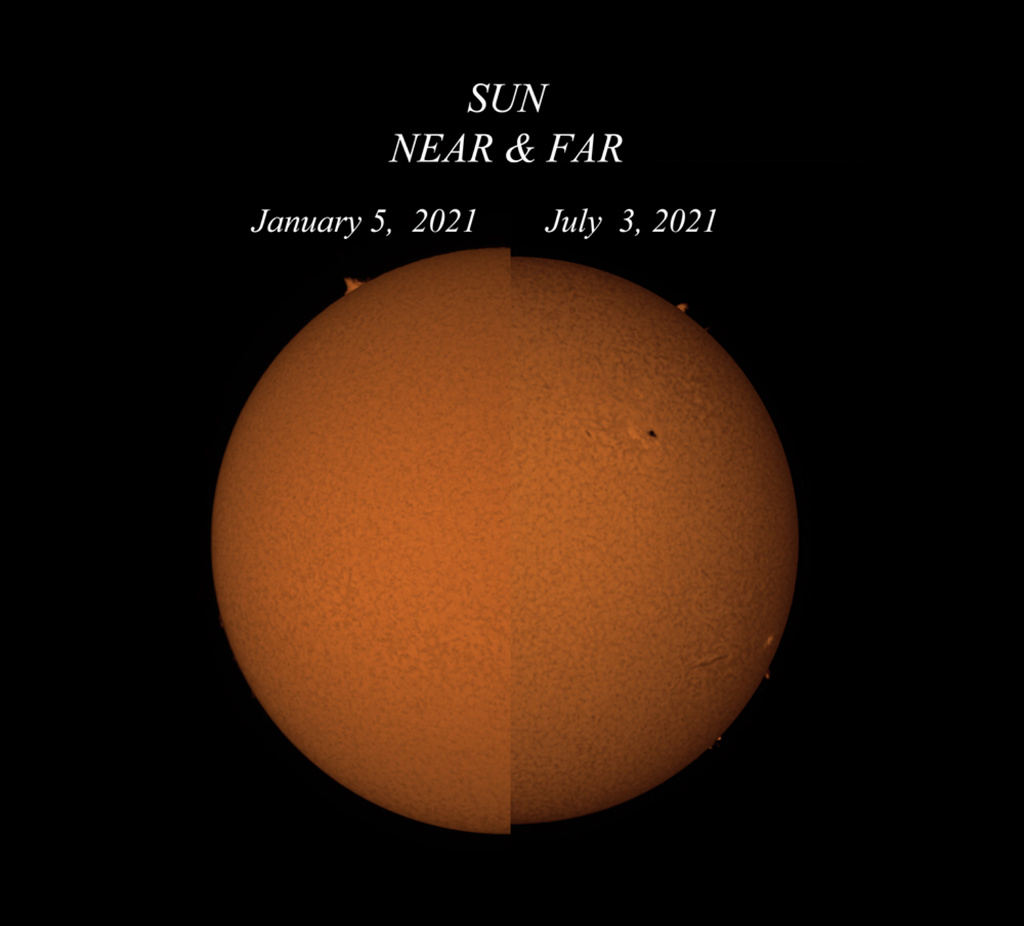
Aphelion for 2021 occurred on July 5th. That's the point in Earth's elliptical orbit when it is farthest from the Sun. Of course, the distance from the Sun doesn't determine the seasons. Those are governed by the tilt of Earth's axis of rotation, so July is still summer in the north and winter in the southern hemisphere. But it does mean that on July 5 the Sun was at its smallest apparent size when viewed from planet Earth. This composite neatly compares two pictures of the Sun, both taken with the same telescope and camera. The left half was captured close to the date of the 2021 perihelion (January 2), the closest point in Earth's orbit. The right was recorded just before the aphelion in 2021. Otherwise difficult to notice, the change in the Sun's apparent diameter between perihelion and aphelion amounts to a little over 3 percent.

https://apod.nasa.gov/apod/ap210708.html ( July 08, 2021)

ISS Daily Summary Report – 7/06/2021

iss-about-banner


Payloads Collapsible Contingency Urinal (CCU) Demo: The crew performed multiple handheld fill and drain cycles of the CCU using fruit punch as a test fluid. The ground team guided and observed the operations to analyze performance characteristics and observe fluid dynamics and stability of liquid in the system. The CCU is exploration hardware flown to … ...

July 06, 2021 at 12:00PM
From NASA: https://blogs.nasa.gov/stationreport/2021/07/06/iss-daily-summary-report-7-06-2021/

There's a Starr in the Asteroid Belt


Our birthday wishes for Ringo Starr's 81st birthday are almost boundless.

from NASA http://www.nasa.gov/image-feature/theres-a-starr-in-the-asteroid-belt
via IFTTT