Wednesday, May 12, 2021

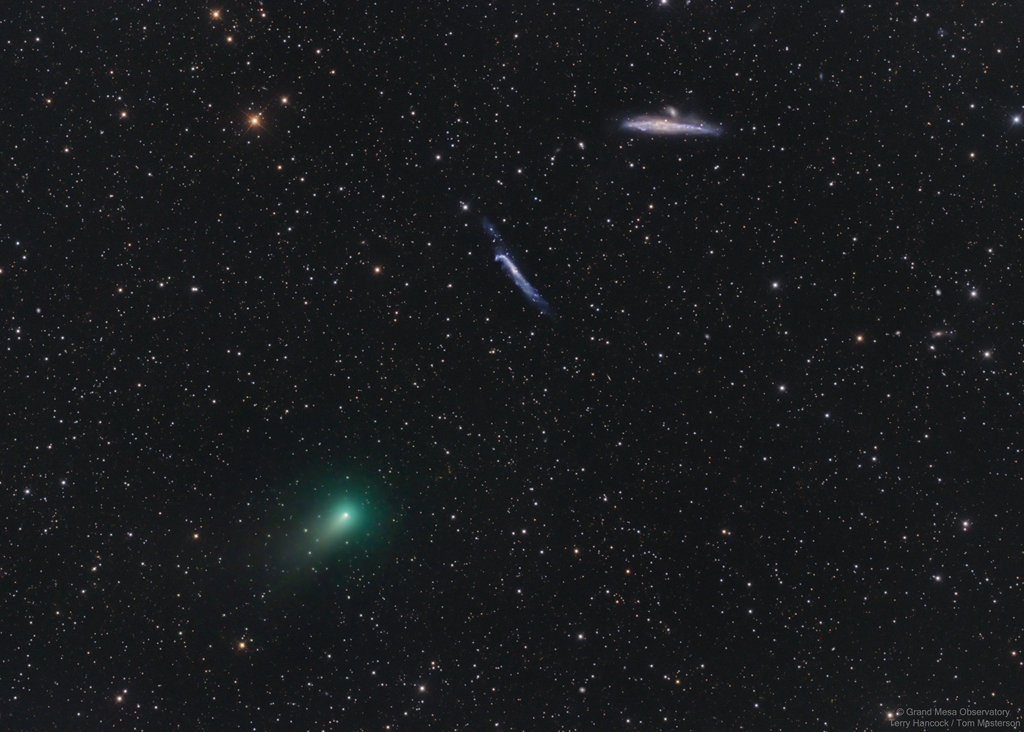
The Comet, the Whale, and the Hockey Stick


Closest to the Sun on March 1, and closest to planet Earth on April 23, this Comet ATLAS (C/2020 R4) shows a faint greenish coma and short tail in this pretty, telescopic field of view. Captured at its position on May 5, the comet was within the boundaries of northern constellation Canes Venatici (the Hunting Dogs), and near the line-of-sight to intriguing background galaxies popularly known as the Whale and the Hockey Stick. Cetacean in appearance but Milky Way sized, NGC 4631 is a spiral galaxy seen edge-on at the top right, some 25 million light-years away. NGC 4656/7 sports the bent-stick shape of interacting galaxies below and left of NGC 4631. In fact, the distortions and mingling trails of gas detected at other wavelengths suggest the cosmic Whale and Hockey Stick have had close encounters with each other in their distant past. Outbound and only about 7 light-minutes from Earth this Comet ATLAS should revisit the inner solar system in just under 1,000 years.

https://apod.nasa.gov/apod/ap210513.html ( May 13, 2021)

Systems Engineer Allen Chen


Perseverance entry, descent, and landing lead Allen Chen, gives remarks during a NASA Perseverance rover mission landing update.

from NASA http://www.nasa.gov/image-feature/systems-engineer-allen-chen
via IFTTT

Tuesday, May 11, 2021

A Meteor and the Gegenschein


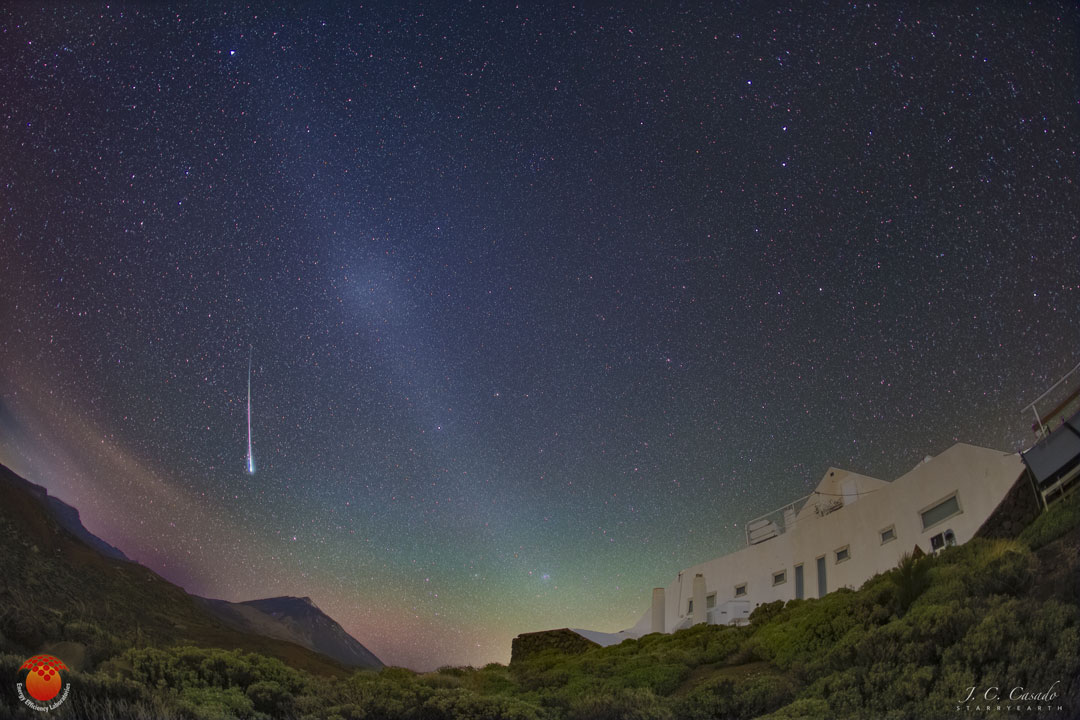
Is the night sky darkest in the direction opposite the Sun? No. In fact, a rarely discernable faint glow known as the gegenschein (German for "counter glow") can be seen 180 degrees around from the Sun in an extremely dark sky. The gegenschein is sunlight back-scattered off small interplanetary dust particles. These dust particles are millimeter sized splinters from asteroids and orbit in the ecliptic plane of the planets. Pictured here from last March is one of the more spectacular pictures of the gegenschein yet taken. The deep exposure of an extremely dark sky over Teide Observatory in Spain's Canary Islands shows the gegenschein as part of extended zodiacal light. Notable background objects include a bright meteor (on the left), the Big Dipper (top right), and Polaris (far right). The meteor nearly points toward Mount Teide, Spain's highest mountain, while the Pyramid solar laboratory is visible on the right. During the day, a phenomenon like the gegenschein called the glory can be seen in reflecting air or clouds opposite the Sun from an airplane.

https://apod.nasa.gov/apod/ap210512.html ( May 12, 2021)

OSIRIS-REx Bids Farewell to Asteroid Bennu


OSIRIS-REx bids farewell to Asteroid Bennu and begins its long journey home.

from NASA http://www.nasa.gov/image-feature/osiris-rex-bids-farewell-to-asteroid-bennu
via IFTTT

Monday, May 10, 2021

Lightning and Orion Beyond Uluru


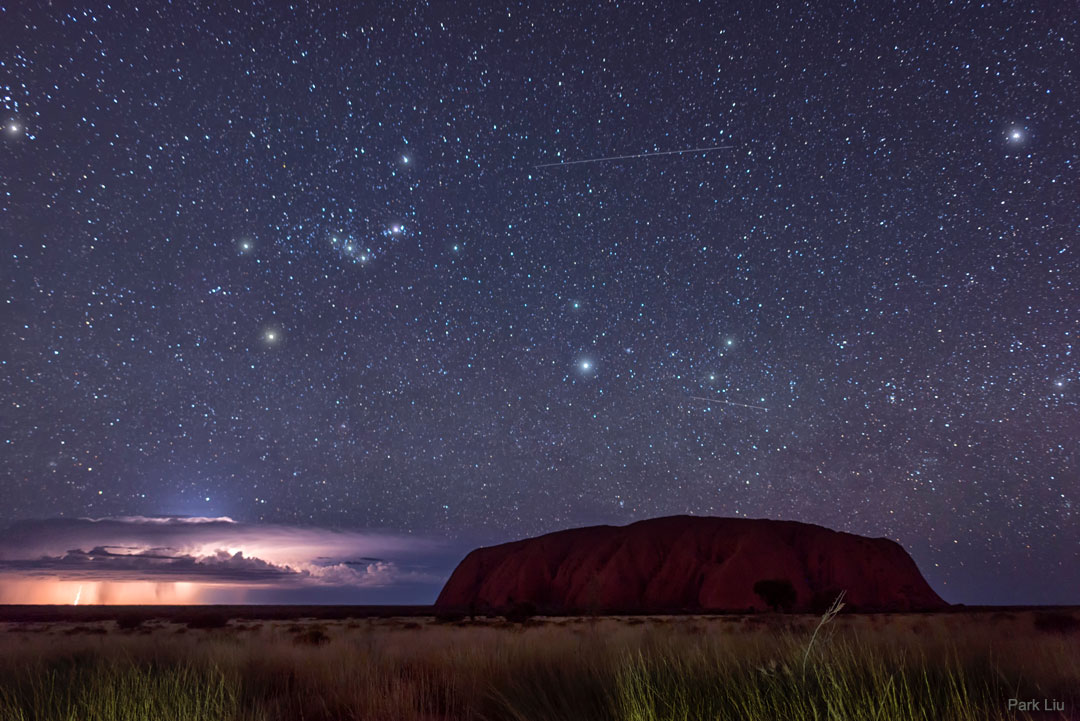
What's happening behind Uluru? A United Nations World Heritage Site, Uluru is an extraordinary 350-meter high mountain in central Australia that rises sharply from nearly flat surroundings. Composed of sandstone, Uluru has slowly formed over the past 300 million years as softer rock eroded away. In the background of the featured image taken in mid-May, a raging thunderstorm is visible. Far behind both Uluru and the thunderstorm is a star-filled sky highlighted by the constellation of Orion. The Uluru region has been a home to humans for over 22,000 years. Local indigenous people have long noted that when the stars that compose the modern constellation of Orion first appear in the night sky, a hot season involving lightning storms will soon be arriving.

https://apod.nasa.gov/apod/ap210511.html ( May 11, 2021)

Looking at Stars in the Early Universe


This June 2020 image from the Hubble Space Telescope shows the galaxy cluster MACS J0416.

from NASA http://www.nasa.gov/image-feature/looking-at-stars-in-the-early-universe
via IFTTT

Sunday, May 9, 2021

Star Clusters M35 and NGC 2158


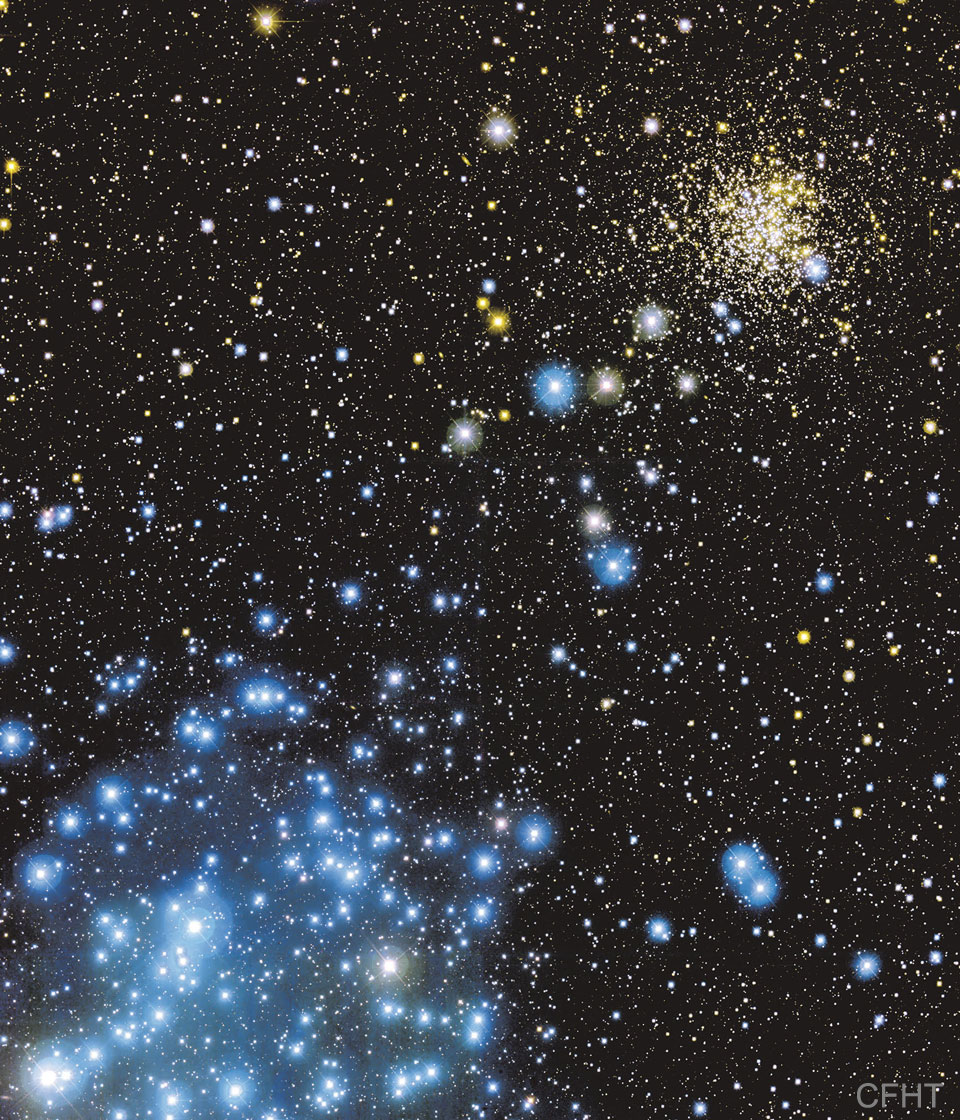
Clusters of stars can be near or far, young or old, diffuse or compact. The featured image shows two quite contrasting open star clusters in the same field. M35, on the lower left, is relatively nearby at 2800 light years distant, relatively young at 150 million years old, and relatively diffuse, with about 2500 stars spread out over a volume 30 light years across. Bright blue stars frequently distinguish younger open clusters like M35. Contrastingly, NGC 2158, on the upper right, is four times more distant than M35, over 10 times older, and much more compact. NGC 2158's bright blue stars have self-destructed, leaving cluster light to be dominated by older and yellower stars. In general, open star clusters are found in the plane of our Milky Way Galaxy, and contain anywhere from 100 to 10,000 stars -- all of which formed at nearly the same time. Both open clusters M35 and NGC 2158 can be found together with a small telescope toward the constellation of the Twins (Gemini).

https://apod.nasa.gov/apod/ap210510.html ( May 10, 2021)

Saturday, May 8, 2021

Horsehead and Orion Nebulas


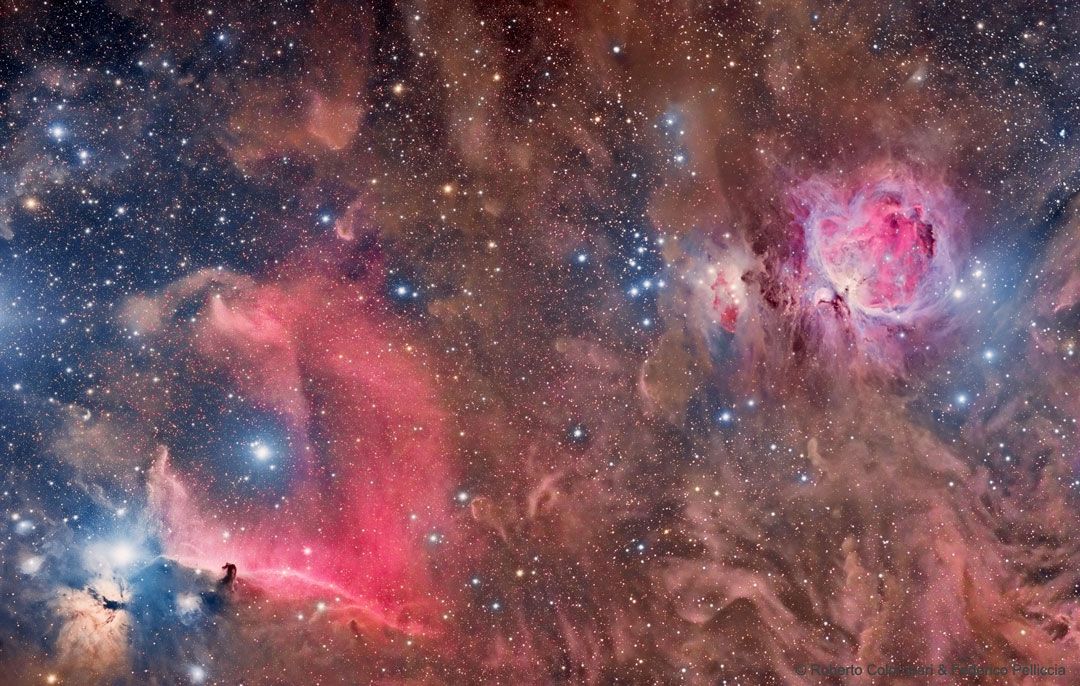
The dark Horsehead Nebula and the glowing Orion Nebula are contrasting cosmic vistas. Adrift 1,500 light-years away in one of the night sky's most recognizable constellations, they appear in opposite corners of the above stunning mosaic. The familiar Horsehead nebula appears as a dark cloud, a small silhouette notched against the long red glow at the lower left. Alnitak is the easternmost star in Orion's belt and is seen as the brightest star to the left of the Horsehead. Below Alnitak is the Flame Nebula, with clouds of bright emission and dramatic dark dust lanes. The magnificent emission region, the Orion Nebula (aka M42), lies at the upper right. Immediately to its left is a prominent reflection nebula sometimes called the Running Man. Pervasive tendrils of glowing hydrogen gas are easily traced throughout the region.

https://apod.nasa.gov/apod/ap210509.html ( May 09, 2021)

Friday, May 7, 2021

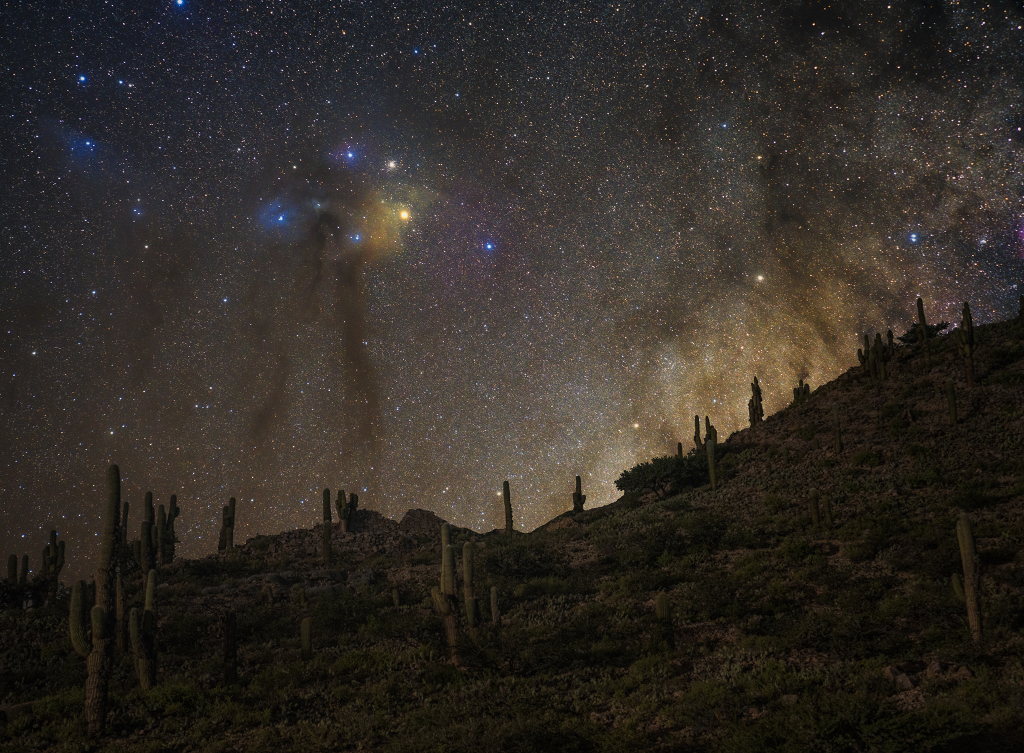
Deepscape at Yacoraite


In this evocative night scene a dusty central Milky Way rises over the ancient Andean archaeological site of Yacoraite in northwestern Argentina. The denizens of planet Earth reaching skyward are the large Argentine saguaro cactus currently native to the arid region. The unusual yellow-hued reflection nebula above is created by dust scattering starlight around red giant star Antares. Alpha star of the constellation Scorpius, Antares is over 500 light-years distant. Next to it bright blue Rho Ophiuchi is embedded in more typical dusty bluish reflection nebulae though. The deep night skyscape was created from a series of background exposures of the rising stars made while tracking the sky, and a foreground exposure of the landscape made with the camera and lens fixed on the tripod. In combination they produce the single stunning image and reveal a range of brightness and color that your eye can't quite perceive on its own.

https://apod.nasa.gov/apod/ap210508.html ( May 08, 2021)

Hubble Gazes at a Cluster Full of Cosmic Clues


This detailed image features Abell 3827, a galaxy cluster that offers a wealth of exciting possibilities for study.

from NASA http://www.nasa.gov/image-feature/goddard/2021/hubble-gazes-at-a-cluster-full-of-cosmic-clues
via IFTTT