Wednesday, July 6, 2022

ISS Daily Summary Report – 7/05/2022

iss-about-banner


NRAL Trash Deploy: On Saturday, the Flight Control Team performed the first trash deploy utilizing the Nanoracks Airlock (NRAL). The deploy demonstrated the trash deployment capability by executing the jettison of a disposable bag containing approximately 26.5 CTBE (78.1 kg) of dry common trash. The Space Station Remote Manipulator System (SSRMS) grappled NRAL and demated … ...

July 05, 2022 at 12:00PM
From NASA: https://blogs.nasa.gov/stationreport/2022/07/05/iss-daily-summary-report-7-05-2022/

Become a Jovian Vortex Hunter!


NASA citizen science project, Jovian Vortex Hunter, seeks your help spotting vortices – spiral wind patterns – and other on Jupiter.

from NASA http://www.nasa.gov/image-feature/become-a-jovian-vortex-hunter
via IFTTT

Tuesday, July 5, 2022

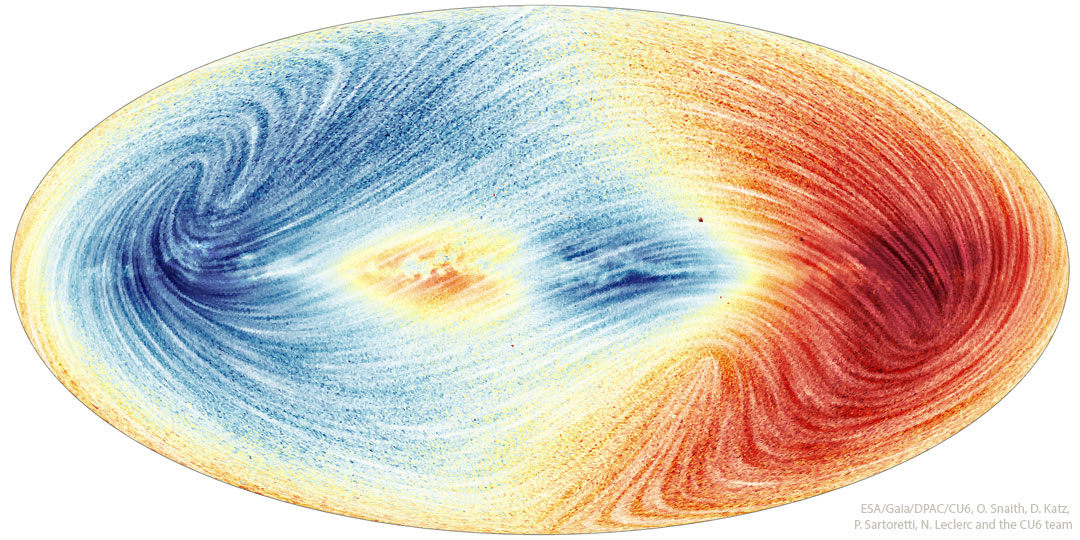
Milky Way Motion in 3D from Gaia


Our sky is alive with the streams of stars. The motions of 26 million Milky Way stars are evident in the featured map constructed from recent data taken by ESA's Gaia satellite. Stars colored blue are moving toward us, while red indicates away. Lines depict the motion of the stars across the sky. The large blue on the left and red areas on the map's right give the overall impression that stars in the Milky Way are rotating around the center. However, there is a region near the middle -- caused by our own Sun's motion relative to a rigidly-rotating central Galactic bar -- that seems to reverse it. Understanding details about the motion of stars is helping humanity to better understand the complex history of our Milky Way galaxy and the origin of our Sun.

https://apod.nasa.gov/apod/ap220706.html ( July 06, 2022)

Orbital Sunset Over Brazil


The last rays of an orbital sunset burst through Earth's horizon as the International Space Station flew 258 miles above Brazil.

from NASA http://www.nasa.gov/image-feature/orbital-sunset-over-brazil
via IFTTT

Monday, July 4, 2022

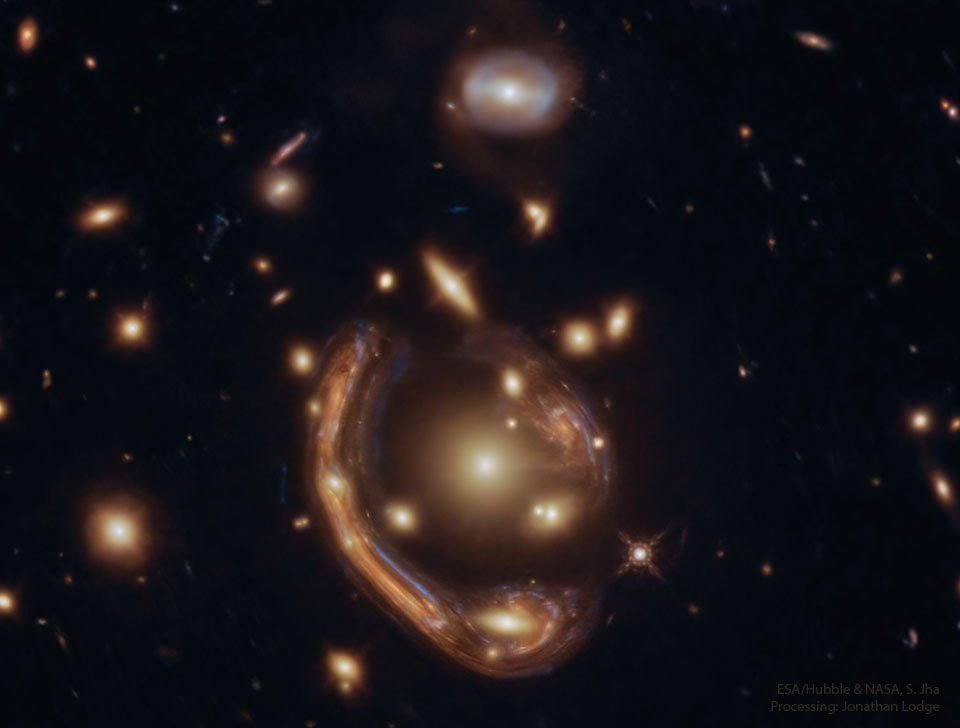
A Molten Galaxy Einstein Ring Galaxy


It is difficult to hide a galaxy behind a cluster of galaxies. The closer cluster's gravity will act like a huge lens, pulling images of the distant galaxy around the sides and greatly distorting them. This is just the case observed in the featured image recently re-processed image from the Hubble Space Telescope. The cluster GAL-CLUS-022058c is composed of many galaxies and is lensing the image of a yellow-red background galaxy into arcs seen around the image center. Dubbed a molten Einstein ring for its unusual shape, four images of the same background galaxy have been identified. Typically, a foreground galaxy cluster can only create such smooth arcs if most of its mass is smoothly distributed -- and therefore not concentrated in the cluster galaxies visible. Analyzing the positions of these gravitational arcs gives astronomers a method to estimate the dark matter distribution in galaxy clusters, as well as infer when the stars in these early galaxies began to form.

https://apod.nasa.gov/apod/ap220705.html ( July 05, 2022)

Sunday, July 3, 2022

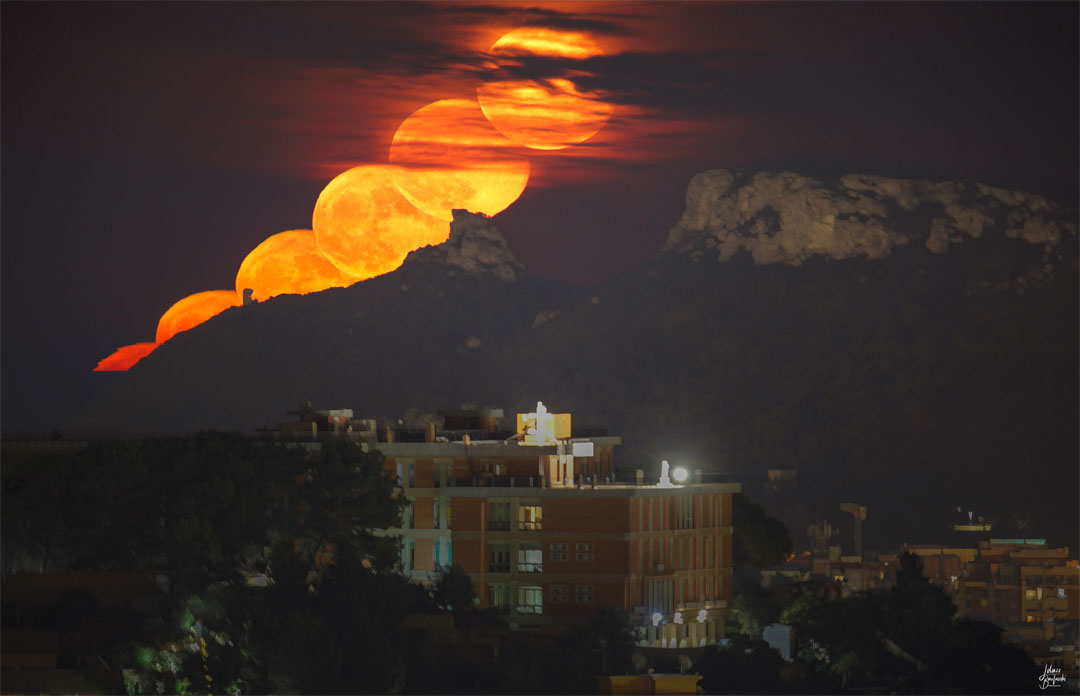
Strawberry Supermoon Over Devils Saddle


Near the horizon the full moon often seems to loom large, swollen in appearance by the famous Moon illusion. But time-lapse image sequences demonstrate that the Moon's angular size doesn't really change as it rises or sets. Its color does, though. Recording a frame about every 60 seconds, this image also shows how red the Sun can look while low on the horizon. The featured montage was taken from Cagliari, Sardinia, Italy, the day after June's Strawberry Moon, a full moon dubbed a supermoon due to its slightly larger-than-usual angular size. This Strawberry Supermoon is seen rising behind the Devil's Saddle, a mountain named for the unusual moon-sized dip seen just to the right of the rising moon. A shrinking line-of-sight through planet Earth's dense and dusty atmosphere shifted the moonlight from strawberry red through honey-colored and paler yellowish hues. That change seems appropriate for a northern June Full Moon also known as the Strawberry or Honey Moon. A Thunder Supermoon -- the third of four supermoons in 2022 -- will occur later this month.

https://apod.nasa.gov/apod/ap220704.html ( July 04, 2022)

Saturday, July 2, 2022

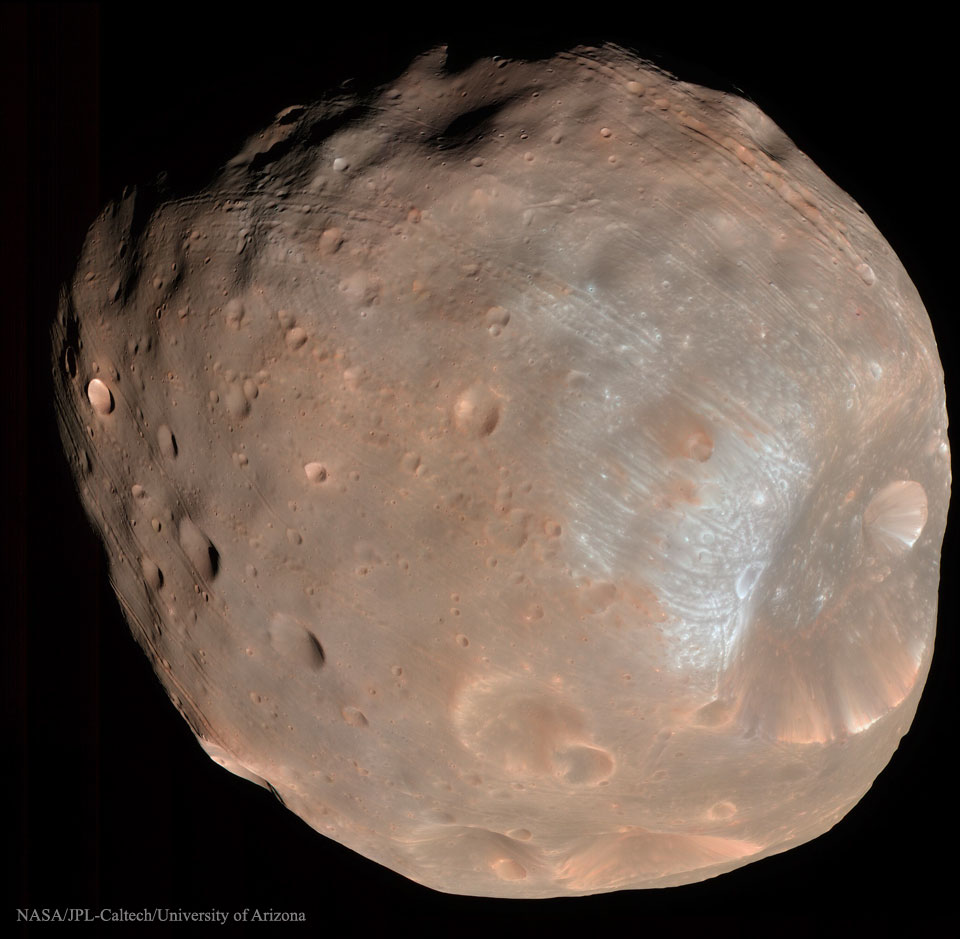
Phobos: Doomed Moon of Mars


This moon is doomed. Mars, the red planet named for the Roman god of war, has two tiny moons, Phobos and Deimos, whose names are derived from the Greek for Fear and Panic. These martian moons may well be captured asteroids originating in the main asteroid belt between Mars and Jupiter or perhaps from even more distant reaches of our Solar System. The larger moon, Phobos, is indeed seen to be a cratered, asteroid-like object in this stunning color image from the robotic Mars Reconnaissance Orbiter, with objects as small as 10 meters visible. But Phobos orbits so close to Mars - about 5,800 kilometers above the surface compared to 400,000 kilometers for our Moon - that gravitational tidal forces are dragging it down. In perhaps 50 million years, Phobos is expected to disintegrate into a ring of debris.

https://apod.nasa.gov/apod/ap220703.html ( July 03, 2022)

Friday, July 1, 2022

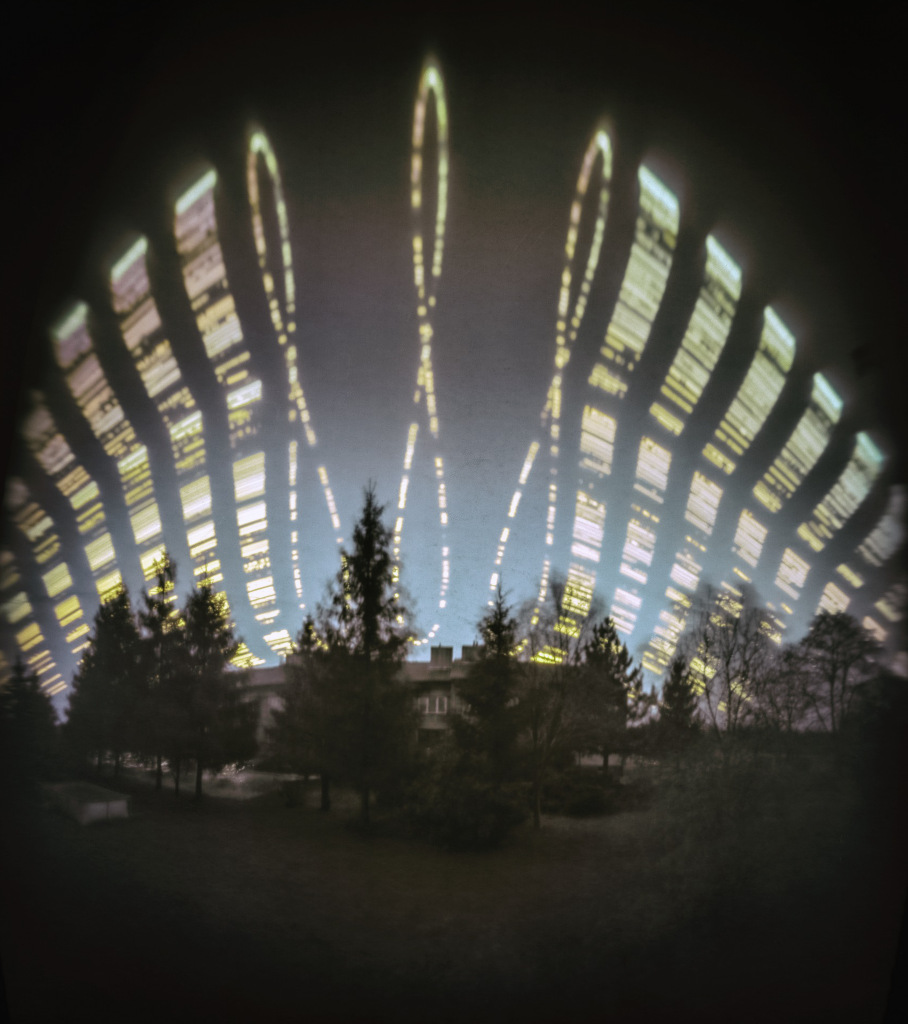
Solargraphic Analemmas


For the northern hemisphere June 21 was the summer solstice, the Sun reaching its northernmost declination for the year. That would put it at the top of each of these three figure-8 curves, or analemmas, as it passed through the daytime sky over the village of Proboszczow, Poland. No sequence of digital exposures was used to construct the remarkable image though. Using a pinhole camera fixed to face south during the period June 26, 2021 to June 26, 2022, the image was formed directly on a single sheet of photographic paper, a technique known as solargraphy. The three analemmas are the result of briefly exposing the photo paper through the pinhole each day at 11:00, 12:00, and 13:00 CET. Groups of dashed lines on the sides show partial tracks of the Sun from daily exposures made every 15 minutes. Over the year-long solargraphic photo opportunity clouds blocking the Sun during the pinhole exposures created the dark gaps.

https://apod.nasa.gov/apod/ap220702.html ( July 02, 2022)

ISS Daily Summary Report – 6/30/2022

iss-about-banner


Payloads: Actiwatch: The actiwatches were doffed, connected to a USB hub for charging and data management, and then returned to the appropriate crewmembers for donning. The Actiwatch is a waterproof, non-intrusive, sleep-wake activity monitor worn on the wrist of a crewmember and contains a miniature uniaxial accelerometer that produces a signal as the subject moves. … ...

June 30, 2022 at 12:00PM
From NASA: https://blogs.nasa.gov/stationreport/2022/06/30/iss-daily-summary-report-6-30-2022/

Making a Picture-Perfect Landing


An adult osprey, carrying a fish in its talons, prepares to land in its nest atop a speaker platform in the parking lot at Kennedy Space Center.

from NASA http://www.nasa.gov/image-feature/making-a-picture-perfect-landing
via IFTTT