Tuesday, July 6, 2021

In Orbit Around a Red Dwarf Star


Planet TOI-1231 b orbits a red dwarf star some 90 light-years away from Earth and is oddly reminiscent of our own Neptune.

from NASA http://www.nasa.gov/image-feature/in-orbit-around-a-red-dwarf-star
via IFTTT
Monday, July 5, 2021

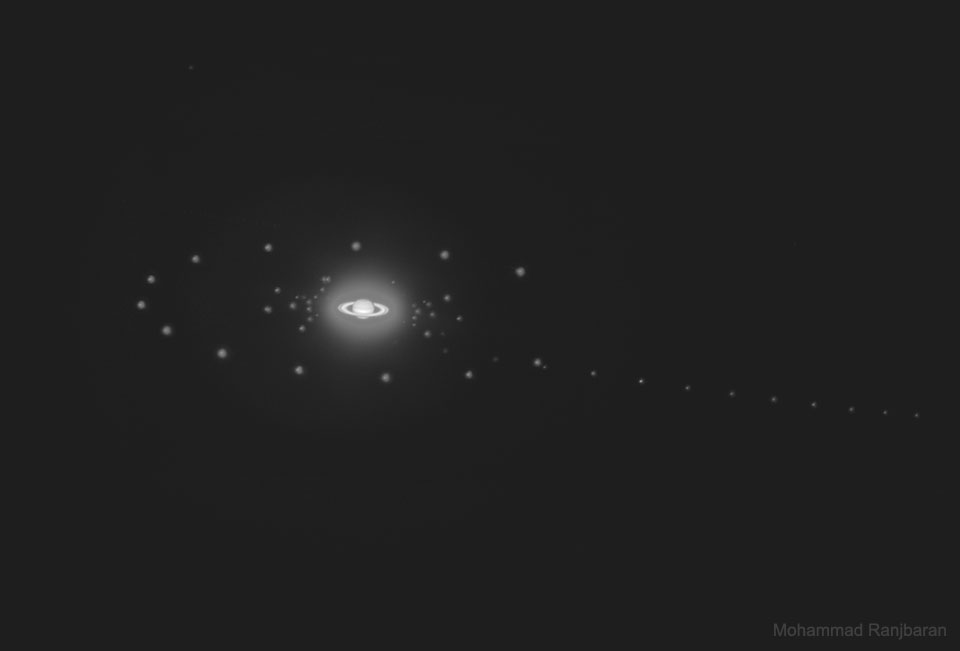
Saturn and Six Moons


How many moons does Saturn have? So far 82 have been confirmed, the smallest being only a fraction of a kilometer across. Six of its largest satellites can be seen here in a composite image with 13 short exposure of the bright planet, and 13 long exposures of the brightest of its faint moons, taken over two weeks last month. Larger than Earth's Moon and even slightly larger than Mercury,Saturn's largest moon Titan has a diameter of 5,150 kilometers and was captured making nearly a complete orbit around its ringed parent planet. Saturn's first known natural satellite, Titan was discovered in 1655 by Dutch astronomer Christiaan Huygens, in contrast with several newly discovered moons announced in 2019. The trail on the far right belongs to Iapetus, Saturn's third largest moon. The radius of painted Iapetus' orbit is so large that only a portion of it was captured here. Saturn leads Jupiter across the night sky this month, rising soon after sunset toward the southeast, and remaining visible until dawn.

https://apod.nasa.gov/apod/ap210706.html ( July 06, 2021)

Sunday, July 4, 2021

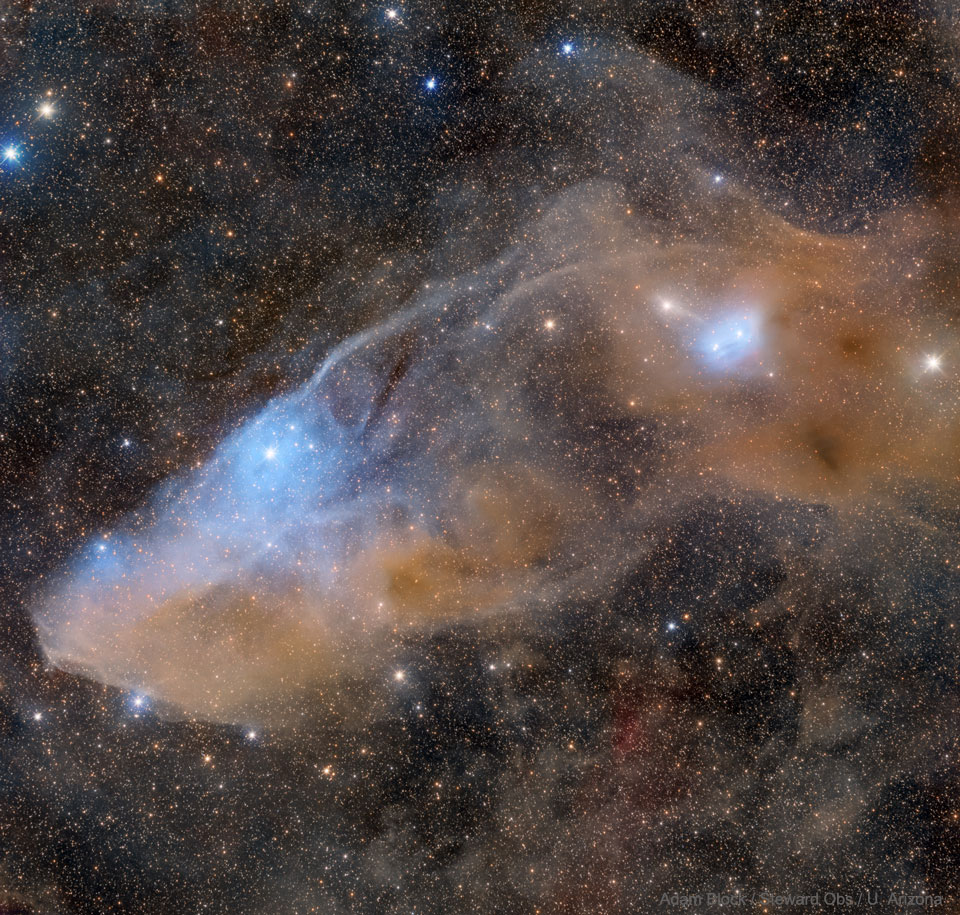
IC 4592: The Blue Horsehead Reflection Nebula


Do you see the horse's head? What you are seeing is not the famous Horsehead nebula toward Orion but rather a fainter nebula that only takes on a familiar form with deeper imaging. The main part of the here imaged molecular cloud complex is a reflection nebula cataloged as IC 4592. Reflection nebulas are actually made up of very fine dust that normally appears dark but can look quite blue when reflecting the visible light of energetic nearby stars. In this case, the source of much of the reflected light is a star at the eye of the horse. That star is part of Nu Scorpii, one of the brighter star systems toward the constellation of the Scorpion (Scorpius). A second reflection nebula dubbed IC 4601 is visible surrounding two stars to the right of the image center.

https://apod.nasa.gov/apod/ap210705.html ( July 05, 2021)

Saturday, July 3, 2021

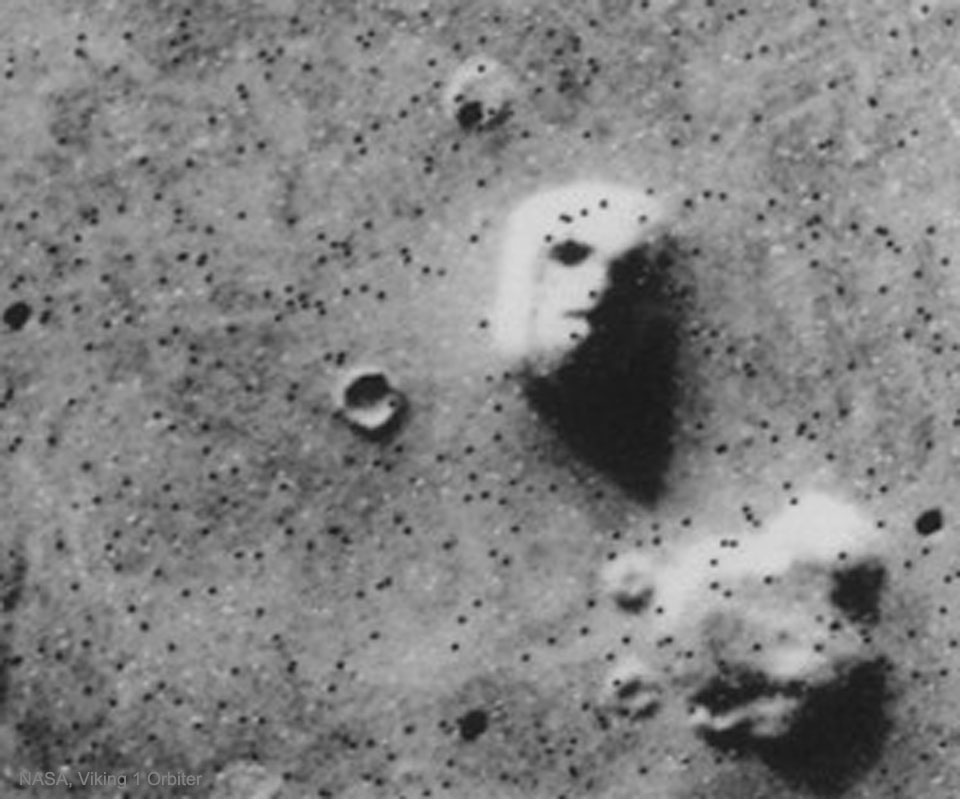
The Face on Mars


Wouldn't it be fun if clouds were castles? Wouldn't it be fun if the laundry on the bedroom chair was a superhero? Wouldn't it be fun if rock mesas on Mars were interplanetary monuments to the human face? Clouds, though, are floating droplets of water and ice. Laundry is cotton, wool, or plastic, woven into garments. Famous Martian rock mesas known by names like the Face on Mars appear quite natural when seen more clearly on better images. Is reality boring? Nobody knows why some clouds make rain. Nobody knows if life ever developed on Mars. Nobody knows why the laundry on the bedroom chair smells like root beer. Scientific exploration can not only resolve mysteries, but uncover new knowledge, greater mysteries, and yet deeper questions. As humanity explores our universe, perhaps fun -- through discovery -- is just beginning.

https://apod.nasa.gov/apod/ap210704.html ( July 04, 2021)

Friday, July 2, 2021

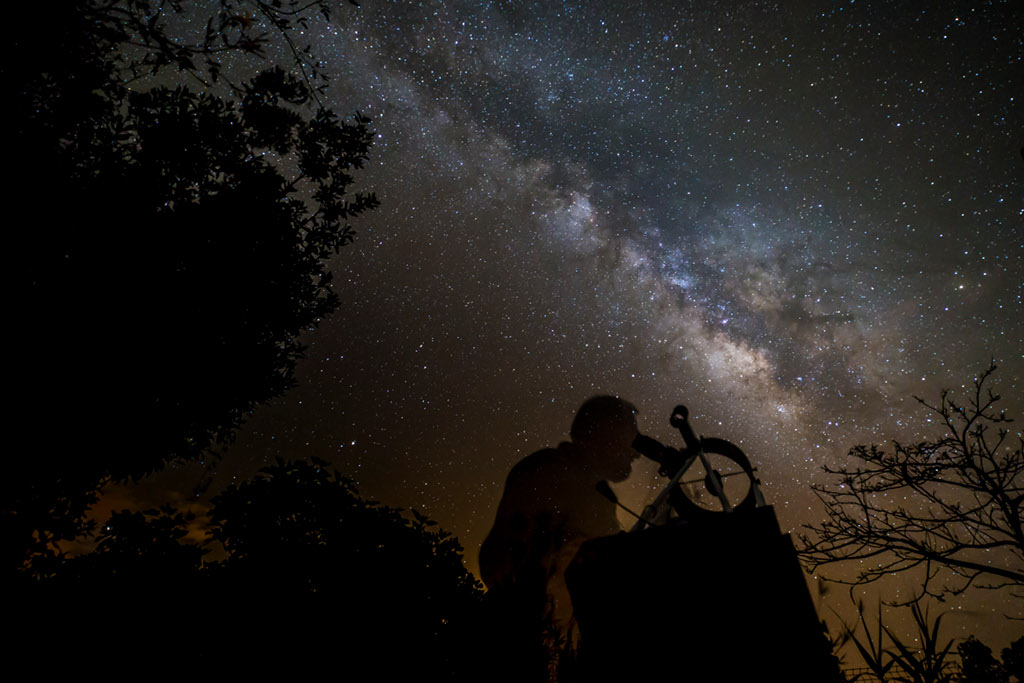
Along the Milky Way


You can't walk along the Milky Way. Still, under a dark sky you can explore it. To the eye the pale luminous trail of light arcing through the sky on a dark, moonless night does appear to be a path through the heavens. The glowing celestial band is the faint, collective light of distant stars cut by swaths of obscuring interstellar dust clouds. It lies along the plane of our home galaxy, so named because it looks like a milky way. Since Galileo's time, the Milky Way has been revealed to telescopic skygazers to be filled with congeries of innumerable stars and cosmic wonders.

https://apod.nasa.gov/apod/ap210703.html ( July 03, 2021)

ISS Daily Summary Report – 7/01/2021

iss-about-banner


Payloads Cold Atom Lab (CAL): The crew attached CAL science module 2 to a battery and packed it for return to the ground. The CAL produces clouds of atoms that are chilled to about one ten billionth of a degree above absolute zero, much colder than the average temperature of deep space. At these low … ...

July 01, 2021 at 12:00PM
From NASA: https://blogs.nasa.gov/stationreport/2021/07/01/iss-daily-summary-report-7-01-2021/

Hubble Sees a Cluster of Red, White, and Blue


This image taken with the NASA/ESA Hubble Space Telescope depicts the open star cluster NGC 330, which lies around 180,000 light-years away inside the Small Magellanic Cloud.

from NASA http://www.nasa.gov/image-feature/goddard/2021/hubble-sees-a-cluster-of-red-white-and-blue
via IFTTT

Thursday, July 1, 2021

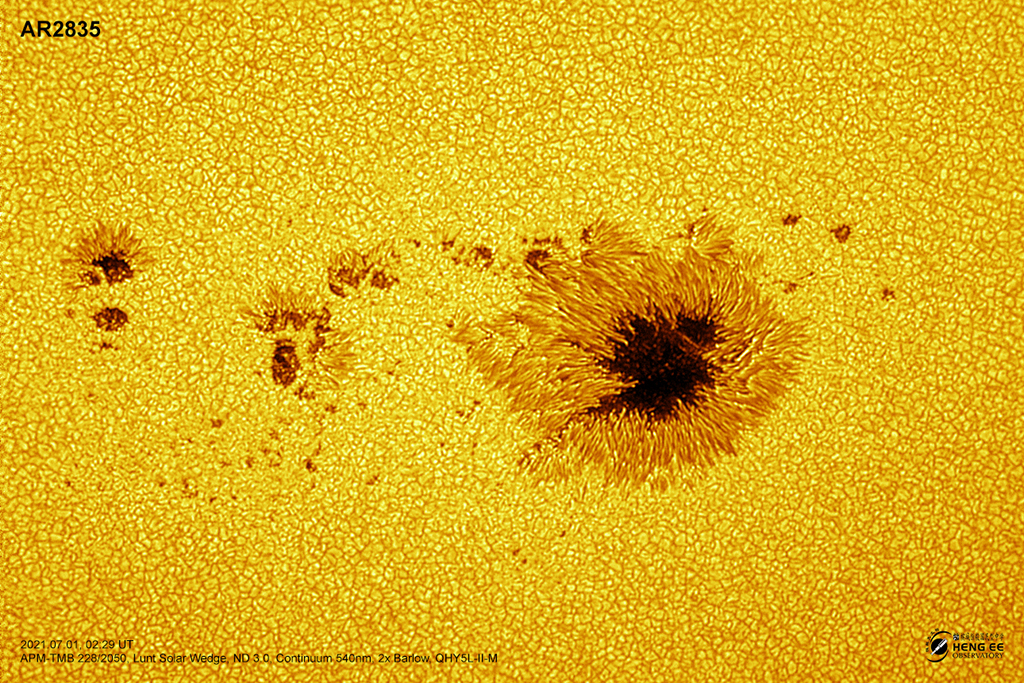
AR2835: Islands in the Photosphere


Awash in a sea of incandescent plasma and anchored in strong magnetic fields, sunspots are planet-sized dark islands in the solar photosphere, the bright surface of the Sun. Found in solar active regions, sunspots look dark only because they are slightly cooler though, with temperatures of about 4,000 kelvins compared to 6,000 kelvins for the surrounding solar surface. These sunspots lie in active region AR2835. The largest active region now crossing the Sun, AR2835 is captured in this sharp telescopic close-up from July 1 in a field of view that spans about 150,000 kilometers or over ten Earth diameters. With powerful magnetic fields, solar active regions are often responsible for solar flares and coronal mass ejections, storms which affect space weather near planet Earth.

https://apod.nasa.gov/apod/ap210702.html ( July 02, 2021)

ISS Daily Summary Report – 6/30/2021

iss-about-banner


78 Progress (78P) Launch: Yesterday at 6:27 PM CT, 78P launched from the Baikonur Cosmodrome carrying food, fuel, and supplies to the ISS. 78P will dock to the ISS on Thursday, July 1st at 8:03 PM CT after completing a 33-orbit rendezvous. Payloads Antimicrobial Coatings (AC) Touch: Per standard procedure, the crew touched both the … ...

June 30, 2021 at 12:00PM
From NASA: https://blogs.nasa.gov/stationreport/2021/06/30/iss-daily-summary-report-6-30-2021/

Chandra Turns Up the Heat in the Milky Way Center


This 2004 image was produced by combining a dozen Chandra observations made of a 130 light-year region in the center of the Milky Way.

from NASA http://www.nasa.gov/image-feature/chandra-turns-up-the-heat-in-the-milky-way-center
via IFTTT