Monday, December 15, 2025


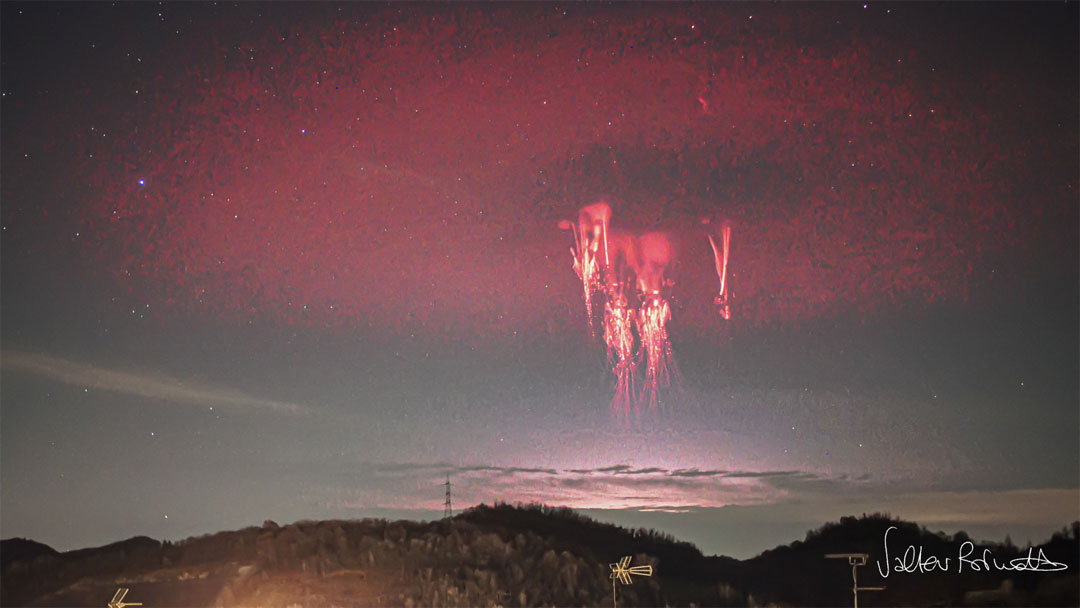
What’s happening over that tree? Two very different things. On the left is the Andromeda galaxy, an object that is older than humanity and will last billions of years into the future. Andromeda (M31) is similar in size and shape to our own Milky Way Galaxy. On the right is a red sprite, a type of lightning that lasts a fraction of a second and occurs above violent thunderstorms. Red sprites were verified as real atmospheric phenomena only about 35 years ago. The tree in the center is a boab, which may live for as long as a thousand years. Boab trees grow naturally in Australia and Africa and are known for being able to store large amounts of water: up to 100,000 liters. The featured image was captured last month near Derby in Western Australia.

https://apod.nasa.gov/apod/ap251216.html ( December 16, 2025)

Sunday, December 14, 2025


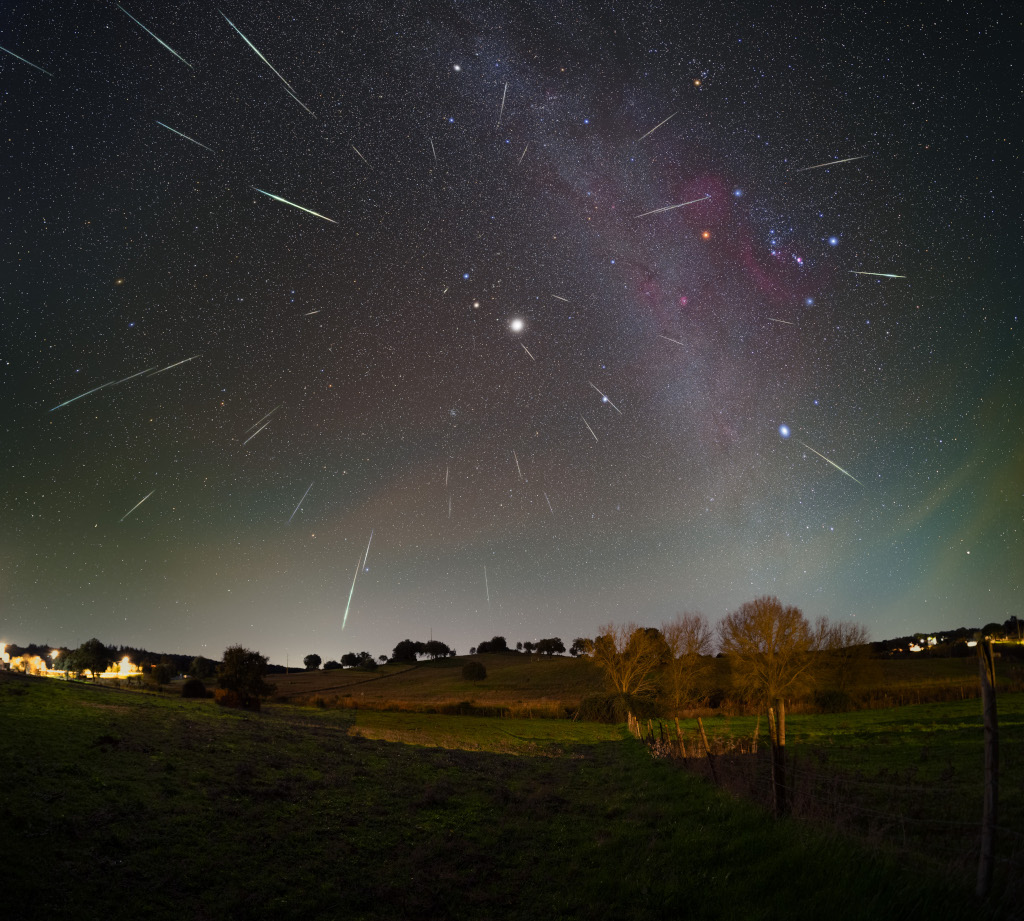
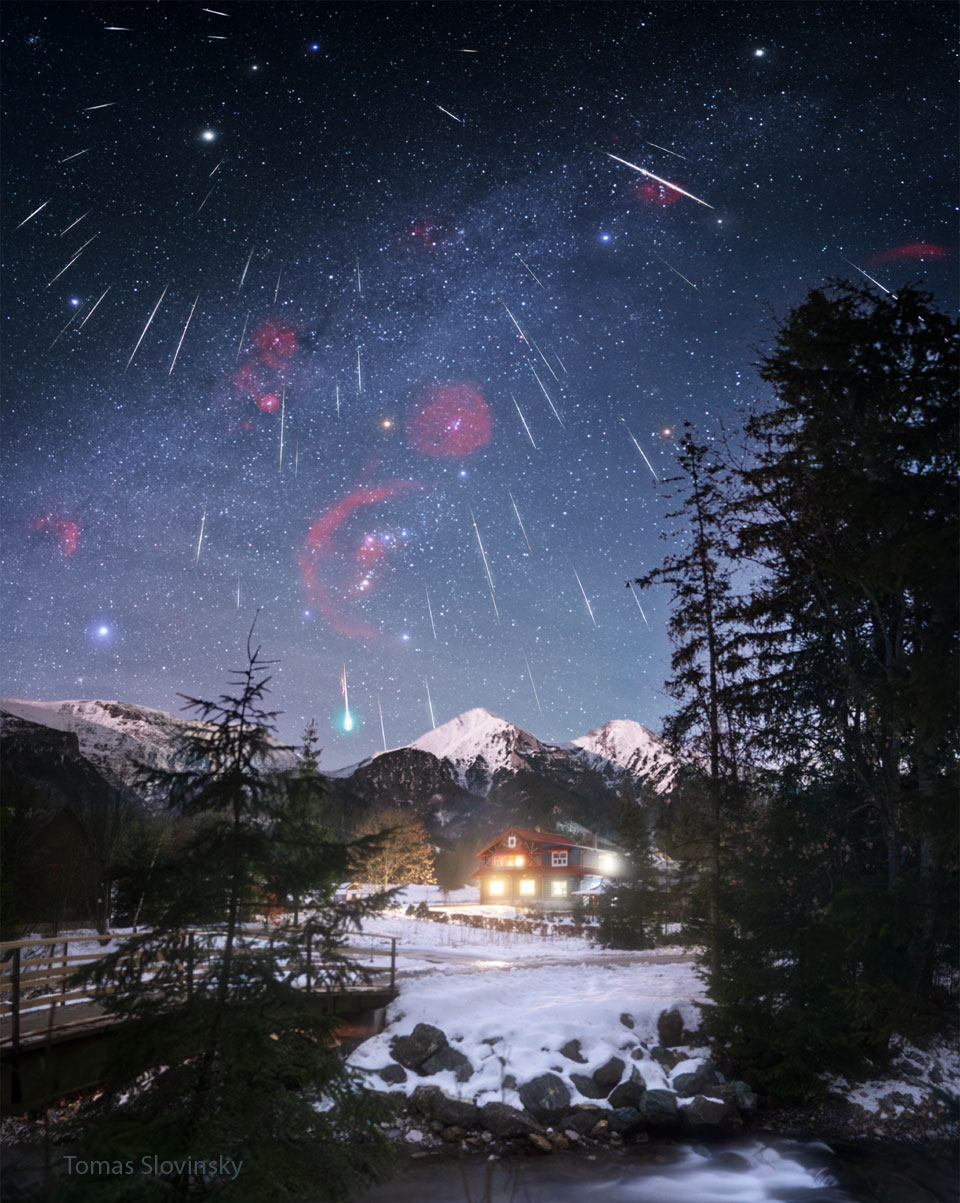
Where are all of these meteors coming from? In terms of direction on the sky, the pointed answer is the constellation of Gemini. That is why the major meteor shower in December is known as the Geminids -- because shower meteors all appear to come from a radiant toward Gemini. Three dimensionally, however, sand-sized debris expelled from the unusual asteroid 3200 Phaethon follows a well-defined orbit about our Sun, and the part of the orbit that approaches Earth is superposed in front of the constellation of Gemini. Therefore, when Earth crosses this orbit, the radiant point of falling debris appears in Gemini. Featured here is a composite of many images taken over the past few days through dark skies from Slovakia and capturing the snow-covered peaks of the Belianske Tatra mountains Numerous bright meteor streaks from the Geminids meteor shower are visible. Orion is visible above the horizon, while the bright star nearest the radiant is Castor.

https://apod.nasa.gov/apod/ap251215.html ( December 15, 2025)

Saturday, December 13, 2025


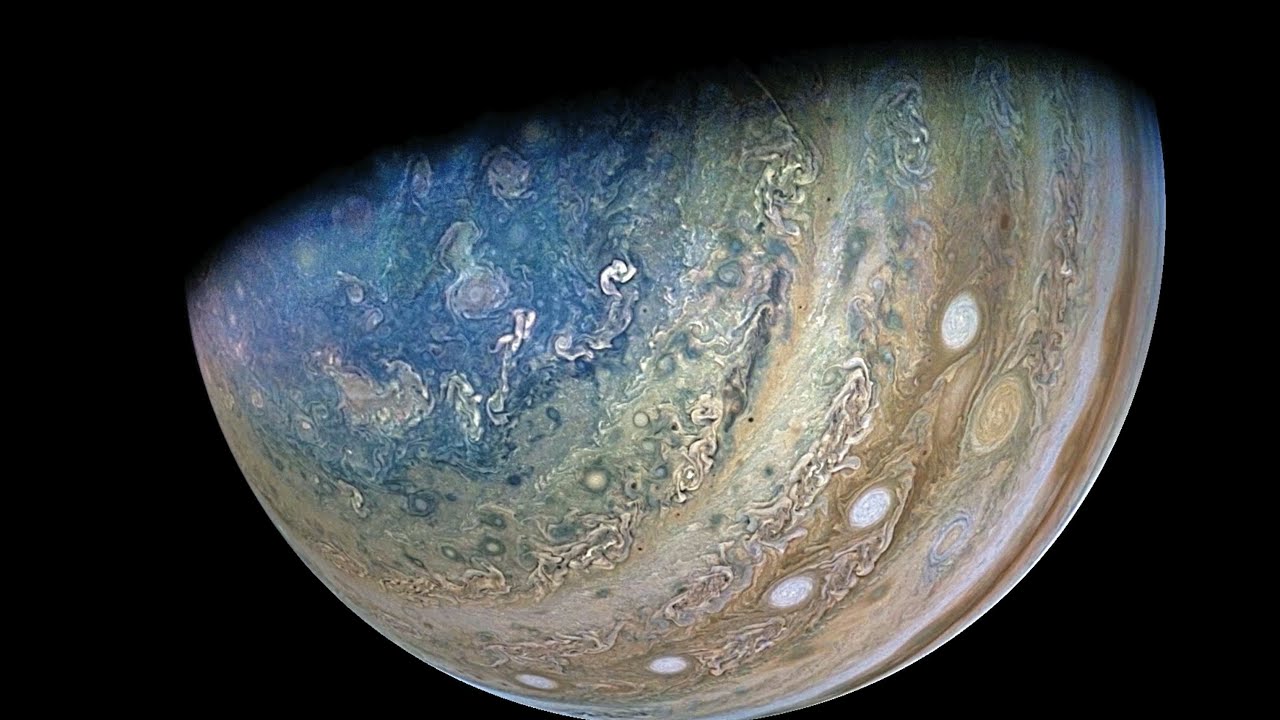
What would it be like to fly over the largest moon in the Solar System? In 2021, the robotic Juno spacecraft flew past Jupiter's huge moon Ganymede and took images that have been digitally constructed into a detailed flyby. As the featured video begins, Juno swoops over the two-toned surface of the 2,000-km wide moon, revealing an icy alien landscape filled with grooves and craters. The grooves are likely caused by shifting surface plates, while the craters are caused by violent impacts. Continuing on in its orbit, Juno then performed its 34th close pass over Jupiter's clouds. The digitally-constructed video shows numerous swirling clouds in the north, colorful planet-circling zones and bands across the middle -- featuring several white-oval clouds from the String of Pearls, and finally more swirling clouds in the south.

https://apod.nasa.gov/apod/ap251214.html ( December 14, 2025)

Friday, December 12, 2025

Orion and the Ocean of Storms


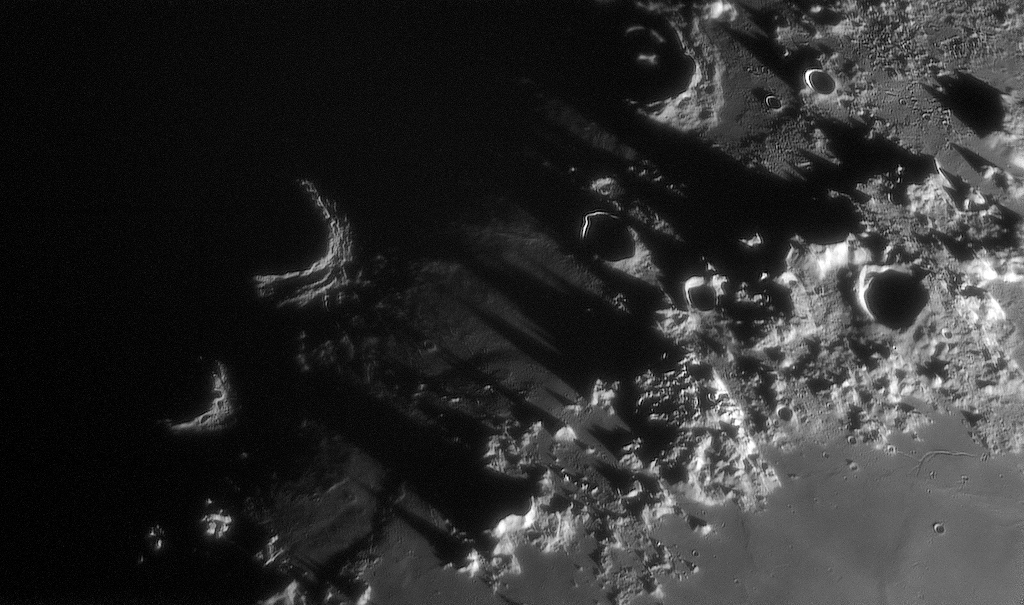
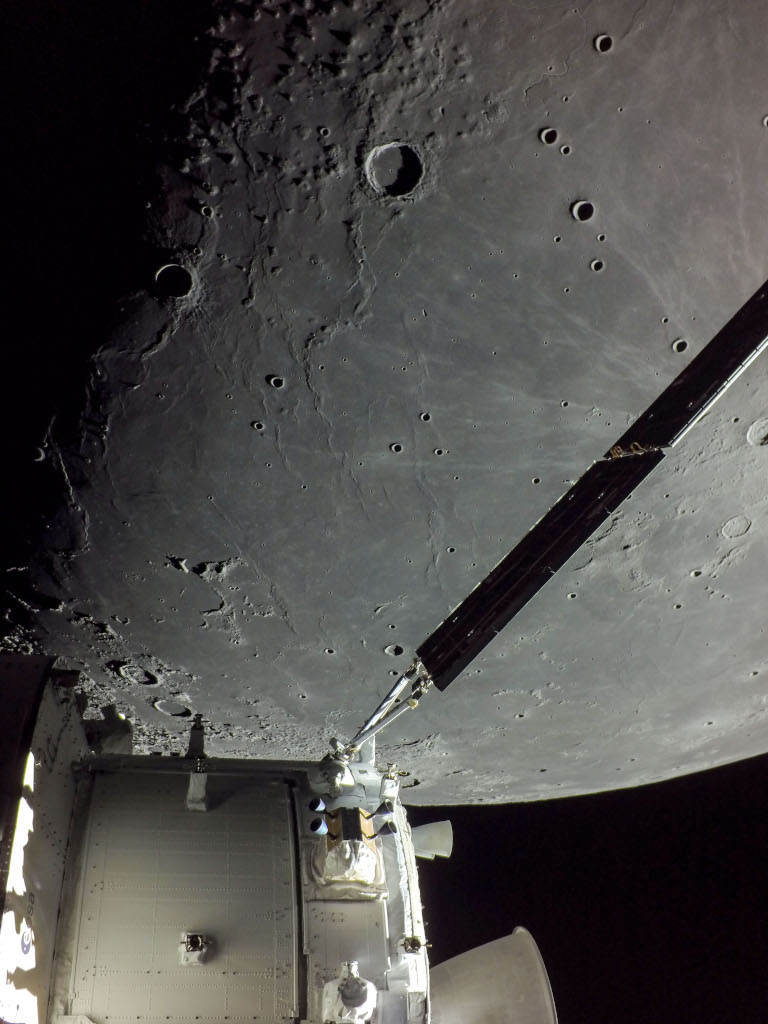
On December 5, 2022, a camera on board the uncrewed Orion spacecraft captured this view as Orion approached its return powered flyby of the Moon. Beyond one of Orion's extended solar arrays lies dark, smooth, terrain along the western edge of the Oceanus Procellarum. Prominent on the lunar nearside Oceanus Procellarum, the Ocean of Storms, is the largest of the Moon's lava-flooded maria. The lunar terminator, the shadow line between lunar night and day, runs along the left of this frame. The 41 kilometer diameter crater Marius is top center, with ray crater Kepler peeking in at the edge, just right of the solar array wing. Kepler's bright rays extend to the north and west, reaching the dark-floored Marius. By December 11, 2022 the Orion spacecraft had returned to its home world. The historic Artemis 1 mission ended with Orion's successful splashdown in planet Earth's water-flooded Pacific Ocean.

https://apod.nasa.gov/apod/ap251213.html ( December 13, 2025)

Thursday, December 11, 2025

Northern Fox Fires


In a Finnish myth, when an arctic fox runs so fast that its bushy tail brushes the mountains, flaming sparks are cast into the heavens creating the northern lights. In fact the Finnish word "revontulet", a name for the aurora borealis or northern lights, can be translated as fire fox. So that evocative myth took on a special significance for the photographer of this northern night skyscape from Finnish Lapland near Kilpisjarvi Lake. The snowy scene is illuminated by moonlight. Saana, an iconic fell or mountain of Lapland, rises at the right in the background. But as the beautiful nothern lights danced overhead, the wild fire fox in the foreground enthusiastically ran around the photographer and his equipment, making it difficult to capture in this lucky single shot.

https://apod.nasa.gov/apod/ap251212.html ( December 12, 2025)

Wednesday, December 10, 2025

Galaxies in the River


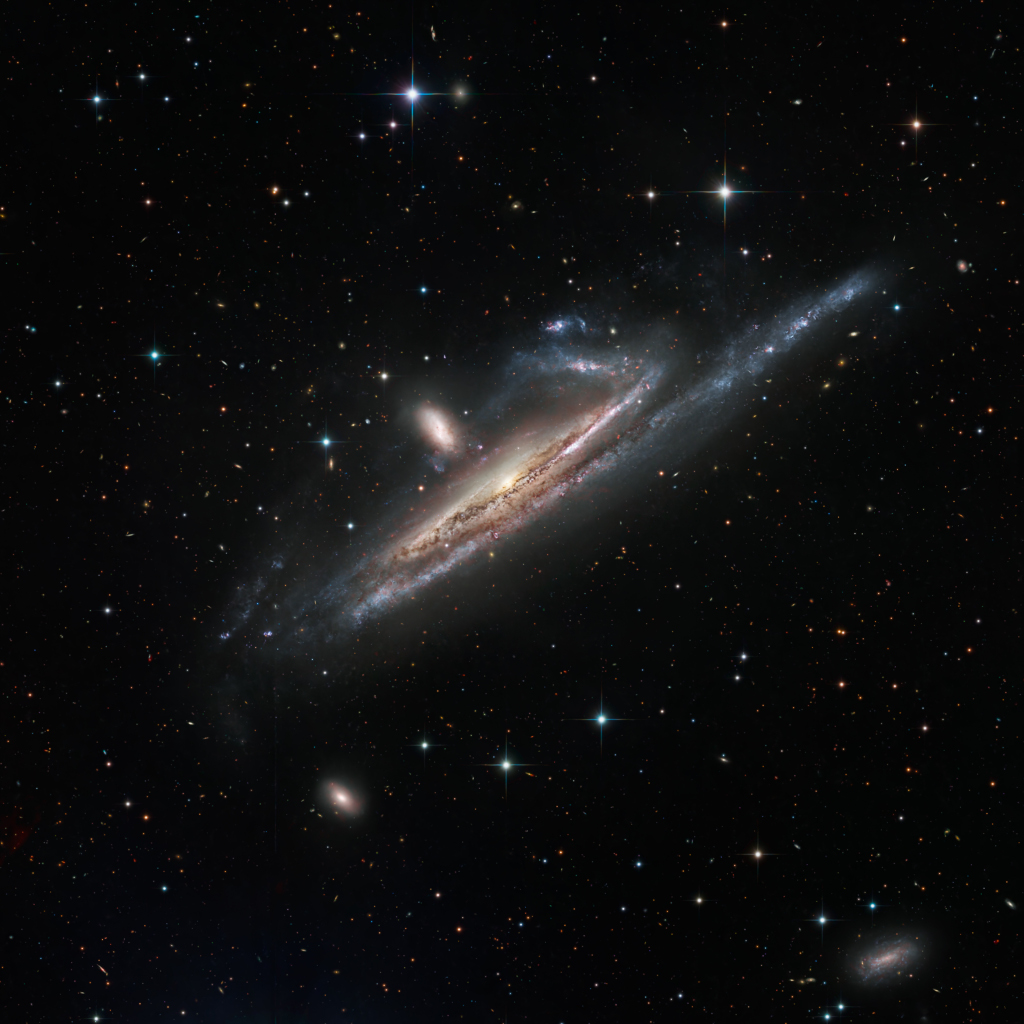
Large galaxies grow by eating small ones. Even our own galaxy engages in a sort of galactic cannibalism, absorbing small galaxies that are too close and are captured by the Milky Way's gravity. In fact, the practice is common in the universe and illustrated by this striking pair of interacting galaxies from the banks of the southern constellation Eridanus, The River. Located over 50 million light years away, the large, distorted spiral NGC 1532 is seen locked in a gravitational struggle with dwarf galaxy NGC 1531, a struggle the smaller galaxy will eventually lose. Seen nearly edge-on, in this sharp image spiral NGC 1532 spans about 100,000 light-years. The NGC 1532/1531 pair is thought to be similar to the well-studied system of face-on spiral and small companion known as M51.

https://apod.nasa.gov/apod/ap251211.html ( December 11, 2025)

Tuesday, December 9, 2025

The Horsehead Nebula


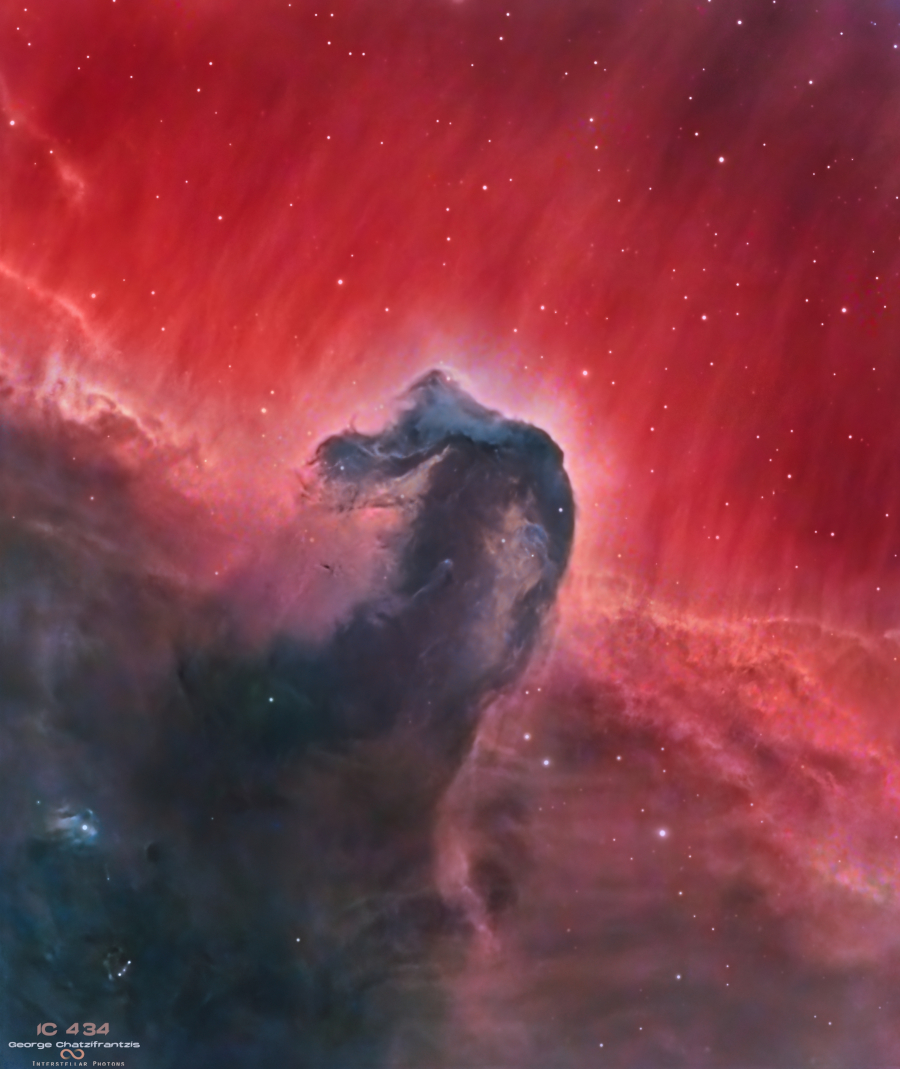
Sculpted by stellar winds and radiation, this dusty interstellar molecular cloud has by chance has assumed an immediately recognizable shape. Fittingly known as The Horsehead Nebula, it lies some 1,500 light-years distant, embedded in the vast Orion cloud complex. About five light-years "tall," the dark cloud is cataloged as Barnard 33, first identified on a photographic plate taken in the late 19th century. B33 is visible primarily because its obscuring dust is silhouetted against the glow of emission nebula IC 434. Hubble space telescope images from the early 21st century find young stars forming within B33. Of course, the magnificent interstellar cloud will slowly shift its apparent shape over the next few million years. But for now the Horsehead Nebula is a rewarding though difficult object to view with small telescopes from planet Earth.

https://apod.nasa.gov/apod/ap251210.html ( December 10, 2025)

Monday, December 8, 2025


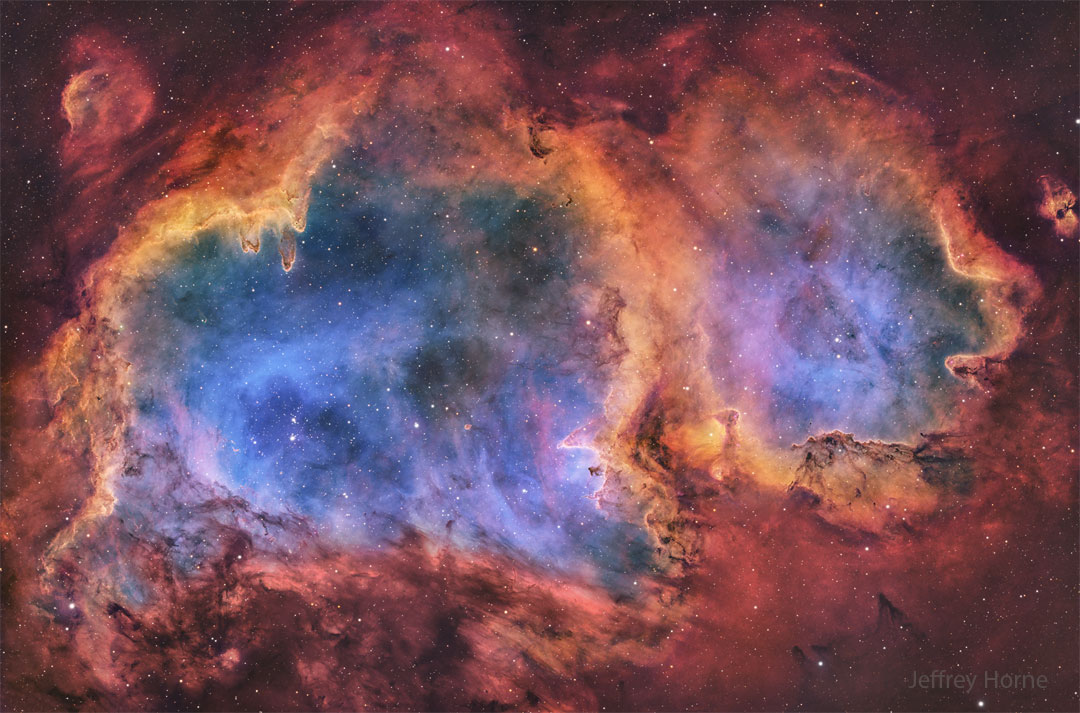
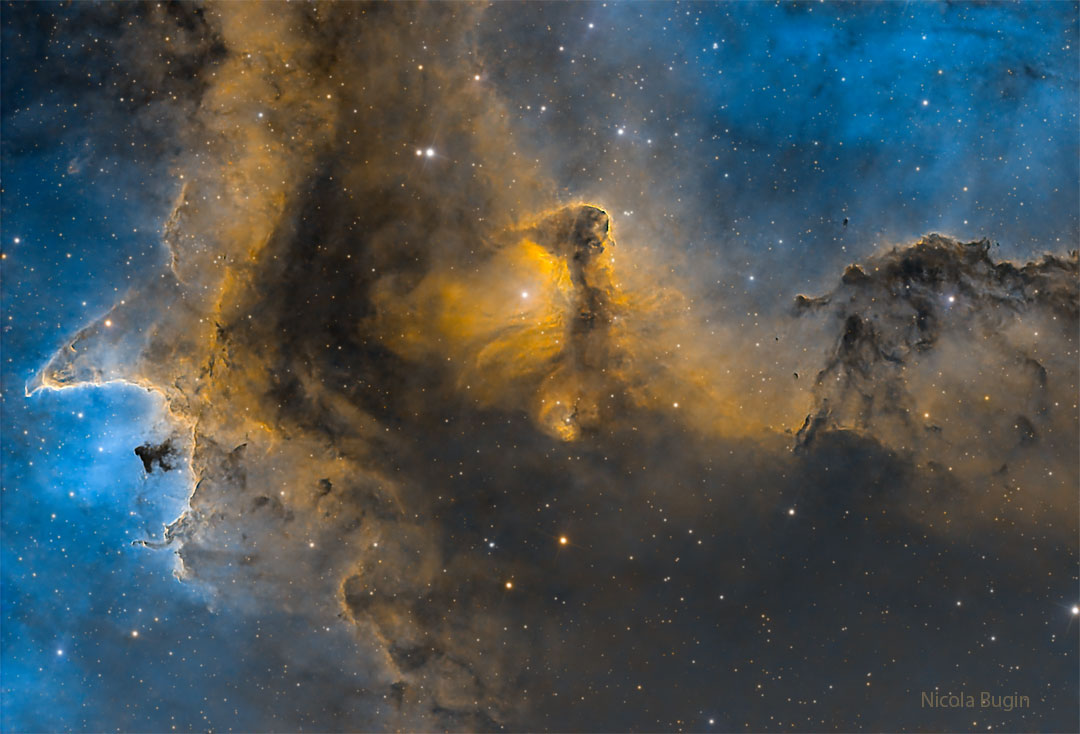
This cosmic close-up looks deep inside the Soul Nebula. The dark and brooding dust clouds outlined by bright ridges of glowing gas are cataloged as IC 1871. About 25 light-years across, the telescopic field of view spans only a small part of the much larger Heart and Soul nebulae. At an estimated distance of 6,500 light-years, the star-forming complex lies within the Perseus spiral arm of the Milky Way, seen in planet Earth's skies toward the constellation of the Queen of Aethiopia (Cassiopeia). An example of triggered star formation, the dense star-forming clouds of IC 1871 are themselves sculpted by the intense winds and radiation of the region's massive young stars. This color image adopts a palette made popular in Hubble images of star-forming regions.

https://apod.nasa.gov/apod/ap251209.html ( December 09, 2025)

Sunday, December 7, 2025


Many wonders are visible when flying over the Earth at night. Such visual spectacles occur every day for astronauts in low Earth orbit, but the featured video captured several from the International Space Station (ISS) in 2011 and set them to rousing music. Passing below are white clouds, orange city lights, lightning flashes in thunderstorms, and dark blue seas. On the horizon is the golden haze of Earth's thin atmosphere, frequently decorated by dancing auroras as the video progresses. The green parts of auroras typically remain below the space station, but the station flies right through the red and purple auroral peaks. Solar panels of the ISS are seen around the frame edges. The ominous wave of approaching brightness at the end of each sequence is just the dawn of the sunlit half of Earth, a dawn that occurs every 90 minutes.

https://apod.nasa.gov/apod/ap251208.html ( December 08, 2025)

Saturday, December 6, 2025


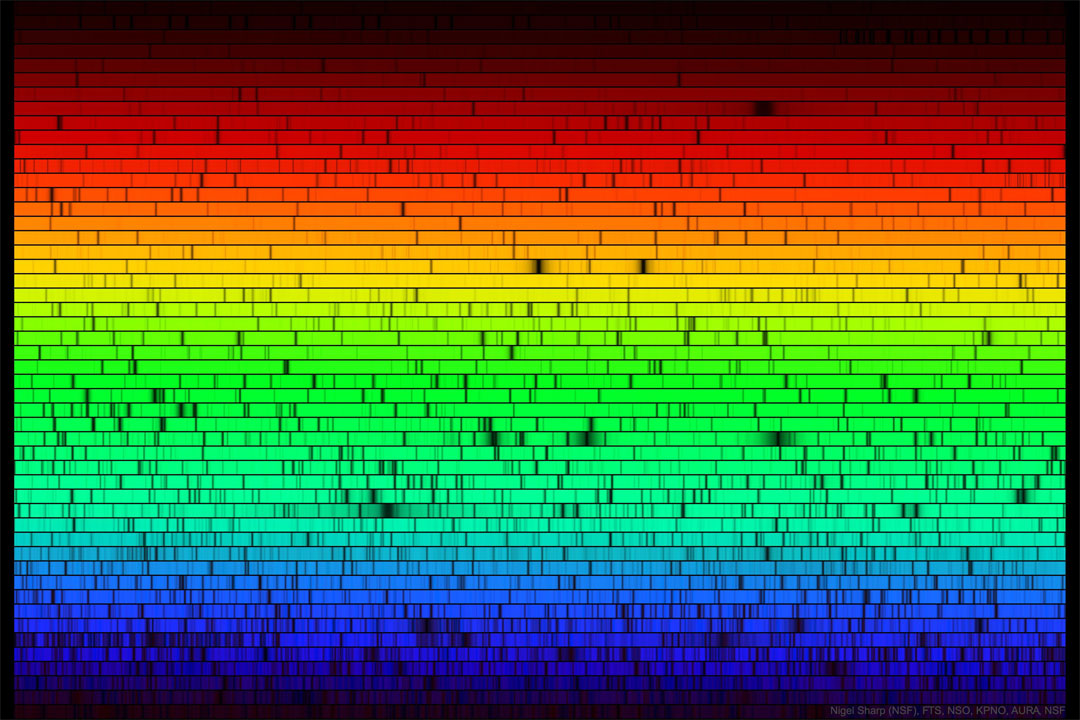
It is still not known why the Sun's light is missing some colors. Here are all the visible colors of the Sun, produced by passing the Sun's light through a prism-like device. The spectrum was created at the McMath-PierceSolar Observatory and shows, first off, that although our white-appearing Sun emits light of nearly every color, it appears brightest in yellow-green light. The dark patches in the featured spectrum arise from gas at or above the Sun's surface absorbing sunlight emitted below. Since different types of gas absorb different colors of light, it is possible to determine what gasses compose the Sun. Helium, for example, was first discovered in 1868 on a solar spectrum and only later found here on Earth. Today, the majority of spectral absorption lines have been identified - but not all.

https://apod.nasa.gov/apod/ap251207.html ( December 07, 2025)

Friday, December 5, 2025

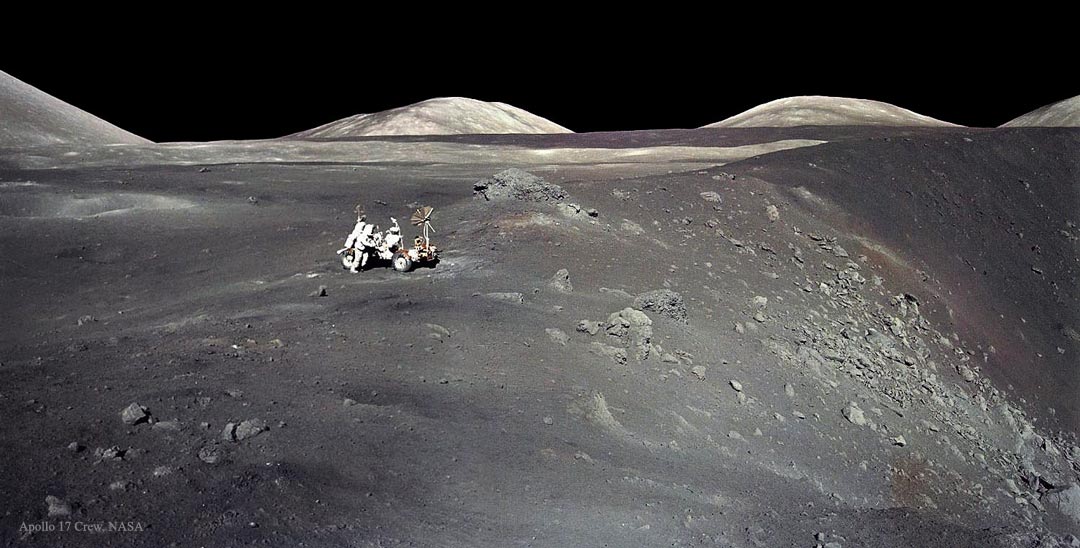
Apollo 17 at Shorty Crater


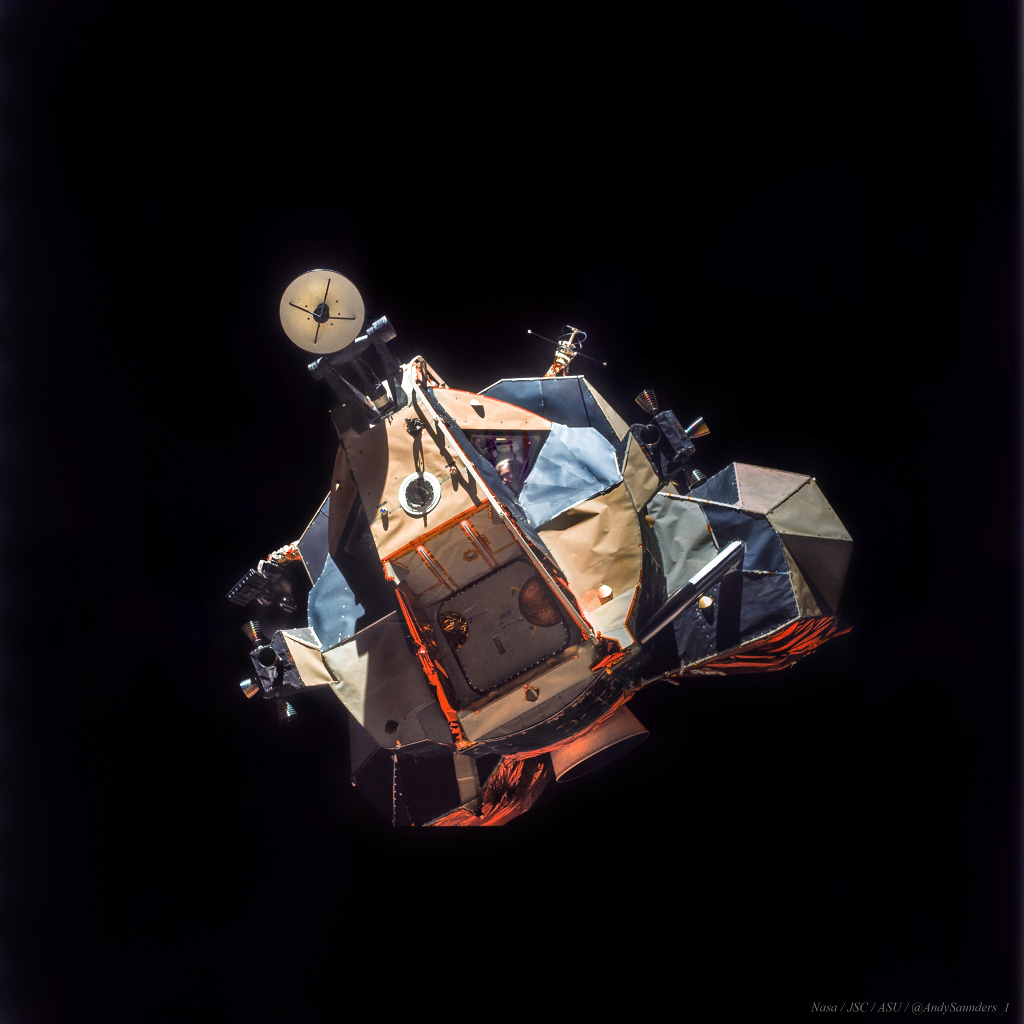
Fifty three years ago, in December of 1972, Apollo 17 astronauts Eugene Cernan and Harrison Schmitt spent about 75 hours on the Moon exploring the Taurus-Littrow valley, while colleague Ronald Evans orbited overhead. This snapshot from another world was taken by Cernan as he and Schmitt roamed the lunar valley's floor. The image shows Schmitt next to the lunar rover parked at the southeast rim of Shorty Crater. That location is near the spot where geologist Schmitt discovered orange lunar soil. The Apollo 17 crew returned with 110 kilograms of rock and soil samples, more than was returned from any of the other lunar landing sites. And for now, Cernan and Schmitt are the last to walk on the Moon.

https://apod.nasa.gov/apod/ap251206.html ( December 06, 2025)

Thursday, December 4, 2025

The Bipolar Jets of KX Andromedae


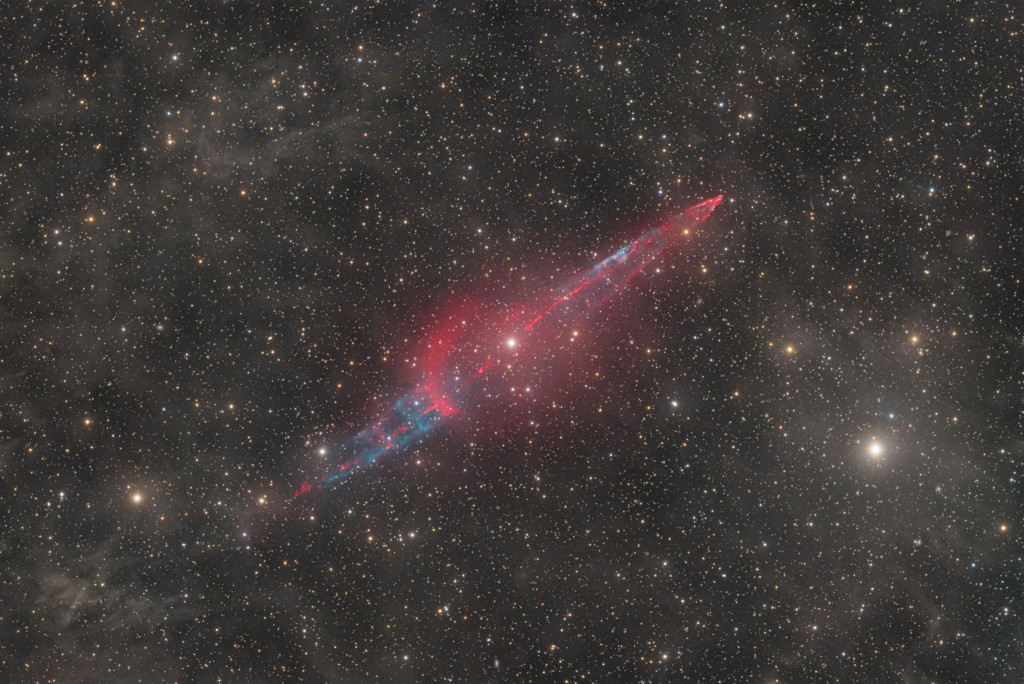
Blasting outward from variable star KX Andromedae, these stunning bipolar jets are 19 light-years long. Recently discovered, they are revealed in unprecedented detail in this deep telescopic image centered on KX And and composed from over 692 hours of combined image data. In fact, KX And is spectroscopically found to be an interacting binary star system consisting of a bright, hot B-type star with a swollen cool giant star as its co-orbiting, close companion. The stellar material from the cool giant star is likely being transferred to the hot B-type star through an accretion disk, with spectacular symmetric jets driven outward perpendicular to the disk itself. The known distance to KX And of 2,500 light-years, angular size of the jets, and estimated inclination of the accretion disk lead to the size estimate for each jet of an astonishing 19 light-years.

https://apod.nasa.gov/apod/ap251205.html ( December 05, 2025)

Wednesday, December 3, 2025

Galaxies in the Furnace


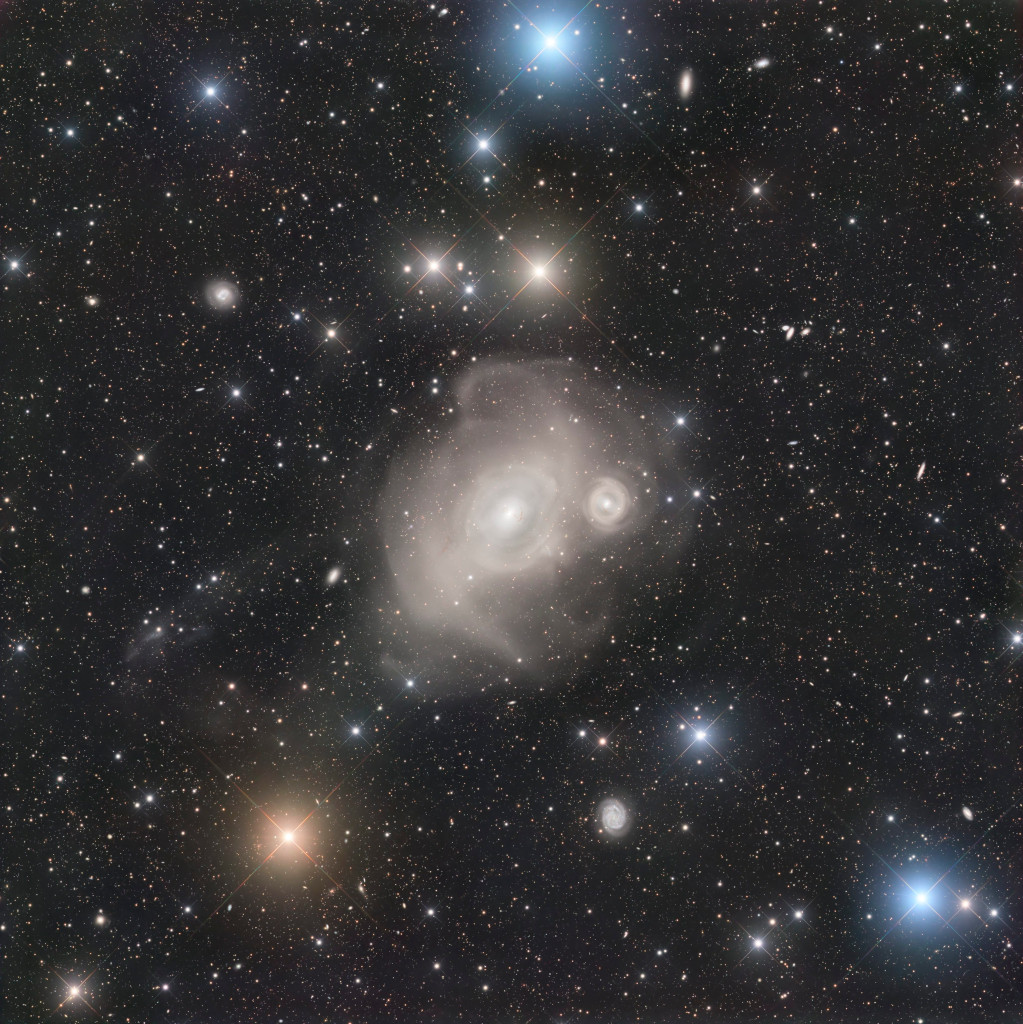
An example of violence on a cosmic scale, enormous elliptical galaxy NGC 1316 lies about 75 million light-years away toward Fornax, the southern constellation of the Furnace. Investigating the startling sight, astronomers suspect the giant galaxy of colliding with smaller neighbor NGC 1317 seen just right of the large galaxy's center, producing far flung star streams in loops and shells. Light from their close encounter would have reached Earth some 100 million years ago. In the sharp telescopic image, the central regions of NGC 1316 and NGC 1317 appear separated by over 100,000 light-years. Complex dust lanes visible within also indicate that NGC 1316 is itself the result of a merger of galaxies in the distant past. Found on the outskirts of the Fornax galaxy cluster, NGC 1316 is known as Fornax A. One of the visually brightest of the Fornax cluster galaxies it is one of the strongest and largest celestial radio sources with radio emission extending well beyond this one degree wide field-of-view.

https://apod.nasa.gov/apod/ap251204.html ( December 04, 2025)

Tuesday, December 2, 2025


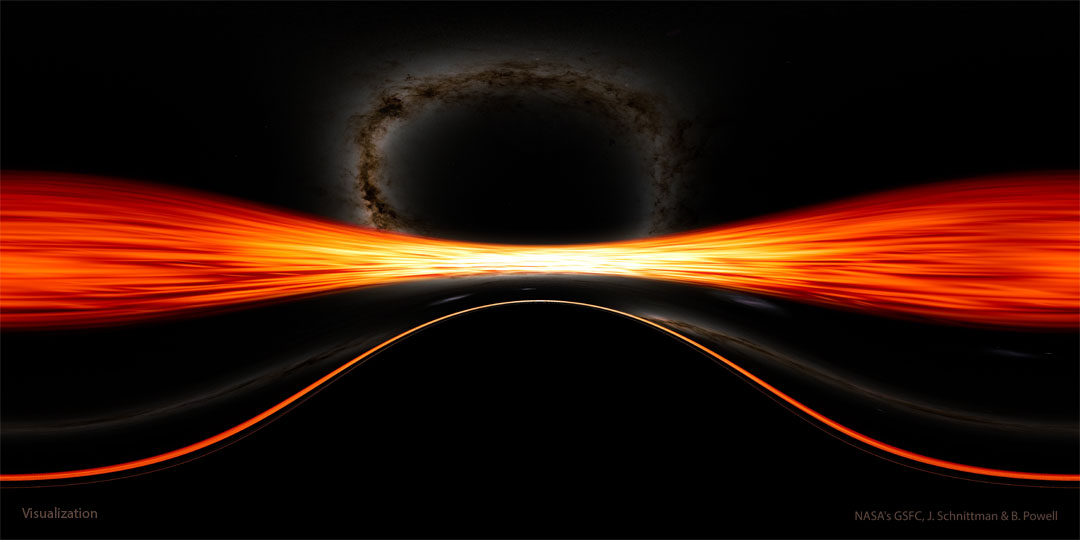
What would it look like to plunge into a monster black hole? This image from a supercomputer visualization shows the entire sky as seen from a simulated camera plunging toward a 4-million-solar-mass black hole, similar to the one at the center of our galaxy. The camera lies about 16 million kilometers from the black hole’s event horizon and is moving inward at 62% the speed of light. Thanks to gravity’s funhouse effects, the starry band of the Milky Way appears both as a compact loop at the top of this view and as a secondary image stretching across the bottom. Move the cursor over the image for additional explanations. Visualizations like this allow astronomers to explore black holes in ways not otherwise possible.

https://apod.nasa.gov/apod/ap251203.html ( December 03, 2025)

Monday, December 1, 2025


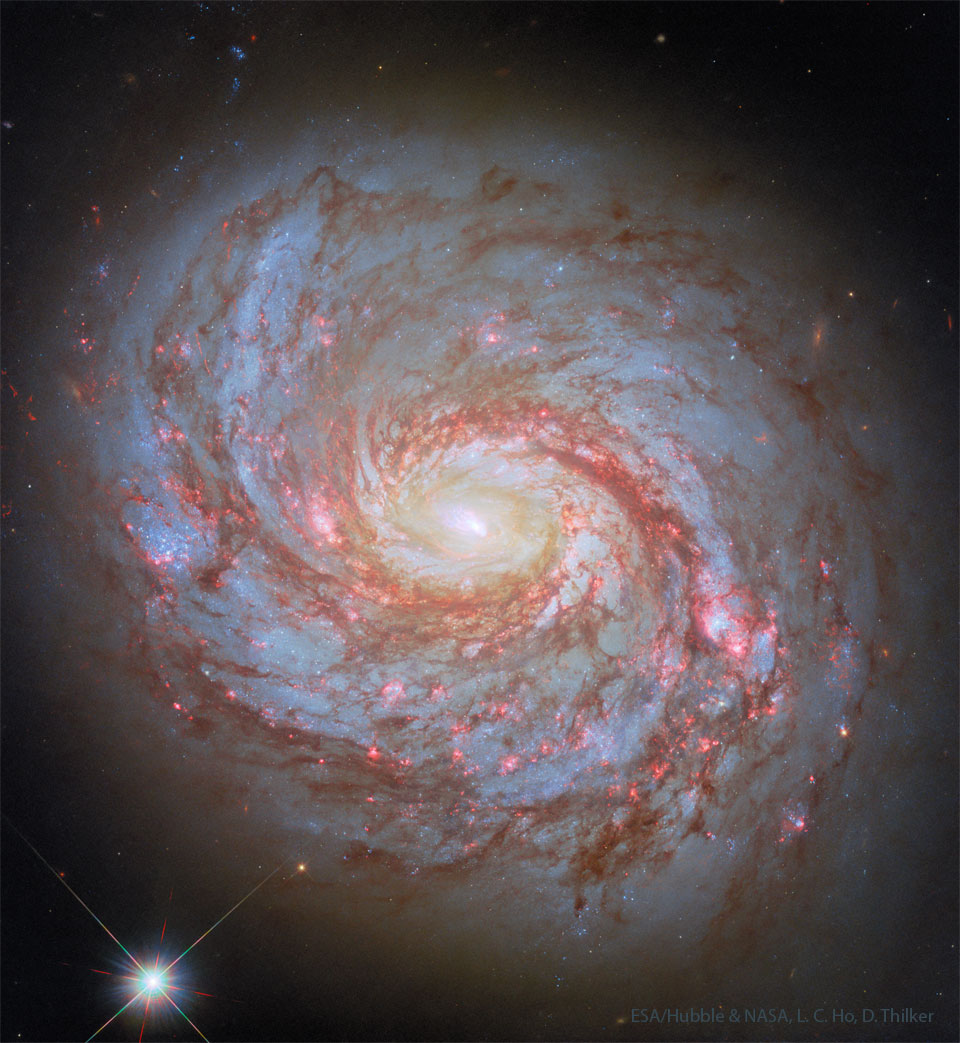
What's happening in the center of nearby spiral galaxy M77? The face-on galaxy lies a mere 47 million light-years away toward the constellation of the Sea Monster (Cetus). At that estimated distance, this gorgeous island universe is about 100 thousand light-years across. Also known as NGC 1068, its compact and very bright core is well studied by astronomers exploring the mysteries of supermassive black holes in active Seyfert galaxies. M77's active core glows bright at x-ray, ultraviolet, visible, infrared, and radio wavelengths. The featured sharp image of M77 was taken by the Hubble Space Telescope. The image shows details of the spiral's winding spiral arms as traced by obscuring red dust clouds and blue star clusters, all circling the galaxy's bright white luminous center.

https://apod.nasa.gov/apod/ap251202.html ( December 02, 2025)